By Staff Reporter
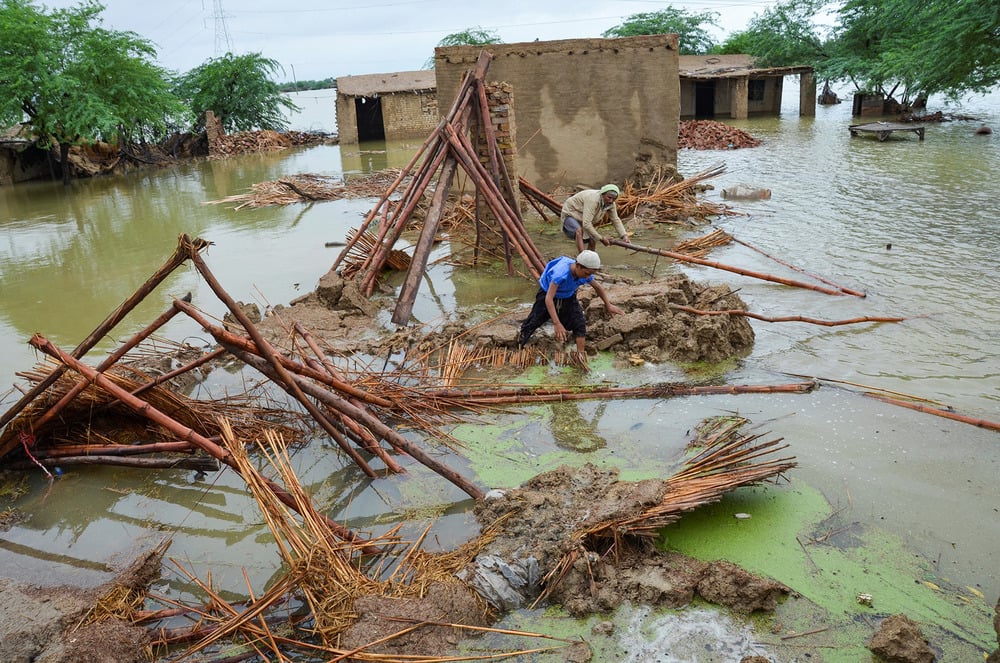
ISLAMABAD: At least nine people have been killed and seven others injured across Pakistan’s northwestern Khyber Pakhtunkhwa province after days of heavy rain brought walls and rooftops crashing down on residents, disaster management authorities said on Friday, as officials issued urgent warnings of glacial lake outbursts and flash floods across the region’s mountain districts.
The deaths — five men, two women and two children — occurred in Dera Ismail Khan, Upper Dir, Kohat and Orakzai districts, where violent storms brought down the walls and roofs of homes. All seven of those injured were men. The Provincial Disaster Management Authority (PDMA) directed local administrations to deliver relief materials to affected families immediately and urged the public to avoid all unnecessary travel.
The toll adds to a deepening crisis across Pakistan, where torrential rains have battered the country for much of the month. A separate spell of severe weather earlier this week killed at least a dozen people and left more than 50 injured across Khyber Pakhtunkhwa and Punjab.
On Thursday, the PDMA issued a glacial lake outburst flood (GLOF) alert for upper Khyber Pakhtunkhwa, warning that sustained rainfall could dramatically raise the risk of flooding and landslides across the province’s most exposed mountain communities. The alert covers Upper and Lower Chitral, Swat, Upper Dir, Kohistan and Mansehra — districts where heavy rainfall is forecast between 18 and 22 June and where glacial lakes, swollen by rising temperatures and persistent rain, can rupture with devastating speed and little warning.
Rescue teams, heavy machinery and emergency personnel have been placed on standby across the affected districts. Authorities have been instructed to monitor conditions continuously, alert vulnerable communities in advance and move residents to safer locations if necessary. Tourists have been specifically warned to stay away from rivers, streams and glacial areas for the duration of the forecast period.
Pakistan’s Meteorological Department said on 15 June that a westerly weather system was likely to affect districts across Khyber Pakhtunkhwa, Punjab, Azad Kashmir and Gilgit-Baltistan and could persist in parts of the country until 22 June. It warned that severe windstorms, hailstorms and lightning could damage weak structures and that landslides were possible across vulnerable areas of upper Khyber Pakhtunkhwa, Gilgit-Baltistan and Kashmir. Urban flooding, the department added, was a risk for Rawalpindi, Gujranwala, Sialkot, Lahore and Faisalabad.
The warnings extended south as well. In Sindh, the provincial PDMA cautioned on Friday that dust storms, thunderstorms and light rain could sweep through more than a dozen districts — among them Jacobabad, Larkana, Sukkur and Khairpur — through 20 June, with strong winds likely to damage solar panels, electricity poles and billboards. Local administrations were urged to remain on alert.
Pakistan is among the countries most exposed to the consequences of climate change, and extreme weather events — floods, heatwaves, cyclones, droughts — have grown in frequency and severity in recent years. Nationwide, the death toll from rain-related incidents in late March and early April alone crossed 80. Last year, more than 1,000 people were killed when intense monsoon rains, compounded by floodwaters released from Indian dams, triggered flash floods across the country in one of the most destructive weather events in Pakistan’s recent history.
Copyright © 2021 Independent Pakistan | All rights reserved