By Staff Reporter
ISLAMABAD: Senior government ministers held rare face-to-face talks with opposition PTI lawmakers on Friday, pledging to lobby the International Monetary Fund to preserve tax exemptions for Pakistan’s former tribal regions that are due to expire at the end of this month — a deadline that has united adversaries across the parliamentary divide in a way little else has managed.
Finance Minister Muhammad Aurangzeb hosted the meeting in his chamber at Parliament House in Islamabad, where he gave a personal commitment that he would approach the Fund to seek an extension of income and sales tax exemptions for the erstwhile Federally Administered Tribal Areas and the Provincially Administered Tribal Areas — regions merged with Khyber Pakhtunkhwa in 2018 but which have retained preferential tax treatment ever since.
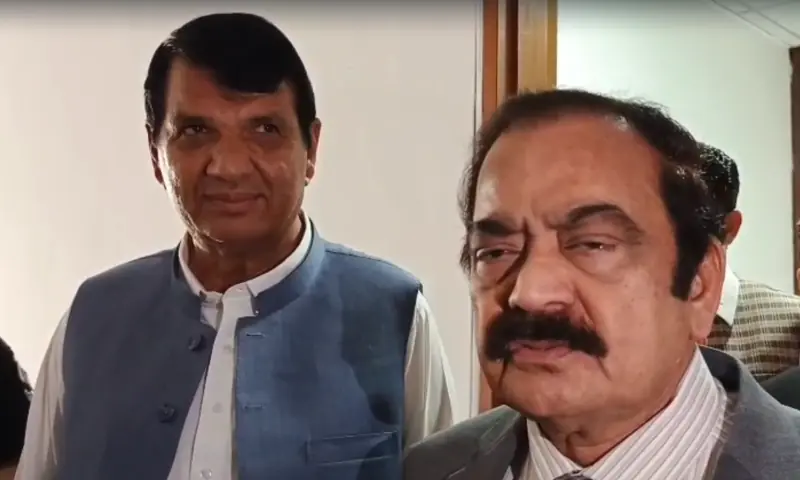
“The finance minister has promised that he will seek to extend these exemptions after speaking with the IMF,” Rana Sanaullah, who serves both as a federal minister and as Prime Minister Shehbaz Sharif’s adviser on political affairs, told reporters afterwards. “God-willing, he will make efforts for it.”
The talks had been convened at the prime minister’s instruction after PTI legislators raised the issue on the floor of the National Assembly earlier in the day, warning that the waivers — which shield individuals in the merged districts from income tax on business profits and gains, and exempt retailers from sales tax — would lapse on 30 June with no replacement in place. Shehbaz directed Sanaullah, Aurangzeb and Minister for Kashmir Affairs and Gilgit-Baltistan Amir Muqam to meet the opposition immediately. The PTI delegation was led by Asad Qaiser, a former speaker of the National Assembly, alongside Junaid Akbar and a group of MNAs from the former Fata constituencies.
The exemptions have been repeatedly extended since the 2018 merger, which incorporated territories long scarred by military operations, militancy and mass displacement into the constitutional mainstream. Pakistan’s government had been weighing whether to allow the reliefs to expire as part of broader negotiations with the IMF, which has pushed for a reduction in preferential tax regimes and a widening of the national tax base. Letting the exemptions lapse was projected to generate over Rs90 billion in additional revenue in the coming fiscal year.
That fiscal logic has collided head-on with political reality. The move has drawn opposition not just from elected representatives but from major industrial associations, with the Pakistan Association of Large Steel Producers warning earlier that any reversal of the phasing-out of Fata and Pata exemptions under IMF pressure would be “the most damaging single measure” for local industry — even as tribal-area lawmakers argue the opposite. The contradictions expose the near-impossible balancing act the government faces: satisfying an international lender demanding a leaner tax code while managing the political and humanitarian expectations of some of Pakistan’s most vulnerable communities.
Muqam, whose portfolio gives him a direct stake in the outcome, had already signalled his own sympathies during the budget debate in the National Assembly earlier this week, calling for the exemptions to continue and underlining that the former tribal belt remains economically fragile after decades of conflict and the upheaval that followed the army’s successive operations there.
Beyond the tax row, Friday’s meeting provided an unusual backdrop for a broader political conversation — one that both sides appeared eager, if cautious, to pursue. Sanaullah said his delegation had pressed the importance of dialogue with considerable emphasis, describing it as “the foundation of democracy.” He said the prime minister had once again extended his standing invitation for the PTI to engage in formal talks and to sign what the government has termed a “Charter of Pakistan.”
“That offer should be accepted,” Sanaullah said. “You should hold a dialogue with the prime minister. You can discuss any issue you want to. He is willing to listen and discuss any subject.”
Qaiser, for his part, signalled the PTI was not opposed in principle, though he framed the party’s conditions in pointed terms. The opposition was prepared to sign what he called a “Charter of Democracy” — but only if it guaranteed a level playing field. “There should be no political vendetta against anyone, the judiciary should be independent, and parliament should be strengthened,” he said. “We are ready for talks at all times for true democracy.”
He said PTI’s internal consultations were ongoing and that a formal decision would be communicated in due course — language that suggested movement without commitment.
The meeting also touched on the deteriorating economic situation along the Afghan border. Qaiser warned that a proposed tobacco tax and the continuing suspension of trade with Afghanistan risked destroying “whatever economy is left” in the region — a concern that carries particular weight in the merged districts, where cross-border commerce has historically been a lifeline.
Sanaullah said the government had welcomed the PTI’s support for a resolution passed unanimously by the National Assembly on Friday praising Pakistan’s leadership for its role in brokering what he described as a US-Iran peace agreement, calling it evidence that the two sides could find common ground when national interest demanded it.
On the question of PTI founder Imran Khan — imprisoned at Rawalpindi’s Adiala jail, where he is reportedly receiving treatment for an eye ailment — Sanaullah was measured. He said the former prime minister was receiving “the best treatment available in Pakistan” and that his release, as a person in judicial custody, was a matter for the courts alone.
Asked about unrest in Azad Jammu and Kashmir, Sanaullah dismissed the situation in characteristically combative terms, describing what he called a “heinous conspiracy to create agitation and interrupt the freedom movement” as having been brought under control, and expressing confidence that disruption to supply chains would be resolved within a week.
Copyright © 2021 Independent Pakistan | All rights reserved