By Staff Reporter
ISLAMABAD: Pakistan said on Wednesday that progress on a major gas pipeline and other economic ventures with Iran will move no faster than the lifting of international sanctions against Tehran, tempering expectations that a landmark visit by Iranian President Masoud Pezeshkian this week would quickly translate into concrete commercial gains.
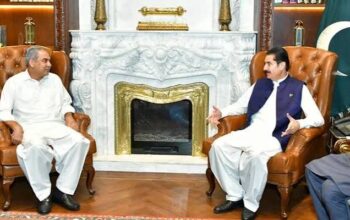
Pezeshkian flew to Islamabad on Tuesday for talks with Pakistan’s civilian and military leadership, the first visit by an Iranian president to Pakistan in years, arriving on the heels of a peace framework between Washington and Tehran to which Islamabad had served as a behind-the-scenes architect.
“The progress on economic projects and the opening up of Iran for economic and trade relations across the world will take place simultaneously with the relief of sanctions,” Foreign Office spokesman Tahir Andrabi told reporters at a weekly press briefing on Wednesday. “Till such time that the sanctions are relieved, the progress on these projects will hinge on the pace of the relief of sanctions. It is important to match the two.”
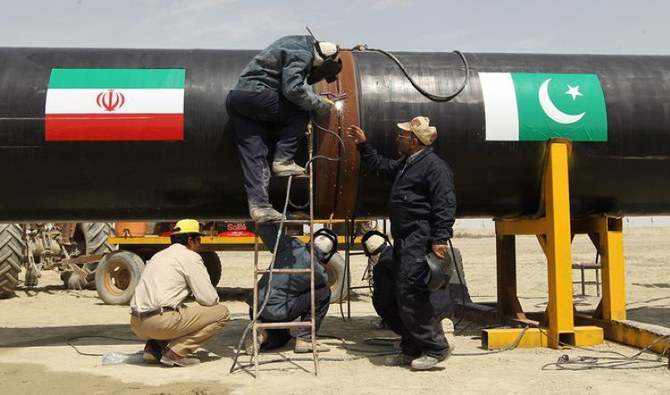
At the centre of those stalled projects is a 1,900-kilometre gas pipeline designed to carry between 750 million and one billion cubic feet of Iranian natural gas per day into Pakistan over 25 years — a supply that Islamabad, which faces chronic energy shortages, has long coveted. Construction on Pakistan’s side has remained frozen for years, largely because of fears that proceeding would trigger United States sanctions against Iran’s energy sector.
The visit produced no new trade accords or memoranda of understanding, a gap that reporters pressed Andrabi on. He was unapologetic, describing Pezeshkian’s visit as “historic” and framing the talks as a deliberate “broad-brush” review of trade and the implementation of agreements already on the books, rather than a negotiating session for fresh commitments.
The “major outcome,” Andrabi said, was a mutual resolve to pursue peace and stability in the region. “The Iranian side reaffirmed their trust in us, for which we are grateful,” he added. “In that sense, the visit carried significant outcomes both in terms of its historic importance as well as its substance for the future of our relations.”
Pezeshkian, writing on X on Wednesday, framed the visit in terms of Pakistan’s regional standing. “Pakistan’s tireless efforts to promote peace in the region are rooted in the rich culture of this country,” he wrote.
MEDIATOR SEEKS A DIVIDEND
Pakistan has positioned itself to harvest economic rewards from its role as a quiet broker between Washington and Tehran. Officials in Islamabad say a durable easing of regional tensions could formalise energy trade with Iran, bolster investor confidence and open new avenues for commerce and capital that have long been blocked by the geopolitics of sanctions.
“Economic stability, policy continuity and diplomatic credibility together can improve investor confidence, strengthen economic partnerships and create new opportunities for trade and investment,” Finance Adviser Khurram Schehzad said. “A growth-oriented economic agenda, coupled with a reputation as a force for peace and stability, places Pakistan in a uniquely favourable position to attract investment into its people, infrastructure, technology and future growth sectors.”
The most immediate opportunity Pakistani officials identify is in energy. Pakistan and Iran share a border stretching more than 900 kilometres, across which fuel and other goods have moved through informal channels for years, with petroleum products accounting for a sizeable share of that unofficial commerce.
“We can do the energy trade with Iran,” a senior finance ministry official said, speaking on condition of anonymity because he was not authorised to discuss the matter publicly. “Earlier it was informal, now it can be formal.”
Turning that prospect into policy would require either a significant relaxation of sanctions or a specific exemption for Pakistan. Officials declined to say whether discussions with Washington on such terms were under way, though one said crude oil imports from Iran — while not yet formally under consideration — could not be ruled out if the broader diplomatic thaw held.
“At this point in time, nothing can be confirmed. But obviously trade will increase, and it will increase for different commodities,” the official said.
The United States remains Pakistan’s largest single trading partner. Bilateral commerce reached $8.38 billion in fiscal year 2025, driven overwhelmingly by Pakistani textile exports, and has already reached $8.58 billion in the first eleven months of the current fiscal year, according to central bank data.
Last week, Pakistan’s Investment Minister Qaiser Ahmed Sheikh and Iran’s ambassador to Islamabad, Reza Amiri Moghadam, reaffirmed a shared goal of raising bilateral trade to $10 billion through deeper economic engagement and the development of special economic zones along the shared border.
ANALYSTS: REAL BUT LIMITED GAINS
Foreign policy analysts offered a mixed reading of what Tuesday’s visit actually delivered.
Maleeha Lodhi, a former Pakistani ambassador to the United States and one of the country’s most seasoned diplomatic voices, said Pezeshkian’s trip carried both symbolic and substantive weight. “Symbolic because it was aimed at conveying Iran’s gratitude to Pakistan for its role as a mediator that helped lead to a peace deal between the US and Iran,” she said.
On the substantive side, Lodhi pointed to the Islamabad Memorandum of Understanding — the framework around which Pakistan has been assigned roles in several task forces and committees charged with implementing the agreement. “This involves close coordination between Iran and Pakistan, and the visit enabled the two to discuss these mechanisms,” she said.
A second former envoy, Imran Ali, was more measured. He described the visit as significant “but not highly so,” noting that relations between the two neighbours were already cordial and that exchanges at this level had become something of a regular feature of Pakistani diplomacy. “The optics, the warmth — that is very important,” he said. “I think the talks took place in a very warm atmosphere.”
Ali said longer-term gains on energy and bilateral investment remained on the table but cautioned that near-term relief from U.S. sanctions appeared limited. “Yes, small and short-term sanctions are going to be lifted through an executive order, at least for 60 days,” he said. “But I think Pakistan and Iran are discussing beyond that, and it will take some more meetings at the lower level.”
Copyright © 2021 Independent Pakistan | All rights reserved