By Staff Reporter
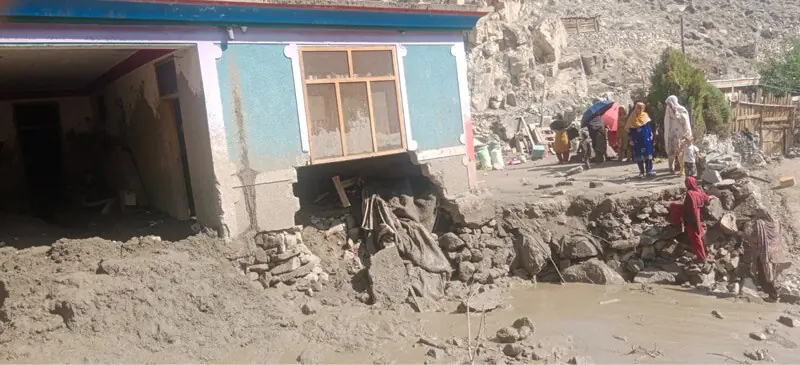
GILGIT: A cloudburst tore through Thore Valley in Pakistan’s northern Diamer district on Saturday, destroying homes, severing roads and leaving dozens of families homeless, as a concurrent heatwave accelerated glacial melt across Gilgit-Baltistan and federal authorities warned of a sharply elevated risk of glacial lake outburst floods through early July.
Flash flooding triggered by the mountain cloudburst swept away vehicles, inundated farmland and damaged orchards across the valley. Floodwaters reached the Wapda Colony, a residential compound housing workers on the Diamer-Bhasha Dam project, and cut off access to several villages by destroying link roads and communication bridges. Electricity and water supply systems were disrupted across the affected areas.
Imtiaz Ahmed, assistant director general of the Gilgit-Baltistan Disaster Management Authority, said the district administration had moved immediately to intensify relief operations. Food supplies, tents and essential items were being distributed among displaced families, and the valley’s main road had been reopened, he said, with a formal damage assessment now underway.
Local residents appealed for urgent humanitarian assistance, including food, shelter and medical aid.
GLOF ALERT
The Thore Valley disaster came as the Pakistan Meteorological Department and the National Disaster Management Authority issued separate alerts on Friday and Saturday, warning that dangerously high temperatures — forecast to persist at least through July 7 in Gilgit-Baltistan and Khyber Pakhtunkhwa — were accelerating snow and ice melt at a pace that could trigger sudden, devastating glacial lake outbursts across the mountainous north.
“This significant warming will substantially accelerate snow and ice melt in the glaciated valleys of these regions,” the NDMA said in its formal advisory. “Water levels in river streams are likely to remain high, existing glacial lakes may rapidly expand, and new glacial lakes are likely to form due to the high volume of melted water.”
The NDMA ordered provincial disaster management authorities to prepare evacuation sites, place rescue teams on standby and restrict civilian movement near glaciers. It also warned of likely temporary closures of the Karakoram Highway — the strategic artery connecting Pakistan to China — as well as the Jaglot-Skardu Road during the June 27 to July 3 alert window, citing risks from landslides, rockfalls and debris flows on saturated mountain slopes.
The NDMA’s National Emergency Operations Centre issued a parallel landslide alert covering Gilgit-Baltistan, upper Khyber Pakhtunkhwa and Azad Jammu and Kashmir for the same period.
CASCADE OF HAZARDS
Evidence of the unfolding conditions was visible across the region. Flooding in Sadpara Nallah blocked the Deosai Road, stranding several tourist vehicles and cutting off Deosai from Skardu. Rising water in Hopper Nallah damaged crops and farmland downstream and threatened roads, bridges and other infrastructure, while water erosion severed the link road to the Badswat area in Ghizer district.
Authorities warned that vulnerable downstream communities in low-lying areas adjacent to riverbeds faced heightened risk of sudden inundation with little warning — a scenario that GLOF events, which can unleash walls of water, mud and debris within minutes, make acutely dangerous.
The NDMA urged residents near rivers and streams to watch for tell-tale precursors: sudden discolouration of water, unusual grinding or rumbling sounds from shifting rock and debris, and unexpectedly rapid rises in water levels. Tourists were advised to avoid glacier-prone trekking routes and to stay away from unstable ice formations.
In Khyber Pakhtunkhwa, the provincial disaster management authority directed deputy commissioners in Upper and Lower Chitral, Dir Upper, Swat, Upper and Lower Kohistan and Mansehra to begin proactive monitoring of glacial lake sites, conduct evacuation drills in at-risk communities and ensure that designated evacuation sites were fully stocked. Local officials were also instructed to run public awareness campaigns on GLOF hazards and to advise tourists against travelling to affected zones while alerts remain active.
Authorities were directed to coordinate with the National Highways Authority, the Frontier Works Organisation and provincial public works departments to allow rapid road and bridge restoration in the event of damage.
SCALE OF VULNERABILITY
Pakistan harbours more glaciers than anywhere outside the polar regions — an estimated 7,000 — and scientists say rising temperatures are destabilising the ice and moraine dams that hold glacial lakes in check, increasing the probability of sudden, catastrophic releases. Earlier this month, Pakistan’s Space and Upper Atmosphere Research Commission identified 130 glacial lakes as potentially dangerous, flagging each as a risk to downstream communities.
The alerts land against a backdrop of deepening climate pressure on one of the world’s most geographically exposed nations. Pakistan accounts for less than one percent of global greenhouse gas emissions yet consistently ranks among the countries most vulnerable to climate change, facing a convergence of intensifying heatwaves, erratic monsoons, prolonged droughts and accelerating glacial retreat.
The scale of what such conditions can produce was made stark in 2022, when catastrophic flooding submerged roughly a third of the country’s landmass, killed more than 1,700 people and displaced or otherwise affected an estimated 33 million. Officials say climate change is compressing the cycle between extreme events and leaving communities with progressively less time to recover.
In a related measure, the Khyber Pakhtunkhwa health department directed hospitals across the province to establish dedicated emergency units for the treatment of heatstroke cases as temperatures continued to climb. The NDMA said the public could access hazard guidance and safety advisories through its “Pak NDMA Disaster Alert” mobile application.
Copyright © 2021 Independent Pakistan | All rights reserved