By Staff Reporter
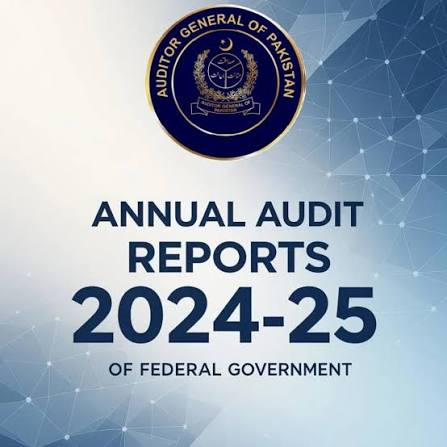
ISLAMABAD: The Auditor General of Pakistan has identified financial irregularities, unrecovered revenues and procedural violations running into hundreds of billions of rupees across federal ministries and state-owned enterprises, according to a 399-page audit report that singles out the country’s tax authority and energy sector for the most serious lapses.
The report, covering the financial year 2024-25, lays bare what auditors describe as systemic weaknesses in tax administration, energy regulation and government procurement — exposing gaps that, officials caution, likely understate the true scale of fiscal leakage because the findings are drawn from only a sample of the institutions examined.
FBR: Rs242 billion in tax irregularities
The Federal Board of Revenue (FBR) accounts for the largest single bloc of irregularities in the report, with auditors flagging discrepancies and non-recoveries totalling Rs242 billion across 193 field office observations spanning income tax, sales tax, federal excise duty, customs and internal expenditure.
The most significant lapse was the non-realisation of Super Tax — a levy on high-earning corporations — amounting to Rs117 billion across 527 cases identified by 19 field offices. A further 18 field offices failed to collect or under-collected minimum tax worth Rs15 billion in 601 cases.
Under-assessment of income tax added another Rs25 billion to the tally, with 16 field offices found to have permitted inadmissible expense claims in 276 cases. Three field offices allowed unjustified depreciation deductions, costing the treasury Rs4 billion, while six others failed to apportion expenses correctly, resulting in a further Rs2 billion shortfall.
In sales tax and federal excise duty, the audit found that 12 field offices overlooked Rs42 billion in inadmissible input tax credits claimed against invoices issued by suspended or blacklisted taxpayers — a particularly glaring control failure involving 159 cases. Twenty field offices failed to collect Rs13 billion in sales tax on taxable goods and services in 870 cases. Additional shortfalls included Rs758 million in unrecovered further tax and Rs2 billion in under-collected federal excise duty.
The customs sector recorded Rs3.56 billion in revenue losses attributable to misclassification and undervaluation of imported goods across 9,831 cases, according to 33 field office observations. Ten field offices granted inadmissible exemptions worth Rs700 million, while seven failed to recover Rs809 million in surcharges on late removal of warehoused goods. In a sign of broader enforcement weakness, 22 field offices had failed to dispose of confiscated goods and vehicles valued at Rs13 billion across 3,231 cases.
An FBR spokesman said the 2024-25 audit report had been published in August 2025 and that Departmental Audit Committee and Public Accounts Committee meetings had already resolved or placed before superior courts a significant portion of the amounts identified. He noted that income tax returns filed on the FBR’s IRIS system carry the legal status of self-assessed declarations under Pakistani law and that the revenue authority has a five-year window to pursue discrepancies.
“This is a routine matter of the FBR and the AGP,” the spokesman said, adding that efforts to highlight the findings risked obscuring productive collaboration between the two bodies. He noted that the Supreme Court had recently raised questions about the scope of the Auditor General’s direct audit of private taxpayers’ returns, and said both institutions were working toward a shared framework to better safeguard state revenues.
The AGP countered that its findings reflect weak internal controls, inadequate monitoring and non-compliance with tax laws, and recommended a comprehensive overhaul of internal audit mechanisms and enforcement procedures.
Energy sector: Rs82.5 billion in losses and unrecovered dues
The report identifies financial irregularities, weak governance and unrecovered revenues exceeding Rs82.46 billion in the Petroleum Division and its affiliated entities.
The largest single item was gas distribution losses. Sui Northern Gas Pipelines Limited (SNGPL) and Sui Southern Gas Company (SSGC) recorded Unaccounted-for-Gas (UFG) losses far beyond the limits permitted by the Oil and Gas Regulatory Authority (Ogra), carrying a combined financial impact of Rs39.43 billion.
The Directorate General of Petroleum Concessions failed to collect 15 percent of the wellhead value of petroleum produced by exploration and production companies, along with outstanding royalties and late payment surcharges on natural gas and crude oil, leaving Rs14.06 billion uncollected. The Petroleum Division also failed to recover Rs5.04 billion in outstanding non-tax receipts.
State-owned entities were separately cited for retaining Benazir Employees’ Stock Option Scheme (BESOS) funds and failing to deposit unclaimed dividends totalling Rs3.23 billion. The entities named include the Oil and Gas Development Company Limited (OGDCL), Pakistan Petroleum Limited (PPL), SNGPL, SSGC and the Pakistan Mineral Development Corporation (PMDC).
OGDCL drew some of the sharpest criticism. The company received a Rs5.19 billion signature bonus on LPG sales in violation of the LPG Policy 2016 and made an unjustified refund of Rs3.81 billion in previously realised liquidated damages to a contractor. The audit also found that OGDCL made procurement decisions worth Rs347.94 million on the basis of fake bank guarantees and without competitive bidding, in breach of Public Procurement Regulatory Authority rules.
In the coal sector, PMDC incurred an estimated revenue loss of Rs4.66 billion by continuing to operate coal mines under expired, non-competitive contracts yielding margins well below departmental profitability benchmarks. PPL failed to recover Rs3 billion in take-or-pay revenue from the Genco-II power utility under a Gas Sales Agreement governing guaranteed gas supply quantities.
The Department of Explosives failed to enforce the Petroleum Rules of 1937, resulting in Rs1.72 billion in unrecovered government revenue. SSGC owed Rs1.64 billion in outstanding gas bills from Pakistan Post and lost Rs208.9 million after its legal and management teams failed to refile court appeals in time, leading to cases being dismissed as time-barred.
A thematic audit also found that regasified liquefied natural gas (RLNG) was diverted to domestic and commercial consumers during summer months — despite adequate availability of cheaper indigenous gas — generating inadmissible subsidy claims and pushing artificial costs into public gas tariffs, forcing consumers to absorb charges they should not have faced.
The AGP directed SNGPL and SSGC to strengthen oversight of gas distribution losses, called for a formal probe into OGDCL’s liquidated damages refund, and instructed the Petroleum Division to develop a transparent policy to end unjustified RLNG diversions. It also ordered SNGPL to launch an internal inquiry to fix responsibility for the time-barred court dismissals and recover the resulting loss from the officers concerned.
Interior Ministry leads federal audit objections
Among individual ministries, the Interior Ministry and Narcotics Control recorded the highest number of audit paragraphs — 65 — ahead of the Higher Education Commission (31), Trade Development Authority of Pakistan (18), Ministry of National Food Security and Research (17) and Ministry of Science and Technology (16).
Auditors identified a range of financial and regulatory violations within the interior portfolio. These included non-recovery of Rs22 million in annual renewal fees and penalties on no-objection certificates for armoured vehicles; Rs27 million in unpaid renewal fees from private security companies; and Rs56 million in arms licence receipts from 3,421 licences that were never deposited into the government treasury.
The audit questioned the reliability of the process for converting manual arms licences to digital format and flagged data discrepancies in records relating to prohibited-bore weapons. It also objected to a revision of driving licence fees by the Islamabad Chief Commissioner’s office without mandatory approval from the Finance Division.
A Rs40 million grant received by the Chief Commissioner’s office from UNICEF for a child labour survey attracted particular scrutiny. Auditors said records relating to the receipt of funds, the bank accounts used, and how the money was spent were never made available for inspection. The ministry responded that the funds had been channelled through the Punjab Bureau of Statistics under UNICEF’s operational policy, but auditors said no supporting documentation was produced to verify this account.
The report separately flagged the issuance of stamp papers worth Rs290 million to vendors whose registrations had been cancelled and raised concerns over mutation fees, road challan recoveries, and the regularity of appointments at the Frontier Corps, Pakistan Rangers, Gilgit-Baltistan Scouts, National Police Foundation and Islamabad Capital Territory Police.
The Anti-Narcotics Force was cited for spending Rs1.2 billion on overhauling two helicopters without an open competitive tender. Auditors recommended a formal inquiry to apportion responsibility.
The ministry’s director-general for media, Qadir Yar Tiwana, did not respond to a request for comment before publication.
Copyright © 2021 Independent Pakistan | All rights reserved