By Staff Reporter
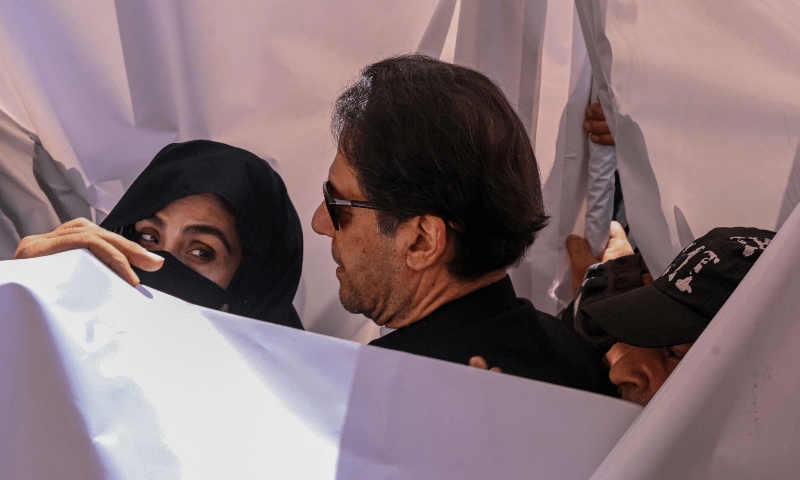
ISLAMABAD: The Islamabad High Court on Monday granted a two-week adjournment to lawyers for jailed former prime minister Imran Khan and his wife Bushra Bibi to begin arguments in their appeal against convictions in a corruption case, after dismissing contempt petitions the couple had filed against jail authorities.
A two-judge bench, comprising Chief Justice Sardar Muhammad Sarfaraz Dogar and Justice Muhammad Asif, said the contempt petitions had become “infructuous” after determining that powers of attorney needed to pursue the couple’s appeals had been signed.
The contempt petitions had accused jail authorities of delaying the powers of attorney required for the appeals to proceed. Islamabad Advocate General Naveed Malik told the court that Khan’s defence team had misled it during a previous hearing by saying the documents were signed on June 16 without disclosing that the jail superintendent had contacted defence lawyers two days later, on June 18, to help finalise them.
Barrister Salman Safdar, representing the defence, told the court that while authorities had now supplied the powers of attorney relating to the high court proceedings, other required documents had not yet been provided. Chief Justice Dogar said those documents would also be furnished.
The court then moved to the substantive appeals against the couple’s convictions and ordered the defence to begin arguments, warning that if Khan’s lawyers did not proceed, the bench would instead hear from the prosecutor representing the National Accountability Bureau (NAB), the country’s anti-graft agency.
Safdar told the court that an appeal challenging an earlier high court order was pending before the Supreme Court, and argued that opening arguments in the high court while that appeal was unresolved would render it ineffective. He sought additional time on that basis.
When the bench signalled it would proceed to hear from the NAB prosecutor, Pakistan Tehreek-e-Insaf (PTI) chairman Barrister Gohar Ali Khan and senior counsel Latif Khosa asked for a two-week adjournment, telling the court that arguments would begin at the next hearing.
Chief Justice Dogar questioned whether the two senior lawyers held valid powers of attorney for the appeals, and said repeated adjournment requests amounted to undue pressure on the court. Khosa told the bench he needed two weeks to meet Khan in person ahead of the next hearing. The court accepted the request, recording Khosa’s undertaking that the defence would begin arguments after the adjournment, and scheduled the appeals for hearing in two weeks.
An accountability court in Islamabad sentenced Khan to 14 years in prison and Bushra Bibi to seven years on Jan. 17, 2025, in the case, formally a NAB reference and widely known in Pakistan as the Al-Qadir Trust case. Prosecutors allege the couple received billions of rupees and large tracts of land from real estate developer Bahria Town Ltd. in exchange for facilitating the legalisation $170 that Britain’s National Crime Agency had seized and returned to Pakistan during Khan’s tenure as prime minister. Khan and Bushra Bibi have denied wrongdoing.
The couple challenged their convictions before the Islamabad High Court shortly after sentencing and separately sought suspension of their sentences pending appeal, a request the court rejected in May 2026. Khan’s party and family have since alleged delays in scheduling the appeal hearings.
Khan, 73, has been imprisoned since August 2023 after being convicted in a separate case over his failure to disclose state gifts he had retained, a case related to what is known in Pakistan as the Toshakhana matter. He is currently held at Adiala jail in Rawalpindi.
Solitary confinement petitions
In a separate proceeding, another bench of the Islamabad High Court on Monday set aside registrar’s office objections to two petitions alleging that Khan and Bushra Bibi have been held in solitary confinement, and ordered that both petitions be formally registered. Justice Khadim Hussain Soomro, who heard the matter, deferred the question of whether the petitions are legally admissible to a future hearing.
The petitions were filed by Khan’s sister, Aleema Khan, on his behalf, and by Bushra Bibi’s daughter, Mubashara Khawar Maneka, on her mother’s behalf. The registrar’s office had objected on the grounds that neither petitioner qualified as an aggrieved party. Safdar, representing both petitioners, argued that their family relationships gave them standing to bring the case, citing a precedent in which a prisoner’s wife had successfully challenged solitary confinement on his behalf.
Safdar told the court he had raised the solitary confinement issue during earlier appeal proceedings but had been advised by the high court’s chief justice to pursue it through a separate forum. He said Khan and Bushra Bibi had been held in solitary confinement for seven months and had been denied access to newspapers, television and family visits. “I have not met Bushra Bibi since December,” Safdar told the court, adding that he had been permitted to meet Khan only twice, both times on the directions of Pakistan’s chief justice and the Islamabad High Court’s chief justice.
NAB prosecutor Rafay Maqsood disputed elements of Safdar’s account, telling the court that after meeting Khan, Safdar had not informed the court that his client was being held in solitary confinement and had instead argued only on applications related to suspending the sentence. Maqsood also argued that a written application on the solitary confinement issue had already been rejected and that any further challenge should go to the Supreme Court rather than through a constitutional petition. Safdar disputed that the application had been rejected.
Justice Soomro ordered the registrar’s objections removed and the petitions numbered, while leaving the question of maintainability to be decided separately. At Safdar’s request, the court adjourned further hearing of the solitary confinement petitions until Tuesday.
In her petition, filed last week, Aleema Khan described her brother’s detention conditions as unlawful. According to the petition, lawyers who met Khan on April 8 said he was being held in solitary confinement for 22 hours a day, while Bushra Bibi was confined in isolation around the clock. Maneka’s petition made similar allegations on behalf of her mother and asked the court to declare the conditions unlawful.
Copyright © 2021 Independent Pakistan | All rights reserved