By Staff Reporter
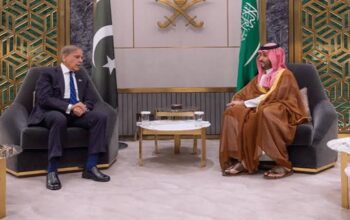
ISLAMABAD: Prime Minister Shehbaz Sharif will travel to Iran and Turkey from July 3 to 6 in a renewed push to shore up a fragile truce between Washington and Tehran, officials said on Tuesday.
Sharif is expected to meet Iranian and Turkish leaders during the trip and to press both Tehran and Washington toward restraint, officials said, pointing to the Islamabad memorandum of understanding that underpins the peace process Pakistan has helped broker since the war began four months ago.
The visit comes just days after the most serious flare-up in weeks tested that process. U.S. Central Command said early Sunday it had struck 10 Iranian military targets, blaming “continued Iranian aggression against commercial shipping” after an attack on a vessel transiting the Strait of Hormuz. Iran responded with missile and drone strikes on U.S. bases in Bahrain and Kuwait before both sides stood down. The exchange has clouded a round of talks both Washington and Tehran say they intend to hold in Doha this week, even as the two governments offer conflicting accounts of whether direct negotiations will actually take place.
The war was launched by the United States and Israel against Iran on February 28, 2026, all but halting traffic through the Strait of Hormuz — a waterway that had carried roughly a fifth of the world’s seaborne oil trade — and sending shockwaves through energy markets worldwide.
A push for a regional framework
Iran’s foreign minister, Abbas Araghchi, said Monday that Tehran wants a new arrangement covering every country in the region, conducted “without the presence or interference of any country from outside the region.” The comment echoed a proposal raised earlier in the week by Iranian President Masoud Pezeshkian, who called for a new regional security structure during a visit to Pakistan in which he credited Sharif and Pakistan’s military chief, Field Marshal Asim Munir, with helping advance the mediation effort.
That visit followed direct U.S.-Iran talks in Switzerland, dubbed the Lake Lucerne Summit, which opened the process now under way under the Islamabad memorandum. Presidents Trump and Pezeshkian signed the memorandum on June 17, and Pakistan said the following day that the deal would bring an immediate end to both Iran’s blockade of the strait and a U.S. counter-blockade of Iranian ports. Under the 14-point framework, the two countries committed to reopening the strait and resolving outstanding disputes within 60 days. The Swiss talks, held in the resort town of Burgenstock, were mediated by Pakistan and Qatar, with Sharif and Munir representing Islamabad; mediators said afterward that “encouraging progress” had been made, including a new channel meant to prevent incidents in the strait and a so-called de-confliction mechanism intended to keep the fighting from reigniting in Lebanon.
Doha meeting hangs in the balance
That progress looked considerably shakier on Monday. Trump told reporters in the Oval Office that the planned Doha meeting would be “perhaps important, perhaps not,” while maintaining that the United States was still winning militarily and repeating his demand that Iran be barred from developing a nuclear weapon. He said separately that Iran had asked for the meeting, even as Tehran insisted no direct talks with Washington had been arranged.
White House press secretary Karoline Leavitt said Trump’s son-in-law and adviser, Jared Kushner, along with special envoy Steve Witkoff, would lead the U.S. delegation to Qatar this week; Witkoff was reported to already be en route by early Tuesday. Iran’s foreign ministry spokesperson, Esmaeil Baghaei, confirmed a delegation of Iranian experts was also traveling to Doha but said the trip had no connection to the American visit, adding that Tehran would not hold negotiations “at any level” with U.S. officials in the coming days. One senior Iranian official said any meeting that does take place Tuesday would focus narrowly on managing the strait and de-escalating tensions, in contrast to the broader nuclear and sanctions issues discussed in Switzerland, while a separate official said American and Iranian technical teams were expected to meet separately with Qatari and Pakistani mediators on Wednesday.
The dispute over whether the sides will even meet has underscored how fragile the June 17 accord remains, with the unresolved conflict continuing to weigh on global oil flows and creating a political liability for Trump ahead of November’s congressional elections, where some members of his own party have faulted him for waging war without explicit authorization from Congress.
Congress briefed, Democrats unconvinced
Witkoff and Secretary of State Marco Rubio briefed members of Congress by phone on Monday. Republican Senator Steve Daines told reporters administration officials kept their remarks brief but called the call “constructive.” Senate Democratic leader Chuck Schumer was far harsher, describing the briefing as “deficient and devoid of details” and saying Rubio had effectively confirmed that Iran stood to collect billions of dollars in oil revenue while retaining significant leverage over the strait.
Tehran banks a partial asset release
Separately, Pezeshkian said Monday that $6 billion of the $12 billion in Iranian assets frozen in Qatar would be released and returned to Iran, according to Iranian state media. He described the broader memorandum — which also includes U.S. waivers on sanctions affecting Iran’s oil and petrochemical sectors — as “a great victory for the Iranian people.”
A fight over control of the strait
Much of the remaining friction centers on who controls the waterway itself. Iran has used its position alongside Oman along the strait as leverage, saying it intends to charge ships transit fees and to obstruct vessels that stray from routes it designates. Iranian Deputy Foreign Minister Kazem Gharibabadi said the first meeting of a new Joint Hormuz Committee had been held in Muscat, and Iran’s Revolutionary Guards said they were taking further steps to control traffic, warning that vessels violating their rules would be dealt with more firmly than before. An adviser to Iran’s supreme leader wrote on social media that Washington’s regional ambitions would not be realized so long as Iran retained control of the waterway. The strait itself lies within Iranian and Omani territorial waters, though international law generally bars either country from blocking passage or imposing tolls, and the published text of the memorandum says Iran is to work out the strait’s future administration in dialogue with Oman and other Gulf states, but in keeping with international law.
That tension boiled over into the weekend’s strikes. U.S. officials say Iran hit at least two commercial vessels with missiles or drones in recent days, prompting the American strikes on Iranian military facilities early Sunday; Iran’s retaliatory strikes on the U.S. bases in Kuwait and Bahrain followed hours later. A separate dispute has opened with France: President Emmanuel Macron said Monday, after meeting Omani Sultan Haitham bin Tariq in Paris, that France would work with Oman and other partners to clear mines from the strait — prompting a sharp rebuke from Gharibabadi, who said the 14-point plan assigns de-mining solely to Iran and warned Paris against complicating the situation further.
Shipping data illustrate how far traffic remains from normal. The maritime tracking firm Kpler recorded just 29 vessels crossing the strait on Saturday and 12 on Sunday, after a ship was struck, with none using a southern route through Omani waters; a separate tracker, AXSMarine, found 44 vessels had stopped transmitting their position altogether.
Oil retreats even as Gulf shipments climb
Oil benchmarks fell early Tuesday and were on track for a second straight monthly decline, with traders weighing the prospects for the Doha talks against the absence of any real normalization in strait traffic. Brent’s front-month August contract, due to expire later in the day, eased 64 cents, or 0.9%, to $72.51 a barrel as of 0356 GMT, putting it roughly 22% below its level a month earlier; the more heavily traded September contract slipped 31 cents to $73.60. U.S. West Texas Intermediate for August fell 39 cents, or 0.6%, to $70.36, about 19% below its close on May 29. Both benchmarks have now drifted back close to where they stood just before the war began on February 27.
KCM Trade chief market analyst Tim Waterer said the market was pricing in hopes for a breakthrough in Doha even though shipping through the strait had yet to show genuine signs of normalizing, leaving traders “cautiously hopeful” but still hedging their bets pending firmer evidence of de-escalation. Neil Crosby, head of research at Sparta Commodities, said investors were also waiting for clearer signs of a pickup in Chinese crude purchases before wagering on a fuller recovery in demand from the world’s largest oil importer.
Despite the renewed strikes, Gulf producers have kept loading oil and liquefied natural gas, and shipping data show traffic through the strait reached its highest level last week since the war began at the end of February.
Strain extends to Lebanon
The broader peace effort is also under pressure in Lebanon, where state media reported an Israeli strike hit the south of the country — a Hezbollah stronghold — on Monday, despite a framework accord between Lebanon and Israel signed only last week. Hezbollah’s rocket fire into Israel in March drew Lebanon into the wider war, prompting an Israeli air campaign and ground invasion. Under the U.S.-brokered framework, Hezbollah is to disarm under the supervision of the Lebanese army, with Israeli forces remaining in the south until that happens; Hezbollah has fiercely opposed the deal, and Parliament Speaker Nabih Berri, an ally of the group, has voiced doubts about its prospects. Israel has not joined the broader U.S.-Iran talks and has kept its distance from the memorandum process altogether.
Copyright © 2021 Independent Pakistan | All rights reserved