By Staff Reporter
KARACHI: Pakistan has requested proposals from advisers to arrange its first dollar-settled, rupee-linked bonds, adding a new instrument to a slate of planned Eurobond and Sukuk sales as the government works to widen its pool of foreign investors and push out the maturity schedule of its external debt.
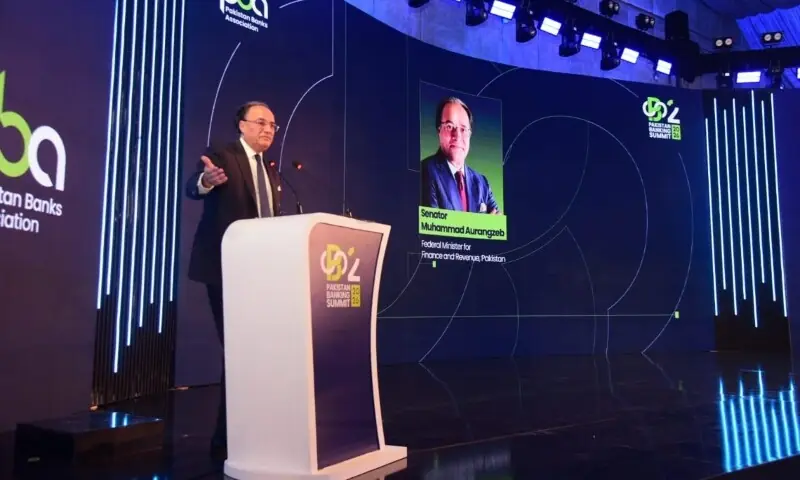
Finance Minister Muhammad Aurangzeb disclosed the plans on Tuesday at the second Pakistan Banking Summit in Karachi, framing the bonds as part of a broader push to re-establish Pakistan as a regular issuer in international capital markets following a period of macroeconomic stabilization.
“We have just issued RFPs for Sukuks, for Eurobonds, and for the first time, dollar-settled, rupee-linked bonds, because we do want to go back into the international capital market and extend the maturities of our international debt as we move forward,” Aurangzeb said.
The new bonds would let overseas investors take on exposure to the Pakistani rupee while settling their trades in dollars, sidestepping the need to transact in the local currency — a structure designed to draw a broader set of foreign funds than Pakistan’s existing dollar-denominated debt typically attracts.
The RFPs have gone out to international banks and investors as the government gauges demand and pricing for the new offerings, Aurangzeb said.
The push follows two successful returns to international debt markets this year. Pakistan sold a $750 million Eurobond in April, its first such sale in four years, after strong demand allowed the government to exercise a greenshoe option and upsize the deal. It followed that in May with a $250 million-equivalent Panda bond — its first sale of yuan-denominated debt — which drew orders for more than five times the amount on offer and priced at a record low for a three-year sovereign issue.
Aurangzeb called the Panda bond a milestone Islamabad had chased for the better part of a decade. “We have been pursuing the Panda Bond for seven to eight years,” he said. “Not tapping the world’s second-largest and second-deepest capital market has been a missed opportunity.”
The finance minister said the coming bond sales are designed largely to refinance existing obligations rather than add to Pakistan’s debt stock. “A lot of these are going to be actually replacement trades,” he said. “These are not going to be incremental debt that we have, and how we replace some of the bilateral stuff is going to be part of the picture as we move forward.”
Pakistan’s public finances closed the last fiscal year on firmer footing across most major gauges, Aurangzeb said, pointing to a primary surplus, an all-time-low fiscal deficit and a debt-to-GDP ratio below 70%. Economic growth came in at 3.7%, powered by a rebound in large-scale manufacturing. The current account remained strong on the back of record remittance inflows, which Aurangzeb said should total between $41 billion and $42 billion for the fiscal year. Overall exports declined, he said, but the drop was concentrated in food shipments, while value-added exports — particularly textiles — kept posting year-on-year gains. Foreign-exchange reserves are on track to reach roughly $18.4 billion by fiscal year-end, above earlier government projections, he added.
Aurangzeb also detailed an overhaul of Pakistan’s tax administration that he described as a fundamental change in how the state deals with taxpayers. Parliament has approved a new operating model that relies on artificial intelligence to manage taxpayer engagement, including the automated generation of notices, with what Aurangzeb called minimal human intervention. The government plans to follow the restructuring with a medium-term tax strategy, he said.
This year’s federal budget was assembled for the first time under the Tax Policy Office following its transfer into the Finance Division, Aurangzeb said. He listed export-led growth, the removal of the advance tax and the super tax, low-cost subsidized financing and continued tariff reform among the government’s budget priorities, and thanked Prime Minister Shehbaz Sharif and the federal cabinet for backing the measures.
Access to credit will be central to sustaining Pakistan’s recovery, Aurangzeb said, citing lending to small and medium-sized enterprises, exporters, agriculture, manufacturing, construction and the technology sector as “mission-critical.” He said he has set up a task force, led by the State Bank of Pakistan with senior representation from the Pakistan Banks’ Association, the Small and Medium Enterprises Development Authority, chambers of commerce and industry, and the Ministry of Finance, to improve SME access to bank financing.
On the Pakistan Stock Exchange, Aurangzeb said underlying market drivers matter more than headline index levels, pointing to a growing investor base — including rising participation from Gen Z investors — and a return to double-digit corporate profit growth.
The minister also updated the state of Pakistan’s privatization program, saying Pakistan International Airlines is now fully under private ownership. Roadshows for the sale of three state-owned electricity distribution companies have been completed, he said, while 28 state-owned entities have been handed to the Privatisation Commission for further action.
Zafar Masud, chairman of the Pakistan Banks’ Association, told the summit that the banking industry paid more than 1 trillion rupees in taxes to the government last year. He said bank lending to agriculture rose 39% over the past year and housing lending climbed 90%, while lending to small and medium-sized enterprises grew 111%, with the total amount disbursed to SMEs up 80%. Masud pointed to gains in priority-sector financing, digital transformation and financial inclusion as evidence of the banking sector’s progress, and said continued coordination between banks, policymakers and regulators would be essential to building a resilient financial system.
Bilal Azhar Kayani, minister of state for finance and railways and head of the prime minister’s delivery unit, outlined the government’s roadmap for a cashless Pakistan, pointing to digital payments and coordinated public-private action as tools for deepening financial inclusion and improving economic documentation. Saleem Ullah, deputy governor of the State Bank of Pakistan, laid out the central bank’s plans for expanding SME access to finance as part of a broader push for inclusive economic growth.
The bond plans come as Pakistan operates under a $7 billion International Monetary Fund program that has underpinned the country’s macroeconomic stabilization.
1.
2. Pakistan Taps Banks for Debut Dollar-Rupee Bond Sale
3. Pakistan Seeks Advisers for New Bonds to Stretch Debt Maturities
4. Pakistan Adds Dollar-Rupee Bonds to Fresh Eurobond, Sukuk Plans
5. Pakistan Plots Return to Bond Markets With New Rupee-Linked Debt
Copyright © 2021 Independent Pakistan | All rights reserved