By Staff Reporter
ISLAMABAD: For nearly four decades, the campaign to wipe polio from the face of the Earth has been a study in incremental, hard-won progress: a disease that once paralyzed hundreds of thousands of children a year narrowed, country by country, until only two remained where it still spreads on its own. Now, with the finish line closer than it has ever been, the people running that campaign say they are running out of money to reach it.
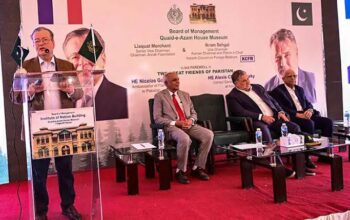
The Global Polio Eradication Initiative said this week that shrinking international funding is jeopardizing the effort to stop poliovirus transmission in Pakistan and Afghanistan, the only two countries on Earth where the disease remains endemic. The warning came as a high-level delegation from the initiative’s oversight board wrapped up several days of meetings in Pakistan, according to the country’s National Emergency Operations Center for Polio Eradication, which coordinates the vaccination campaign.
The math behind the warning is stark, and so is what is now at stake. Pakistan has cut its polio caseload by 99.8 percent since the early 1990s, when the country recorded an estimated 20,000 cases a year. Last year it counted 31. So far this year, it has counted three. That decline was purchased through three decades of repeated, nationwide vaccination drives, in a disease that spreads easily but can be stopped cold by a vaccine that costs pennies a dose. Public health officials have long said the last mile of eradication is the hardest and most expensive — and the one most vulnerable to a lapse in money or attention.
The delegation was led by Mike McGovern, a Rotary International volunteer leader who took over this year as chair of the initiative’s Polio Oversight Board, the panel that sets strategy for the global eradication partnership. McGovern, who has represented Rotary on the oversight board since 2018 and has chaired the organization’s PolioPlus Committee since 2014, is a longtime member of the Rotary Club of South Portland-Cape Elizabeth, Maine, where he spent much of his career as town manager. His involvement traces back nearly four decades, to 1988, when he made his first financial contribution to the polio eradication effort.
In Islamabad, the delegation met with Prime Minister Shehbaz Sharif, Health Minister Mustafa Kamal, and Ayesha Raza Farooq, the prime minister’s focal person for polio eradication. According to the emergency operations center, the delegation told Pakistani officials that the global funding picture is narrowing the window to interrupt transmission of the virus in both remaining endemic countries, and pressed the case for sustaining investment in eradication while also shoring up routine childhood immunization more broadly.
Sharif told the delegates that his government is “taking every possible measure to protect Pakistan’s children from polio and secure their future,” according to the emergency operations center. Kamal, the health minister, described a response effort that has been reinforced by tighter coordination among Pakistan’s provinces, more direct government oversight, and improvements in how health services reach children. He said the country’s polio infrastructure has increasingly become the backbone of its broader immunization system, not just its polio defenses.
“Polio eradication investments continue to strengthen the broader immunization and primary health care system,” Kamal said. “Closer integration between the Expanded Programme on Immunization and the Polio Programme is helping improve reach, particularly for zero-dose and under-immunized children. The same systems that help us interrupt poliovirus transmission are also strengthening protection against measles, hepatitis, and other vaccine-preventable diseases.”
The oversight board delegation, for its part, reaffirmed its support for Pakistan’s Expanded Programme on Immunization and for continuing efforts to more closely integrate the country’s polio operations with its routine vaccination system.
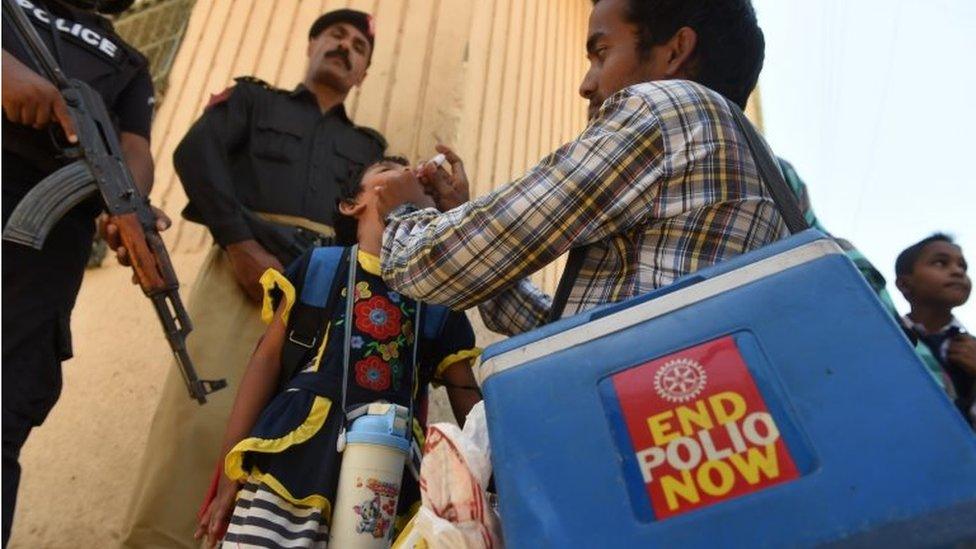
The stakes of losing ground are not abstract. Polio is a highly contagious virus that can cause permanent paralysis and, in a small share of cases, death. It has no cure, only prevention, in the form of repeated doses of an oral vaccine administered to children, often door to door, in some of the most remote and hardest-to-reach parts of Pakistan and Afghanistan. Public health officials have said for years that as long as the virus circulates anywhere, no country is fully safe from its return — a lesson underscored by past outbreaks in countries that had already been declared polio-free.
That combination — a disease on the brink of elimination, and a funding base that officials say is no longer reliable — has become one of the defining tensions of the current eradication push. The initiative did not detail specific dollar figures behind its funding warning, but framed the next six months as pivotal to the effort’s outcome, both in Pakistan and worldwide.
Copyright © 2021 Independent Pakistan | All rights reserved