By Staff Reporter
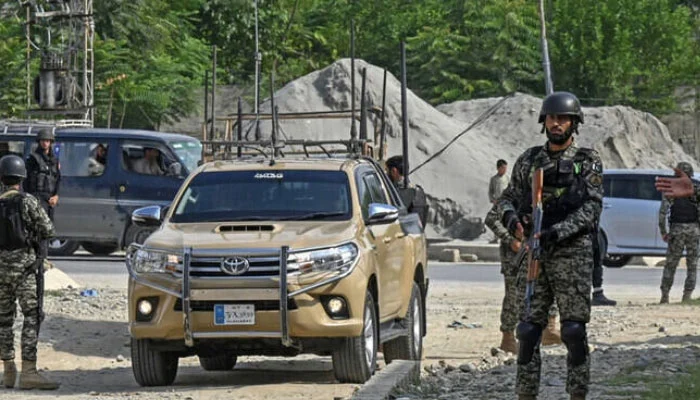
QUETTA: Security forces have killed 102 suspected militants across the restive southwestern province of Balochistan since July 5, military officials said Saturday, as a sweeping counterterrorism campaign launched after a series of coordinated attacks earlier this month showed no signs of slowing.
The latest count, provided by security officials who spoke on condition of anonymity, included 23 militants killed in operations reported Saturday alone. Twelve of those killed belonged to what Pakistani authorities term Fitna al Khawarij — the state’s designation for the banned Tehreek-i-Taliban Pakistan, or TTP. Two others, killed in an intelligence-based raid near the N-25 highway crossing, were linked to a separate insurgent network Pakistani officials call Fitna al Hindustan, a term used for militant groups operating in Balochistan that authorities allege receive backing from India.
Security forces recovered weapons, hand grenades, a motorcycle, mobile phones and flags belonging to a banned organization from the two men killed near the N-25, officials said.
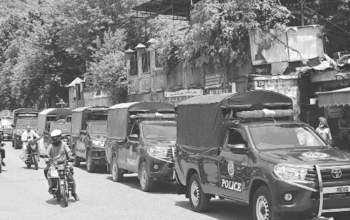
The operations are part of a campaign known as Operation Shaban, launched by the Pakistan Army, the paramilitary Frontier Corps and police after gunmen stormed a police post at the Mangi Dam pumping station outside Quetta on July 5. Nine police officers, including two station house officers, were killed in that initial assault. The attackers then abducted 18 additional policemen at gunpoint. Their bodies were later recovered in the mountainous Zarghoon Gar area, bringing the death toll from that single attack to 27.
By Friday, authorities said, the death toll from Operation Shaban and related intelligence-based operations had reached 79. On Saturday, officials said the number killed specifically under Operation Shaban had climbed to 64, with the broader campaign total — encompassing Shaban and separate intelligence-led raids — reaching 102.
Officials said the operation would not stop until what one security source described as “the last terrorist is eliminated.”
The Mangi Dam attack was one of three coordinated assaults across Balochistan this month that, combined with the security response that followed, have left at least 42 people dead — four civilians, 27 police officers and 11 security personnel, according to a spokesperson for Pakistan’s military.
Interior Minister Mohsin Naqvi credited the Army, the Balochistan Frontier Corps and police for what he called their “unwavering resolve and bravery” in confronting the militant threat. “The sacrifices and successes of the forces for the sake of peace in Balochistan are a golden chapter in history,” Naqvi said in a statement. “Terrorists are a burden on the country and the nation.” He added that those responsible for the violence “will not find a place to hide anywhere.”
The provincial government, meanwhile, moved to compensate the families of officers killed in the Mangi Dam attack. Shahid Rind, an aide to Balochistan Chief Minister Sarfraz Bugti on information and political affairs, said the chief minister had ordered payments of 11.1 million rupees — roughly $39,000 — to each family of the slain officers. Rind said the province had fast-tracked the administrative and financial approvals needed to disburse the funds and pledged that the government would also cover educational expenses for the officers’ children.
Prime Minister Shehbaz Sharif traveled to Quetta on Thursday to chair a meeting of the Provincial Apex Committee on the National Action Plan, Pakistan’s framework for counterterrorism policy. He was joined by Field Marshal Asim Munir, the army chief and newly designated Chief of Defence Forces.
“One thing is decided: it is a mutual and singular decision of the civil and military leadership that we must end terrorism collectively,” Sharif told the gathering, according to a readout of the meeting.
Sharif also renewed accusations that India was backing the militant campaign in Balochistan, describing the country as Pakistan’s “eastern neighbor” — a familiar diplomatic shorthand — and asserting it had a hand in orchestrating the recent attacks. New Delhi has consistently denied supporting separatist violence in the province. Islamabad has also accused Afghanistan of harboring militants who cross the border to carry out attacks, an allegation Kabul likewise rejects.
Balochistan is Pakistan’s largest province by land area but its least developed, bordering both Iran and Afghanistan. It has been the site of a long-running separatist insurgency, driven in part by grievances over the distribution of the region’s mineral wealth, that has intensified in recent years. Pakistani forces have simultaneously battled the TTP and other religiously motivated militant factions operating in the province.
The province holds particular strategic significance for Islamabad and Beijing alike. China has poured billions of dollars into Balochistan under its Belt and Road Initiative, most visibly through the development of the deep-water port at Gwadar on the Arabian Sea — a project Pakistani officials have suggested makes the province a target for those seeking to destabilise Chinese investment in the country.
Copyright © 2021 Independent Pakistan | All rights reserved