By Staff Reporter
KARACHI: Pakistani stocks suffered their sharpest one-day selloff in months on Tuesday, as investors dumped equities across the board after US President Donald Trump reinstated a US naval blockade of Iran and floated a 20% toll on cargo passing through the Strait of Hormuz, one of the world’s most critical energy corridors.
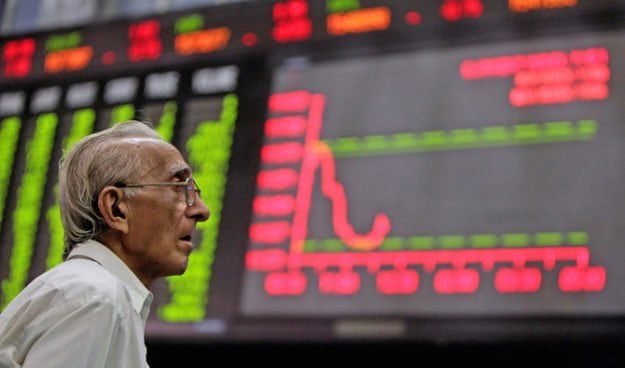
The benchmark KSE-100 Index closed at 173,518.81, down 6,408.23 points, or 3.56%, wiping out several weeks of gains in a single session and marking the second straight day of losses for the Pakistan Stock Exchange. The rout compounded a 1.27% decline on Monday, when the gauge slipped below the psychologically important 180,000 mark for the first time in weeks.
Trading was volatile from the opening bell. The index touched an intraday high of 178,112.04 in the first hour before a wave of selling across cyclical sectors dragged it steadily lower through the session. Losses accelerated in the final hour of trading, pushing the KSE-100 to a low of 173,349.41 — just above where it eventually settled. Brief attempts at a midday recovery failed to gain traction as sellers overwhelmed the market.
Turnover jumped as investors rushed for the exits. Total volume rose to 912.6 million shares from 845.2 million on Monday, with the value of shares traded climbing to 45.6 billion rupees. Of the 498 companies traded in the ready market, only 40 advanced, 439 declined and 19 were unchanged — a breadth reading that underscored the scale of the selloff. Cnergyico Pk led volumes with 84.6 million shares changing hands, the stock slipping 0.37 rupees to close at 9.68 rupees.
“The decline is broad-based, with cyclical sectors witnessing the sharpest percentage losses amid heightened uncertainty over the medium-term outlook due to the emerging geopolitical situation,” said Awais Ashraf, director of research at AKD Securities.
Ahfaz Mustafa, chief executive officer at Ismail Iqbal Securities, said the market was reacting in tandem to the surge in crude prices and the deteriorating security backdrop in the Middle East. “Markets are reacting to a sharp rise in oil prices and the new uncertainty that has developed in the Middle East conflict and oil prices,” Mustafa said, adding that corporate earnings due in coming weeks would help set the market’s near-term direction.
Some of Tuesday’s losses reflected profit-taking after a strong run-up in Pakistani equities in recent months, analysts said, with investors choosing to lock in gains even as the domestic macroeconomic backdrop remained largely supportive. AAH Soomro, an independent investment and economic analyst, said any de-escalation or renewed diplomatic progress could help restore investor confidence and support a technical rebound in fundamentally strong stocks. He cautioned, though, that further escalation risked worsening conditions in global energy markets and regional security. “The fears of war resumption and consequent increase in oil prices is keeping investors nervous again until a final deal is struck,” Soomro said.
Blockade Reinstated
The selloff in Karachi mirrored a broader risk-off move across global markets after Trump said Monday the US would reimpose its naval blockade of Iranian shipping and proposed charging a 20% fee on cargo transiting the Strait of Hormuz — a waterway that carried roughly a fifth of the world’s daily oil and liquefied natural gas supplies before the conflict escalated. The US Navy said the blockade would take effect at 4 p.m. in Washington on Tuesday, targeting vessels moving to and from Iranian ports.
The announcement came after a ceasefire reached last month between Washington and Tehran unraveled amid renewed strikes on commercial shipping in the Gulf. Iranian Foreign Minister Abbas Araghchi rejected the proposed toll as excessive, saying on social media that Iran — not the US — controls the strait and should be compensated instead. The UN’s International Maritime Organization said it opposed any fees for transit through international straits, calling the practice without legal basis.
The renewed hostilities have already drawn casualties. The United Arab Emirates’ Ministry of Defence said one Indian crew member was killed and eight others wounded after two Emirati oil tankers were struck by Iranian cruise missiles in the Strait of Hormuz.
Oil Jumps, Global Markets Slide
Crude prices surged to their highest levels in about a month on the prospect of tighter supply through the strait. Brent crude futures climbed as much as 3.81% to $86.47 a barrel, their strongest level since June 12, while West Texas Intermediate rose 2.75% to $80.29 a barrel, the highest since June 16. Both benchmarks had already posted their biggest single-day gains in years on Monday, with Brent settling at $83.30 and WTI at $78.14, as the initial blockade announcement rattled traders.
US equity futures were mixed in choppy trade as investors weighed the geopolitical risk against a batch of second-quarter earnings from Wall Street’s largest banks. S&P 500 futures slipped about 0.1% in early European trading, while Nasdaq futures held roughly 0.3% to 0.5% higher. The moves followed an overnight selloff on Wall Street, where the S&P 500 fell 0.8% and the Nasdaq Composite dropped 1.6%.
Trading was similarly turbulent across Asia and Europe. The pan-European Stoxx 600 Index slipped 0.4%, led lower by a 2% drop in travel and leisure shares, as investors combed through earnings from BP Plc and Ericsson AB for signs of how the conflict was affecting corporate results. MSCI’s broadest gauge of world shares turned negative as European trading got underway, following a mixed session in Asia.
Chinese equities were a bright spot, climbing 2.15% after June trade data topped economists’ forecasts, with both exports and imports coming in stronger than expected. South Korean shares rose 0.7% and Japan’s Nikkei 225 added about 0.7%, helped by comments from Finance Minister Satsuki Katayama that Japan could adjust the investment strategy of its Government Pension Investment Fund should conditions change sharply. Taiwanese stocks fell 1.42%.
The dollar held near its highest levels of the month, with the US dollar index easing 0.1% to 101.16. Gold rose 0.5% to $4,020.34 an ounce, extending its role as a haven as investors braced for further volatility. Markets were also digesting hawkish remarks Monday from Federal Reserve Governor Christopher Waller, who said the central bank may need to raise interest rates “in the near term” should incoming data show inflation persisting well above the Fed’s 2% target. Traders were pricing in a 43.3% probability of a quarter-point rate increase at the Fed’s July 28-29 meeting, up from 34.2% on Friday, according to CME Group’s FedWatch tool.
For Pakistan, the surge in oil prices poses a particular risk given the country’s reliance on imported energy. Higher crude costs threaten to add pressure to inflation, the external account and corporate profit margins at a time when the domestic economy had otherwise been showing signs of stabilization. Analysts said volatility is likely to persist as investors track both the trajectory of the conflict and the path of international oil prices in the sessions ahead.
Copyright © 2021 Independent Pakistan | All rights reserved