By Staff Reporter
ISLAMABAD: The United States carried out a five-hour bombing campaign against Iran early on Tuesday, the third consecutive night of American strikes, as President Trump moved to seize control of the Strait of Hormuz and declared that ships passing through it would owe Washington a fee.
The strikes, which began at 4:45 p.m. Monday Eastern time, hit targets across a wide swath of Iranian territory, including the port cities of Bushehr, Bandar Abbas, Jask and Konarak, along with Chah Bahar and the island of Abu Musa, according to US Central Command. Military officials said the campaign was intended to “degrade” Iran’s capacity to strike commercial vessels and civilians in the strait, one of the world’s most heavily trafficked oil corridors.
“We’re going to hit them very hard tonight, and we’re going to hit them hard tomorrow,” Trump told the conservative radio host Hugh Hewitt on Monday, adding that Iran had “nothing going, other than they have big mouths.”
Hours earlier, Trump had announced by social media post that the US would reimpose a naval blockade of Iranian ports beginning on Tuesday evening and would levy a 20 percent charge on all cargo moving through the strait — a reversal of Washington’s long-standing position that the waterway must remain toll-free under international law.
“The USA will be, from this point forward, known as ‘THE GUARDIAN OF THE HORMUZ STRAIT,'” Trump wrote, “but as such, and as a matter of FAIRNESS, will be reimbursed, at the rate of 20 percent on all cargo shipped, for any and all costs necessary to do the job of providing safety and security to this very volatile section of the world.”
Iranian ports would remain blockaded, Trump said, but “all other countries will have fair and open use of the strait.”
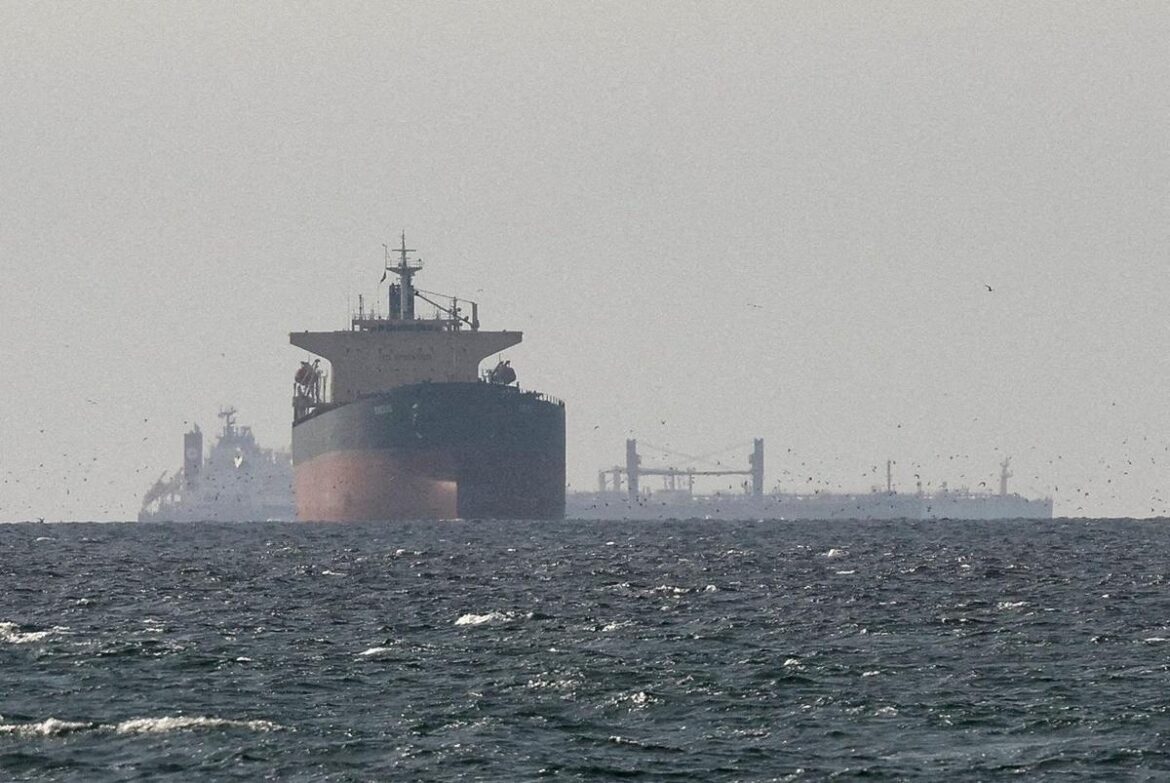
The announcement landed as violence along the waterway reached one of its sharpest points since a fragile understanding between Washington and Tehran began to unravel. Early Tuesday, the United Arab Emirates said Iranian cruise missiles had struck two of its oil tankers, the Mombasa and the Al Bahiyah, as they moved through the strait’s southern shipping lane inside Omani territorial waters. One crew member, an Indian national, was killed, and eight others were wounded, four of them seriously. Six of the injured were Indian, and two were Ukrainian, the UAE’s Ministry of Defence said, calling the strike “brazen” and a “clear breach of international law.”
Iran’s Islamic Revolutionary Guard Corps confirmed it had disabled the tankers, saying in a statement that the vessels had ignored warnings, switched off their navigation systems, and attempted to cross a mined route. Any cooperation with what it called “the aggressor enemy,” the Guard warned, would bring only “regret, damage and delays” and risked touching off “an energy crisis in the world.”
The exchange came after a weekend in which Iran’s Revolutionary Guard claimed new strikes on American interests in Bahrain, Jordan and Kuwait. Guard officials said they had destroyed weapons depots, a satellite communications facility and a building housing US forces in Bahrain, targeted an American drone command center there, and struck what they described as a US missile base in Kuwait, setting fire to launchers and munitions warehouses. Jordan’s military said it intercepted four missiles that had entered its airspace from Iranian territory, aimed at an air base housing US personnel. Iran also claimed to have destroyed radar installations in Oman used to monitor the strait.
For its part, Centcom said American forces had struck Iranian air defences, coastal radar sites, and missile, drone and small-boat capabilities using fighter aircraft, naval vessels and unmanned systems. In a strike Sunday night, the command said, three Corsair surface drones hit a submarine and ship maintenance facility at the Bandar Abbas naval base — the first time, Centcom said, that American forces have used sea drones in combat. Iranian state media reported explosions near Bandar Abbas and the nearby island of Qeshm, and said American strikes on water-pumping stations in Khuzestan and Bushehr provinces had disrupted supply to Kharg Island and killed two people in Mahshahr. At least 25 people have died in Iran since the fighting resumed last Wednesday, according to a tally based on Iranian government announcements.
A DEAL ‘IN CRISIS’
Despite the intensifying campaign, Trump insisted Monday that an agreement to end the broader war remained within reach.
“Yeah, I think a deal is possible. Sure, I do,” he told reporters in the Oval Office. “We had a deal with them two days ago, and then they said, ‘Oh, we can’t make that deal. We have to negotiate it further.'”
Iran’s Foreign Ministry offered a starkly different account of the state of negotiations. Spokesman Esmaeil Baqaei said the memorandum of understanding reached last month in Islamabad — the basis for the current round of talks and for the US decision to lift its earlier blockade — was “in crisis.” Baqaei said Iran would abandon its own obligations under the agreement if Washington continued to do the same, though he added that Tehran was still working with mediators from Qatar, Pakistan and Oman to head off further escalation.
Bader Al-Saif, an associate fellow at Chatham House, said the renewed strikes reflected the difficulty both sides were having in closing out the conflict on favorable terms. “Both sides want to end the impasse on their own terms, and they are increasingly finding it difficult to do so,” Al-Saif said. “Hence the return to and increase in the scale of attacks.”
Under federal war powers law, a US president must notify Congress within 48 hours of initiating hostilities, and any military action undertaken without congressional approval must end within 60 days unless extended. The White House confirmed that Trump sent formal notice to Congress last week that hostilities had resumed on July 7, opening a new 60-day window for the Pentagon to operate in the region without a separate vote. Some Republican lawmakers have joined Democrats in questioning that legal interpretation, and in asking what the country gained from a ceasefire that has now collapsed twice.
Trump also renewed a threat to strike Pickaxe Mountain, a fortified underground facility near Iran’s badly damaged Natanz enrichment site that Western intelligence agencies believe houses an undeclared nuclear program. Experts have said the site’s tunnel complexes were built deep enough to withstand even the most powerful bunker-buster bombs in the American arsenal.
“We’re going to take out Pickaxe Mountain,” Trump said on the Hugh Hewitt show. “Tell the Iranians to be ready. We’re watching it closely. We see no activity there. They’re not doing well with their nuclear situation. Every time we hear about it, we blow it up. So they don’t like talking about it. But we’ll probably give Pickaxe a shot relatively soon.”
A MOCKING RESPONSE FROM TEHRAN
Iranian Foreign Minister Abbas Araghchi answered Trump’s toll announcement with open sarcasm, turning the president’s own language back on him.
“POTUS is absolutely right,” Araghchi wrote on social media. “Whoever provides secure and safe passage of commercial vessels through the Strait of Hormuz should be compensated for this service.” Iran, he said, “has always been the GUARDIAN of the Strait and will remain so FOREVER” — before adding: “20 percent is of course too much. We will be fair.”
The exchange underscored a fight over the strait that has taken on outsized economic stakes. By Trump’s math, a 20 percent levy would amount to roughly $30 million on a fully loaded supertanker. Iran, by contrast, has floated a toll of $1 per barrel, or up to $2 million on a comparable vessel — a fraction of the American figure.
Washington has for years opposed the idea of any toll on passage through Hormuz, arguing that international law bars such fees on straits used for international navigation. The UN’s International Maritime Organization repeated that position on Monday. “IMO stands firmly against charging fees for passage through straits used for international navigation,” a spokesman said. “There is no legal basis through which to introduce mandatory tolls simply to transit through a strait.” Secretary of State Marco Rubio made the same argument just last month, telling reporters that “no country is allowed to charge tolls or fees on an international waterway. That’s existing international law.”
Iran’s Khatam al-Anbiya military headquarters said it would not permit the United States to “interfere in the management” of the strait under any circumstances. Spokesman Ebrahim Zolfaghari said “repeated adventurism and malicious actions” by the US had “seriously endangered regional security, international trade and the passage of oil tankers and commercial vessels,” and warned that any Gulf state cooperation with Washington would be treated as an act of war against Iranian sovereignty. If the conflict spreads further, he said, “the flames of war will engulf all the countries of the region.”
Under international law, coastal states generally control waters up to 12 nautical miles from shore, and at its narrowest point, the strait’s shipping lanes run entirely through Iranian and Omani territorial waters — a fact that has left analysts uncertain what a unilateral American toll or blockade could mean in practice.
MARKETS RATTLED, ASIA EXPOSED
The renewed fighting sent oil prices sharply higher. Brent crude, the international benchmark, jumped more than 9 percent Monday — its steepest one-day gain in more than six years — to settle above $83 a barrel, its highest close in a month. US crude rose about the same amount to settle near $78. Prices continued climbing in Asian trading Tuesday. European natural gas also surged, rising as much as 3.3 percent to its highest level in more than three months.
Before the war began in February, roughly a fifth of the world’s crude oil and liquefied natural gas passed through the strait. Asia is especially exposed to any disruption: about 80 percent of the oil that moves through Hormuz is bound for Asian markets, and Iranian crude alone accounted for roughly 13.4 percent of China’s seaborne oil imports last year.
“The price of oil will really shoot up through the roof,” said Amin Saikal, emeritus professor of Middle Eastern, Central Asian and Islamic studies at the Australian National University. “The world economy once again is going to be taken hostage to high prices of oil.” Saikal questioned, though, whether Washington had any real mechanism for collecting a toll in one of the world’s busiest maritime corridors. “How is he going to enforce it?” Saikal asked. “Does he have the necessary mechanism on the ground to charge that sort of fee?”
Even amid the latest blockade, ship-tracking data suggested Iran had continued moving oil through the strait in recent days. According to data compiled by Bloomberg, six tankers under US sanctions transited the waterway into the Gulf of Oman over the past week with their transponders switched off. Analysts estimated Iran had managed to export at least 57 million barrels of crude during the gap between the earlier American blockade, which was lifted in June, and the one set to take effect Tuesday evening.
“They were just shipping oil out at unbelievable rates,” said Jay Hatfield, chief executive of Infrastructure Capital Management. “We think we’ll hang around this $80 level, unless there’s some movement one way or another on the strait. But I don’t think we’ll go to, like, $90 or $100. And if the strait reopens, we’ll go to $60 in one hell of a hurry.”
The Navy-led Joint Maritime Information Center said the blockade would take effect at 4 p.m. Eastern time Tuesday and would cover the entire Iranian coastline, including ports and oil terminals, regardless of a vessel’s flag. “Any vessel suspected of entering or departing the blockaded area without authorization is subject to interception, diversion and capture,” the center said in a statement, adding that noncompliant vessels “may be legally compelled with force.” Neutral transit to or from destinations outside Iran would not be affected, the statement said, and humanitarian shipments would still be allowed, subject to inspection.
Trump said the United States expected to be reimbursed by the Gulf nations it was helping to protect, naming Saudi Arabia, the United Arab Emirates, Qatar, Bahrain and Kuwait. “We’re going to get paid for guarding it,” he told Fox News. “A lot of money, but we just want to be reimbursed for doing all of this, for putting our people in danger.” In a separate interview, he suggested the US role would extend well beyond collecting a fee. “We’re going to keep the strait, and we’ll probably run it,” he said.
POLITICAL STAKES AT HOME
The renewed fighting arrives at a delicate moment for Trump domestically. He is not on the ballot in November’s midterm elections, but many congressional Republicans are, and both parties have signalled they will face pointed questions from constituents if gasoline prices climb again after repeated administration assurances that they would not. Some Republican lawmakers have already pressed the White House on what the country secured from a ceasefire that has now broken down more than once, and on the legal basis for continuing military action beyond the original 60-day window without a congressional vote.
The current round of hostilities traces back to Feb. 28, when the United States and Israel launched a surprise campaign against Iranian military and government targets that included the killing of Iran’s supreme leader, Ali Khamenei. Iran responded by closing the Strait of Hormuz to foreign shipping altogether and firing missiles and drones at Israel and at American bases across the Gulf. The United States first blockaded Iranian ports in April; five weeks in, the military said it had redirected some 100 commercial vessels and disabled four others attempting to breach the cordon. That blockade was lifted in June under the terms of the Islamabad memorandum, which was meant to open a path toward a lasting settlement. Instead, disputes over control of the strait have repeatedly pulled the two countries back toward open conflict, and the round of talks now sits, in the words of Iran’s own Foreign Ministry, in crisis.
The United States, Iran and international mediators had given no indication by early Tuesday of when, or whether, negotiations might resume.
Copyright © 2021 Independent Pakistan | All rights reserved