By Staff Reporter
MUZAFFARABAD: The chairman of Pakistan Peoples Party proposed the creation of an independent truth and reconciliation commission on Wednesday to help end nearly six weeks of deadly unrest in Azad Kashmir, warning that continued bloodshed there was inflicting lasting damage on both the Kashmir cause and Pakistan’s standing abroad.
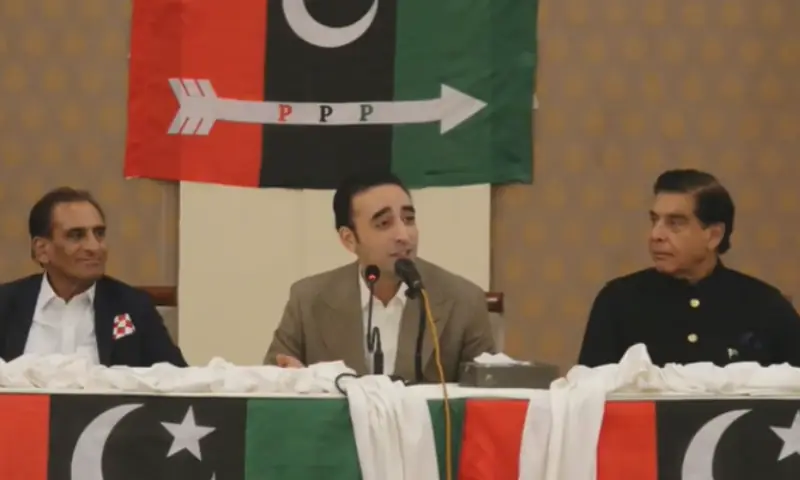
Bilawal Bhutto-Zardari, addressing party workers and election candidates in Muzaffarabad, the territorial capital, said the violence convulsing Azad Jammu and Kashmir had become “very concerning” and that further delay in resolving it would only compound the harm. His remarks came less than two weeks before the region is scheduled to elect a new 53-member legislative assembly, and a day after the deadliest single episode of the unrest so far: a clash Tuesday in Poonch division that left at least two security officials and seven protestors dead.
“The situation in Azad Kashmir over the past month has been deeply worrying,” Bhutto-Zardari said. “Every Kashmiri is worried, and every Pakistani is worried. The longer this continues, the greater the damage to the Kashmir cause and to Pakistan’s reputation.”
The unrest has pitted security forces against the Jammu Kashmir Joint Awami Action Committee, a coalition of protest groups that the regional government outlawed last month under an anti-terrorism law. The committee, JAAC, has been demanding the abolition of 12 seats in the territorial assembly that are set aside for refugees who fled Indian-occupied Kashmir after the 1947 partition of the subcontinent and settled elsewhere in Pakistan. Critics of the arrangement, including many in JAAC, say it dilutes the influence of Kashmiris who never left the region and gives disproportionate power to a shrinking refugee population.
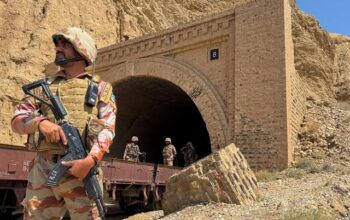
The violence centered on a sit-in JAAC had mounted outside a military hospital in Rawalakot, in Poonch division. Police said armed committee members opened fire on officers there in a coordinated assault, and put the toll at four law enforcement personnel and three committee members killed, with roughly 20 people wounded. JAAC disputed that version of events, saying in its own statement that security forces fired tear gas and artillery shells toward the hospital and that seven of its members died, some of them in darkness after electricity to the area was cut. The two sides’ tallies, drawn from statements issued over the course of Tuesday and Wednesday, have not been independently reconciled.
It was against that backdrop — a rising body count, dueling narratives, and an election clock running down — that Bhutto-Zardari laid out his proposal.
“I propose the establishment of an independent commission of all concerned parties,” he told the gathering. “The commission should be given a sufficiently broad mandate to examine the present situation, establish the relevant facts, consider the grievances and positions of all sides, review the outstanding political, legal, and administrative issues, and recommend a fair and durable way forward.”
He also released a letter responding directly to JAAC, which had written to him this week. In it, he called the continuing deaths “a national tragedy” and offered condolences to the families of those killed, writing that “every Kashmiri’s life is precious” and that “the death of a peaceful citizen cannot be treated as an acceptable consequence of political disagreement, just as the life of every police and security official must also be protected.”
Bhutto-Zardari, a former foreign minister whose party governs in AJK and holds significant sway in the federal coalition in Islamabad, said he had already raised the proposal with Deputy Prime Minister and Foreign Minister Ishaq Dar, who told him he would carry it to Prime Minister Shehbaz Sharif. He asked JAAC to suspend its planned long march and sit-ins if the government agreed to form the commission, and asked authorities in turn to hold off on further action while the panel did its work.
He was careful, however, not to cast the appeal as one-sided. The state, he said, could not be seen to be “blackmailed” into concessions, but neither could the grievances animating the protests be waved away. “We still want a middle ground,” he said. “We want a peaceful, political solution to all outstanding issues.”
Bhutto-Zardari drew a hardline on two fronts. He said any criticism of the Pakistani military emerging from the protests was unacceptable, calling the armed forces “a red line” for his party regardless of the source of the criticism. And he said harsh language toward Kashmiris themselves — including suggestions, aired at times in the national conversation, that question their loyalty or their very identity — was equally intolerable. He recalled that he had objected on the floor of the National Assembly when the Kashmiri identity of residents of the town of Rawalakot was called into question.
“No one sitting in Islamabad has the right to determine who is or who is not a Kashmiri,” he said, adding that the “dignity and identity” of AJK’s residents did not depend on their agreement with any government.
On the reserved-seats dispute at the center of the standoff, Bhutto-Zardari stopped short of endorsing either side’s position outright. “No constitutional amendment can be imposed through guns or sit-ins,” he said, but added that residents should ultimately have a say. “If the issue is the 12 reserved seats, then let the people decide. If they want to keep them, keep them; if they want reforms, discuss reforms. But the representation of refugees must be protected.” He floated a separate idea for after the election: a constitutional convention in AJK to consider broader governance changes, along with expanded observer status for the territory in federal bodies such as Parliament, the Senate, and the National Finance Commission.
Officials in the AJK government offered a starkly different account of the crisis on Wednesday. Chaudhry Guftar Hussain, the territory’s home secretary, told reporters that JAAC had waged a campaign of “baseless claims and propaganda” designed to turn residents against the state, and accused the group of using women and children as “human shields” after its own leaders failed to deliver on their promises. He said the committee had blocked roads, disrupted daily life, and worked to damage the historical relationship between AJK and the Pakistani military — allegations, he said, that raised serious questions about the group’s ties to “anti-state forces.”
“All these actions prove that JAAC’s actual purpose is not to protect the rights of the people but to damage AJK’s peace, economy and law and order,” Hussain said.
Irfan Masood Kashfi, a spokesman for AJK police, said officers were focused on restoring normal movement on roads blocked during the unrest, including in the Shujaabad Kotera area, where a route was reopened Wednesday morning. He said the operation would continue “until all roads had been restored” and vowed that no armed group would be permitted to challenge state institutions. Both officials said the elections would proceed as scheduled on July 27.
The clash in Rawalakot was not the first time the reserved-seats dispute has turned deadly. The territory saw an earlier wave of unrest last October, when protests over constitutional and governance grievances left at least nine people dead, including three police officers. That round ended in a negotiated settlement covering 12 core and 13 additional points, including a commitment to form a committee examining the refugee-seat question — a commitment that has since become a point of dispute in its own right, with JAAC and the government offering conflicting accounts of what, if anything, was actually implemented.
Under the current system, six of the 12 contested seats represent refugees from the Jammu division, a population of roughly 434,000, while the other six represent refugees from the Kashmir Valley, a group of about 30,000 — a disparity that even many outside JAAC have called difficult to defend.
Word of a possible breakthrough emerged on Wednesday afternoon, when JAAC said in a social media post that a government delegation led by former prime minister Raja Pervez Ashraf had flown to Rawalakot for another round of talks. The committee said it had given the delegation until later in the day to consult further on its demands before the delegation returned to Muzaffarabad. The group said Bhutto-Zardari had remained in Muzaffarabad to monitor the negotiations, and that Maulana Fazlur Rehman, head of the religious party Jamiat Ulema-e-Islam-F, was also working behind the scenes toward a settlement. “Positive signals,” the committee said, were being received from state institutions, and it said an announcement on ending the sit-in could follow later Wednesday if the talks succeeded.
Copyright © 2021 Independent Pakistan | All rights reserved