By Staff Reporter
ISLAMABAD: Finance minister said the government must overhaul the formula that determines how the country distributes federal tax revenue among its four provinces, arguing that a system weighted overwhelmingly toward population size has become untenable as the nation grapples with one of the world’s fastest-growing populations.
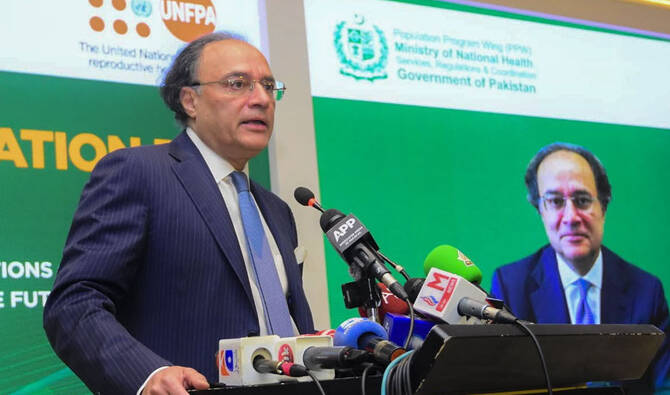
Muhammad Aurangzeb told a World Population Day seminar in Islamabad that the mechanism underpinning the National Finance Commission — the constitutional body that governs the split of tax revenue between Islamabad and the provinces — requires a fundamental rethink. Population currently accounts for 82% of the criteria used to calculate each province’s share, dwarfing other factors such as poverty levels, revenue collection and inverse population density.
“There are also more structural issues, such as the NFC, where population accounts for 82 percent of the allocation formula,” Aurangzeb said. “That is simply not sustainable.”
The remarks add momentum to a push by senior members of Prime Minister Shehbaz Sharif’s cabinet to reweight the formula, even as the proposal runs into opposition from provincial stakeholders wary of ceding ground on an issue tied to constitutional balance of power.
A Formula Under Strain
The NFC formula in its current form traces back to the seventh commission award, which broadened the allocation criteria beyond population alone for the first time. Before that shift, population determined the entirety of each province’s share. The seventh award cut that weighting to 82%, introducing poverty (10.3%), revenue generation (5%) and inverse population density (2.7%) as secondary criteria — a compromise that has remained largely untouched through more than a decade of subsequent negotiations.
Under that structure, Punjab — Pakistan’s most populous province — draws roughly 51.7% of the provincial pool, followed by Sindh at 24.6%, Khyber Pakhtunkhwa at 14.6% and Balochistan at 9.1%.
Critics within the government argue the arrangement has created a perverse incentive: because population size drives federal transfers, provinces have little fiscal reason to invest in slowing population growth, even as officials warn that unchecked growth threatens to overwhelm the country’s schools, hospitals and water supplies. Planning Minister Ahsan Iqbal and Health Minister Mustafa Kamal have both pressed in recent months for a formula that rewards development outcomes and other socio-economic indicators rather than sheer population count.
The push comes as the 11th National Finance Commission works through its first substantive round of talks since the previous award lapsed, having convened its inaugural session in December. Any rewrite of the horizontal distribution formula would need to clear a high bar: Article 160 of Pakistan’s constitution bars provinces from receiving a smaller share than they did under the prior award, meaning consensus among the federation and all four provinces is required before any changes take effect.
Provincial Pushback
The proposal has run into resistance from the Pakistan Peoples Party, a key coalition partner to Sharif’s government. PPP officials contend that diluting the population criterion risks eroding the spirit of the 18th Constitutional Amendment, the 2010 legislation that devolved significant fiscal and administrative authority to the provinces. The party has said any recalibration of the formula must proceed only through consensus within the NFC’s constitutional process, rather than be imposed by Islamabad.
That resistance underscores the political sensitivity of altering a mechanism that has, for more than 15 years, shaped the balance of power between Pakistan’s federal government and its provinces — and particularly between Punjab and Sindh, whose rival claims on the divisible pool have historically been a flashpoint in coalition politics.
Girls’ Education, Female Employment Cited as Levers
Aurangzeb framed the funding formula as one piece of a broader demographic challenge. Drawing on what he described as international experience, he said three factors have proven most effective at slowing population growth over the long run: educating girls, expanding women’s participation in the labor force, and enlisting the support of religious scholars. He pointed to Bangladesh, Indonesia and Iran as countries that have meaningfully reduced population growth rates over the past decade.
The government has already taken initial steps, Aurangzeb said, including eliminating the sales tax on contraceptives in the latest federal budget. But he characterized that move as a “tactical” fix rather than a structural solution, saying more substantial reform would be needed to bend Pakistan’s population curve.
He also pointed to financing available outside the annual federal budget, saying the World Bank’s Country Partnership Framework — a 10-year arrangement — makes roughly $600 million to $700 million a year available to fund population-related programs, including efforts to reduce learning poverty and childhood stunting.
Aurangzeb described population growth alongside climate change as “existential issues” for the country, arguing that failure to address both would curtail Pakistan’s development trajectory over the coming decades. He said implementation of the National Population Council’s agenda should be anchored to measurable targets and subject to regular monitoring, rather than left to open-ended policy commitments.
Copyright © 2021 Independent Pakistan | All rights reserved