By Staff Reporter
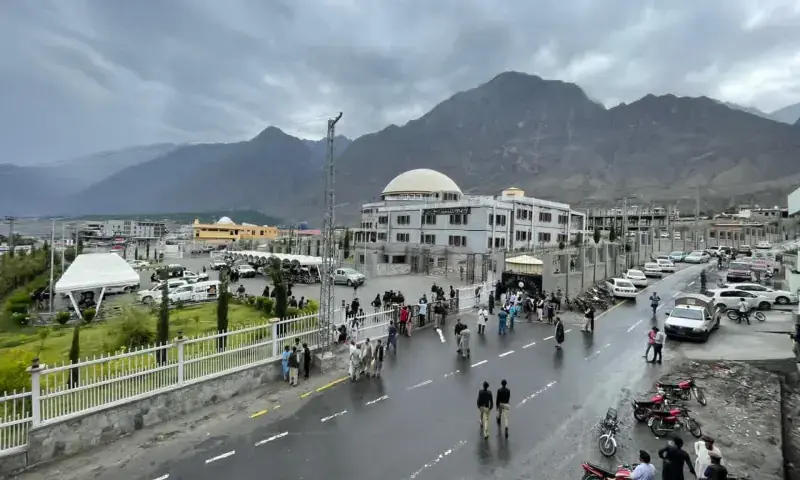
GILGIT: The regional legislature representing Gilgit and Baltistan, one of the most remote and politically ambiguous corners of South Asia, voted unanimously on Thursday to press Pakistan’s federal government for a provincial status, reviving a demand that officials say has simmered among residents for three-quarters of a century.
The resolution, adopted without dissent by the Gilgit-Baltistan Assembly, calls on Islamabad to grant the mountainous region — wedged between Pakistan, China, Afghanistan, and Indian-occupied Kashmir — the same constitutional standing enjoyed by Pakistan’s four established provinces. That would include seats in the National Assembly and Senate, representation that residents of Gilgit-Baltistan have never held despite a population estimated at well over a million people spread across some of the highest terrain on Earth.
Lawmaker Jalal Ali Shah introduced the measure, which drew support from both government and opposition benches — a rare display of unity in a region where political factions frequently clash over how aggressively to pursue autonomy from Islamabad. Deputy Speaker Malik Kifayatur Rehman gaveled through the resolution’s passage after debate concluded.
Gilgit-Baltistan operates under a governance structure that has evolved gradually since the territory’s break from the former princely state of Jammu and Kashmir in the late 1940s. In 2009, the federal government issued what became known as the Gilgit-Baltistan Empowerment and Self-Governance Order, establishing the region’s first elected legislative assembly and expanding its authority over local affairs — a change officials at the time described as significant, though incomplete.
Nearly a decade later, the assembly’s legislative powers were broadened further under the Gilgit-Baltistan Order of 2018, issued at the direction of then-Prime Minister Nawaz Sharif. That order followed recommendations from a reform committee led by Sartaj Aziz, the veteran Pakistani statesman and former finance minister. Aziz’s committee had studied how to more fully integrate the region into Pakistan’s constitutional framework without disturbing the country’s formal position on the broader Kashmir dispute.
It is that unresolved tension — between local aspirations for full political rights and Pakistan’s delicate international posture on Kashmir — that has kept Gilgit-Baltistan in a kind of constitutional limbo for generations. The resolution passed on Thursday attempts to navigate that tension directly, stating that any grant of provisional provincial status would come “without prejudice” to Pakistan’s international commitments and legal position on the Jammu and Kashmir dispute. The measure explicitly notes that such a change would not affect the territory’s final status, which remains subject to United Nations resolutions and the possibility of a future plebiscite.
Should full provincial status remain elusive, the resolution lays out a fallback. It calls on the federal government and the governments of Pakistan’s four provinces to support folding Gilgit-Baltistan into the National Finance Commission Award, the formula through which federal revenue is distributed across the country. Lawmakers argued that mechanism would at least ensure residents receive what they described as their rightful share of national resources, even absent full political representation.
Chief Minister Amjad Hussain, addressing the assembly after the vote, said the resolution captured a demand that has followed the region for 75 years — essentially since its founding — and represented an attempt to finally resolve it through formal channels.
Hafeezur Rehman, the assembly’s opposition leader, told colleagues during the debate that achieving provisional provincial status would require a constitutional amendment at the federal level, a process that typically demands broad political consensus in Islamabad. He said he remained hopeful that the region’s demand would eventually reach parliament in the form of a formal bill. Absent that path, Rehman said, the federal government should at minimum extend Gilgit-Baltistan a share of the NFC Award similar to the arrangement already in place for Azad Jammu and Kashmir, the Pakistan-administered territory that borders the region to the south.
The resolution also directs the federal government to begin consultations with regional stakeholders on the constitutional, legal, and administrative steps needed to carry out its provisions, though it sets no timeline for that process to begin.
Copyright © 2021 Independent Pakistan | All rights reserved