By Staff Reporter
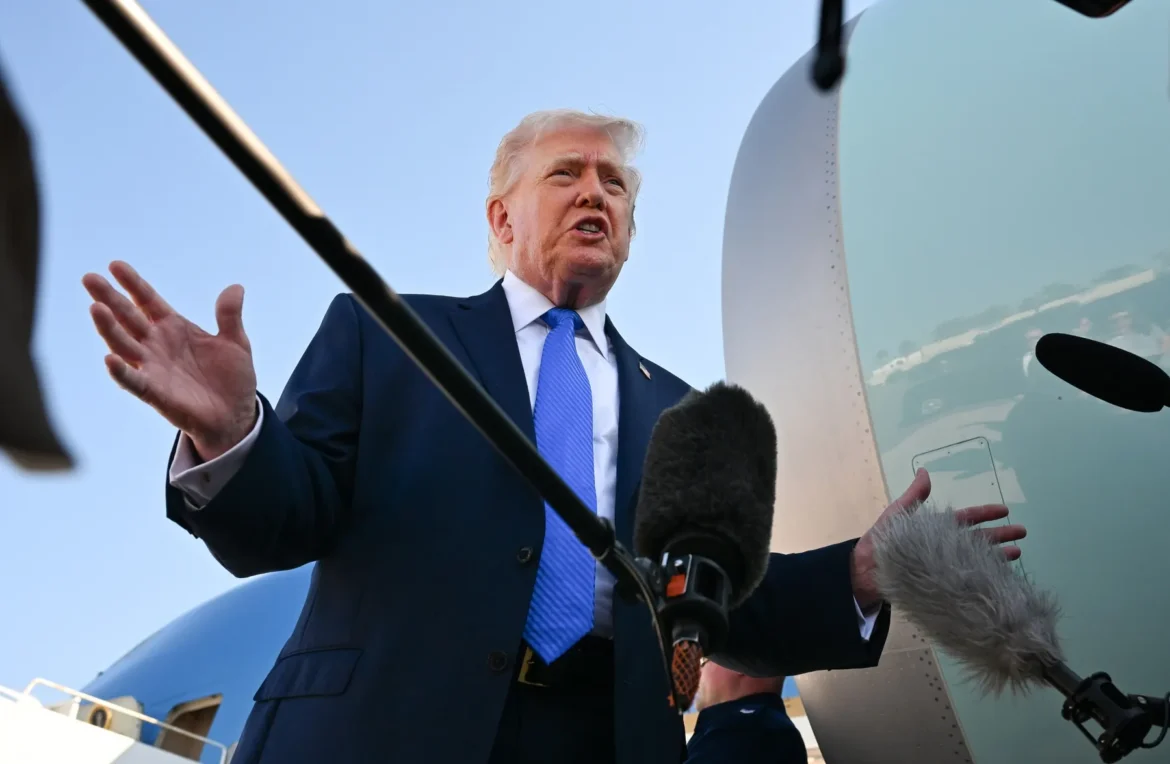
ISLAMABAD: Donald Trump said on Monday that the United States was engaged in “good talks” with Iran and believed there was a genuine chance of a deal to end their five-month conflict, even as he warned that American air strikes would resume within days if negotiations collapsed.
The US president’s comments, delivered to reporters aboard Air Force One, came 72 hours after Washington abruptly suspended a fortnight-long bombing campaign against Iran — the latest reversal in a war that began in late February and has repeatedly defied predictions of resolution.
“We’re talking right now,” Trump said. “We’re having good talks. I think there’s a good chance that something could happen, and if it does, good. If it doesn’t, we go back to doing what we were doing two days ago.”
Pressed later by Axios on how long he would give the process, the president was blunter still. “Not much time,” he said. “Either it goes fast or not at all.” He repeated the warning at a rally in Michigan the same evening, telling supporters: “You can’t bribe them. You’ve got to beat them, and we’ll beat the hell out of them. But we’ll see how it turns out. Right now, there are very friendly negotiations going on.”
The mixed messages — hope tempered by threat — reflected the volatile state of a conflict that has drawn in Saudi Arabia, Israel, Yemen’s Houthi movement and, increasingly, the shipping lanes that carry a fifth of the world’s oil.
Tehran denies seeking talks
Iran’s position on Monday was markedly cooler than the president’s. Foreign ministry spokesman Esmail Baghaei told reporters in Tehran that messages were still passing between the two sides through intermediaries, but he flatly rejected suggestions that Iran had requested negotiations with Washington. “This is not in our DNA,” he said, adding that Iran was not currently engaged in direct talks with the United States.
A senior Iranian official, speaking to Reuters on condition of anonymity, said Tehran’s position remained “attack for attack”: Iran would hold its fire only for as long as the American pause continued, and that message had already been relayed to Washington. A second Iranian source was more sceptical still, suggesting Tehran viewed the pause as tactical rather than a genuine shift in the American position. “There is more scepticism than optimism about the halt in attacks,” the source said. “Iran has accumulated enough bitter experience with what it sees as US deception.”
Drone attacks test the pause
Whatever the diplomatic temperature, the ceasefire was tested within hours on the ground. Saudi Arabia, Jordan and Iraq all reported drone attacks on Monday. Riyadh said its air defences intercepted and destroyed drones aimed at petroleum facilities in the Eastern Region and the capital, and accused Iran-backed militias operating from Iraqi territory of launching them, reserving the right to respond “at the appropriate time and place”.
Yemen’s Houthi movement, an Iranian ally, claimed separate attacks on the East-West Pipeline, the 745-mile route that carries crude to Saudi Arabia’s Red Sea export terminal at Yanbu, saying the strikes were retaliation for Saudi drone incursions into Yemeni airspace. Iran’s Fars news agency reported that the attacks had caused a fire at the kingdom’s Abqaiq facility. Jordan’s armed forces said they had intercepted two further drones, without identifying their origin, while Israel’s military said it had intercepted two drones near the Jordanian border and was investigating their source.
Jordan’s foreign ministry condemned the strikes on Saudi Arabia as “a flagrant violation of Saudi Arabia’s sovereignty” and a breach of international law, pledging solidarity with Riyadh.
Oil prices tumble
The pause in American strikes, combined with Mr Trump’s talk of a possible deal, sent oil prices sharply lower. Brent crude, which had briefly climbed above $100 a barrel last week for the first time since May amid fears over Gulf shipping, fell more than 10 per cent on Monday to trade around $88 a barrel, having earlier dropped as low as $87.55. US benchmark West Texas Intermediate fell 8 per cent to $82.35.
Traders also drew some reassurance from the resumption of crude loadings at the Caspian Pipeline Consortium terminal on Russia’s Black Sea coast, a key export route for Kazakh oil. Markets remained wary, however, after the Houthi claims on Saudi Aramco-linked facilities, which neither the Saudi government nor Aramco had confirmed by Monday evening.
Six ships turned back at Hormuz
Iran’s state broadcaster IRIB reported that its Revolutionary Guard navy had intercepted six vessels attempting to transit the Strait of Hormuz on an “illegal and unsafe” southern route after switching off their navigation and positioning systems. One vessel was fired upon; the rest were turned back into the Gulf, IRIB said, describing the episode as “decisive Iranian management” of the waterway.
The Strait of Hormuz sits at the heart of the dispute. Iran has effectively controlled shipping through it since the war began, insisting that a memorandum of understanding signed with Washington in June entitles it to manage transit and, eventually, to charge vessels a fee. The United States disputes that interpretation and has been encouraging commercial shipping to test a secondary route close to the coast of Oman — the very move that prompted Tehran to open fire on shipping and triggered Mr Trump’s renewed bombing campaign in the first place.
The toll on maritime traffic has been severe. The United Nations Office for Project Services said transits through the strait had fallen to an average of roughly five ships a day over the past week, compared with nearly 130 a day before the war.
Oman’s mediation
Away from the American track, an Omani delegation held two days of technical talks with Iranian officials in Tehran over the weekend, seeking a formula to manage shipping through the strait without escalating the crisis further. Mr Baghaei described the discussions as “useful and constructive” but insisted they were unconnected to Washington. “The goal is for Iran and Oman, as two coastal states, to develop mechanisms to ensure safe shipping in the Strait of Hormuz, while respecting the sovereign rights of the two coastal states and also preserving Iran’s security and national interests,” he said.
Muscat has proposed a voluntary funding model similar to the one governing the Strait of Malacca, under which countries using the waterway contribute to a fund covering environmental and safety services, rather than paying a mandatory toll. Iran’s department of environment has drafted a rival scheme under which vessels would pay fees tied to ship type, cargo volume and pollution history — a proposal that Iranian state media have suggested could work in Tehran’s favour. A diplomat familiar with the discussions said the aim was “to marry the Iran and Oman proposals so what emerges is clearly compliant with the law of the sea, and internationally acceptable.”
Questions over munitions
The decision to pause the bombing campaign has been widely linked to concerns within the US military over the pace at which stocks of precision munitions were being depleted. A US official told Reuters that commanders had told the president they were running out of pre-approved targets, and that General Dan Caine, chairman of the Joint Chiefs of Staff, had privately warned Trump that resuming major operations risked further straining supplies of interceptors used by American air defences in the region. Admiral Brad Cooper, the top US commander in the Middle East, is reported to have recommended halting the campaign on the same grounds.
Trump rejected the characterisation outright. “We have far more munitions than anyone in the world, and far more than we need,” he told the Wall Street Journal, adding to reporters that the military was rapidly rebuilding stockpiles depleted by shipments to Ukraine and that he would like to see more “of the more sophisticated stuff.” US ambassador to the United Nations Mike Waltz struck a more cautious tone on NBC’s Meet the Press, saying the military “has everything that it needs” while acknowledging that Defense Secretary Pete Hegseth had “inherited a depleted situation” on taking office.
Copyright © 2021 Independent Pakistan | All rights reserved