By Staff Reporter
ISLAMABAD: Prime Minister Shehbaz Sharif ordered officials to draw up a “comprehensive strategy” for luring international investors into the country’s power-distribution privatization program and told the Privatization Commission to finish its own institutional overhaul within a month, as the government presses ahead with a sale process the International Monetary Fund has linked to broader fiscal reform.
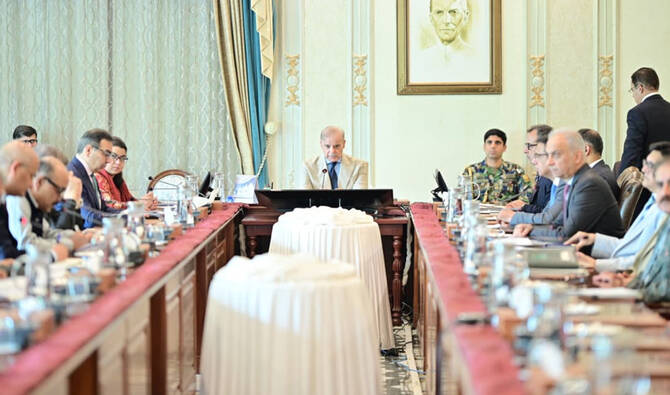
Sharif’s directive, issued during a review meeting in Islamabad on Wednesday, came as officials briefed him on investor roadshows in Turkey, Saudi Arabia and China that the prime minister’s office described as yielding “encouraging results.” The trip, which included stops in eight Pakistani cities as well, was part of a campaign to find buyers for three state-owned electricity distributors — the first tranche in a divestment program that stretches through 2029.
“A comprehensive and effective strategy should be adopted to ensure the participation of investors meeting international standards in the privatization of Discos,” Sharif said, according to a statement from his office. He told officials that consumer interests needed to be protected throughout the process and that each phase of the sale should stick to its timeline under the local law and international best practices.
The three distributors up for sale — Islamabad Electric Supply Co., Faisalabad Electric Supply Co. and Gujranwala Electric Power Co. — together serve more than 14 million customers across Punjab province, the capital region and parts of Azad Jammu and Kashmir. The government is offering buyers a stake of between 51% and 100% in each company along with management control, and has staggered the bidding calendar so it can run the three sales in parallel: expressions of interest are due Aug. 7 for Faisalabad, Aug. 21 for Gujranwala and Sept. 7 for Islamabad, with the government’s privatization adviser, Muhammad Ali, previously saying he expects the actual bidding to unfold sequentially in October, November and December.
The push forms part of a wider effort by Sharif’s government to shrink the state’s footprint in an economy where loss-making public enterprises have long drained the budget. Pakistan’s 2024-29 privatization plan spans 25 assets in total, including power generators, banks, an insurer, airports and even the Roosevelt Hotel in New York. The program picked up momentum in December when a consortium led by Arif Habib Corp. won an auction for a 75% stake in national carrier Pakistan International Airlines for about 135 billion rupees, or roughly $482 million; the government handed over operational control of the airline in June after the deal’s first financial close.
Officials told Sharif that the Privatization Commission had completed prequalification and restructuring plans for the three distributors, work that included commissioning a state-owned special-purpose vehicle to strip out non-transferable assets and liabilities ahead of any sale — a structure designed to make the companies more palatable to buyers wary of inheriting legacy obligations. The commission’s board cleared those restructuring plans last week and forwarded them to the Cabinet Committee on Privatization for approval.
Sharif directed the commission to complete its own restructuring within 30 days, including hiring finance, legal and information-technology specialists that meet international qualification standards. He said their expertise would strengthen the institution’s capacity to draw investment. The prime minister also told officials to fold recommendations from outside consultants into the sale process and to finish the legal and regulatory groundwork needed to support the transactions, including a mechanism for handling consumer complaints once the companies pass into private hands.
The overhaul comes as Pakistan works through a sector long weighed down by electricity theft, weak bill collection and technical losses — problems that feed into so-called circular debt, the web of unpaid obligations that accumulates across power producers, fuel suppliers, distributors and the government and ultimately pushes up consumer tariffs and state subsidies. The IMF has said private-sector control of distribution companies should improve efficiency and governance and help address the debt buildup, though it has also acknowledged the first round of sales has already slipped after investors raised concerns during market consultations; the fund now expects Pakistan to complete the transactions by early 2027.
Those investor concerns have not disappeared. People briefed on the roadshows, which included one-on-one meetings with more than 30 domestic business groups and 23 international investors — among them 11 in Turkey alone, plus meetings with the country’s energy regulator and energy ministry — said participants pressed for clarity on the post-privatization regulatory framework, tariff stability and continuity of government policy, citing lingering wariness from Pakistan’s past privatization efforts. Ali has separately said prospective buyers are seeking an 18% dollar-based return, an end to Pakistan’s uniform consumer tariff, permission to generate their own power and freedom to buy and sell electricity directly — terms he has said the government will not fully meet. Instead, he has said Islamabad plans to offer rupee-based returns of 14% to 15%, with performance-linked incentives that could lift total profitability to as much as 20%.
Unresolved payment disputes with Chinese independent power producers under the China-Pakistan Economic Corridor have also come up in investor discussions, adding another variable for the government to manage as it courts Chinese capital for the distribution sale.
Sharif’s office said meeting was also updated on plans for later privatization rounds, including the Hyderabad and Sukkur electric supply companies, which the government intends to restructure and move toward sale by August or September of next year. Two other distributors — Quetta Electric Supply Co. and Tribal Areas Electric Supply Co. — have been left out of the privatization program entirely. Pakistan’s broader pipeline also includes a long-term concession for Islamabad International Airport and the planned sale of state-owned lender Zarai Taraqiati Bank.
Copyright © 2021 Independent Pakistan | All rights reserved