By Staff Reporter
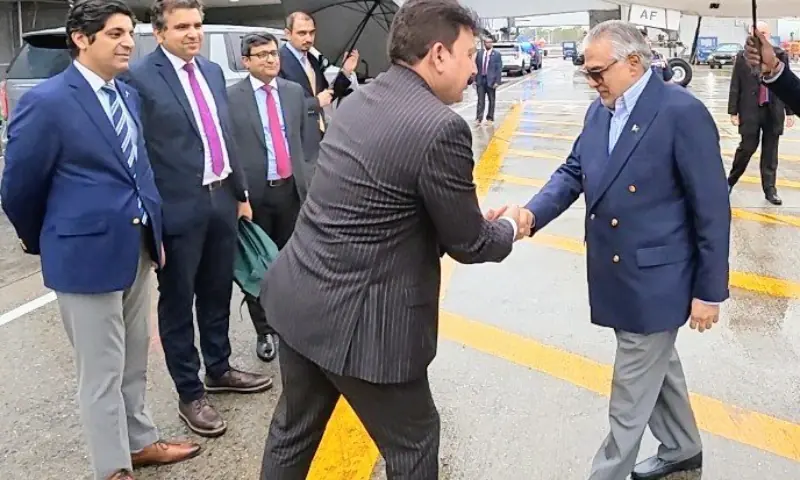
ISLAMABAD: Foreign Minister Ishaq Dar has arrived in New York to press for an end to the US-Iran war at the United Nations, as world leaders gather for a General Assembly overshadowed by a conflict now in its eighth month.
Dar, who is also Pakistan’s deputy prime minister, landed in the city on Monday for the high-level week of the 81st session of the UN General Assembly. He said Islamabad would use the occasion to highlight its efforts to end the fighting and to advance discussions on Palestine, according to the Pakistani foreign ministry.
The General Debate opens on Tuesday. It convenes against a Middle East in flames, with Iran and Yemen’s Houthis attacking regional states and the US and Iran again trading strikes despite a peace deal that Pakistan had helped to broker.
Pakistan has become one of the few functioning channels between Washington and Tehran since US and Israeli strikes on Iran began on 28 February. It helped negotiate a two-week ceasefire in April, hosted the Islamabad talks that followed, and in June secured an interim memorandum of understanding signed by the American and Iranian presidents.
The agreement did not last. The ceasefire collapsed on 8 July after Iran struck commercial vessels in the Strait of Hormuz and the US hit back at Iranian territory. The memorandum has since lapsed, and Congress’s research service says the two sides are again exchanging limited strikes amid a stepped-up American sanctions campaign.
The Congressional Budget Office has estimated the cost of US military operations at $38bn as of 1 August.
Pakistan’s foreign ministry said Mr Dar would take part in ministerial forums and deliver statements on bilateral, regional and international priorities. “He will highlight Pakistan’s ongoing efforts for regional and international peace and stability, and exchange views on important regional and international challenges,” it said in an earlier statement.
Dar will attend several high-level meetings on Palestine, including a gathering of the group of eight Arab and Islamic countries and a ministerial meeting of the Global Alliance for the Implementation of the Two-State Solution. Pakistan, which has no diplomatic ties with Israel, has consistently condemned Israeli military action, called for humanitarian aid to reach Palestinian territories without interruption, and backed a sovereign, independent and contiguous Palestinian state based on pre-1967 borders.
He will also attend a meeting of the Organisation of Islamic Cooperation’s contact group on Jammu and Kashmir to underline Pakistan’s support for Kashmiri self-determination, address a UN Security Council briefing on artificial intelligence, attend a high-level meeting on pandemic prevention, and chair a meeting of the Economic Cooperation Organisation’s Council of Ministers. He will hold bilateral talks with counterparts and accompany Prime Minister Shehbaz Sharif in his own engagements.
Sharif is due to address the Assembly on 25 September. Pakistan’s permanent representative to the UN, Asim Iftikhar Ahmad, said that the prime minister would speak about Kashmir and Palestine, as well as multilateral cooperation, climate change and the current global situation.
The Foreign Office has said the address will also cover sustainable development, counterterrorism, Islamophobia, global economic challenges, UN reform and the concerns of the Global South. Ahmad said Pakistan was also working to arrange a meeting between Mr Sharif and Apple’s executive chairman, Tim Cook.
Dar has been meeting foreign ministers and other officials in advance of the prime minister’s arrival. The Foreign Office has said Pakistan will continue to call for dialogue and diplomacy to resolve conflicts.
Pakistan shares a 900km border with Iran and maintains close ties with Saudi Arabia, which has come under sustained Houthi attack. Last week’s assaults wounded 73 people in the kingdom and disrupted energy facilities, and Saudi air defences said they destroyed a Houthi drone before it entered restricted airspace around Makkah. Mr Sharif has assured Crown Prince Mohammed bin Salman that Pakistan will keep working to ease tensions, and the crisis is seen as the first major test of the Makkah defence alliance linking Pakistan, Saudi Arabia and Turkey.
Islamabad has kept its own lines to Tehran open. Iran’s foreign minister, Abbas Araghchi, spoke by telephone with Pakistan’s army chief, Field Marshal Asim Munir, from Beijing last week, Iranian state media reported.
The Strait of Hormuz remains at the heart of the confrontation. In late August, the US military said it had cleared Iranian mines from the shipping lanes. Days later, American forces struck Larak Island, which they said Iran was using to lay new mines, prompting Iranian retaliation. American forces have since targeted Iranian oil tankers, according to Britannica.
The wider assembly is likely to be dominated by the same conflict. More than 130 heads of state and government are expected. Donald Trump is due to meet Gulf leaders to discuss the next phase of the war, according to CNN, and Iran’s president, Masoud Pezeshkian, is expected to address the hall on 23 September. Benjamin Netanyahu, who is wanted by the International Criminal Court over Gaza, which he denies, is also due to speak. The Palestinian president, Mahmoud Abbas, has reportedly been denied a US visa for a second year running.
Copyright © 2021 Independent Pakistan | All rights reserved