By Staff Reporter
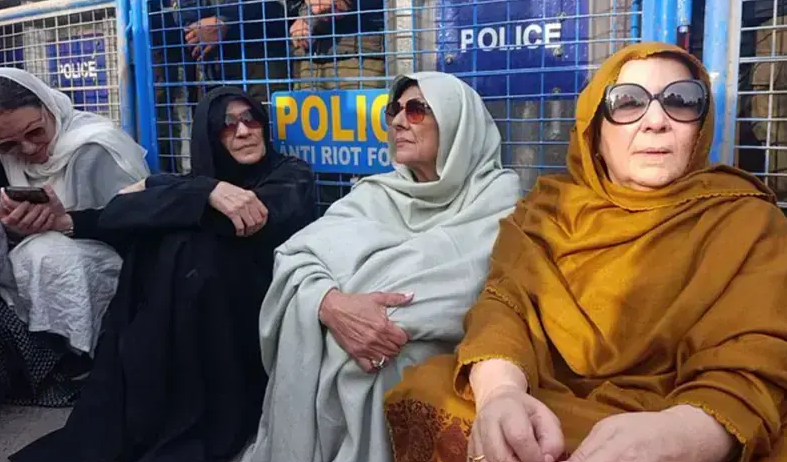
LAHORE: Two more sisters of Imran Khan were detained for 30 days on Monday, a day after a third was taken into custody, as authorities moved against the jailed former prime minister’s family in the run-up to a mass protest planned for 27 September.
Dr Uzma Khan and Noreen Niazi were held under the Punjab Maintenance of Public Order Ordinance, 1960, on the orders of the Lahore deputy commissioner, according to an order dated 20 September. Their detention follows that of their sister Aleema Khan, who was jailed on Sunday under the same law.
All three women are now understood to be held at Kot Lakhpat jail in Lahore.
The order described the two women as “prejudicial to the public safety and maintenance of public order”. It accused them of involvement in the May 9 protest, when supporters of Mr Khan attacked military and government buildings after his first arrest in 2023, and said they had “motivated the workers to damage public and government property”. It further alleged they were “again mobilising the workers through social media and public meetings to create a law and order situation” and “raising/chanting objectionable slogans” against the government and state institutions.
Multiple cases, including one registered at Race Course police station, were cited in the order, which called the women “potential dangers to public peace and tranquillity”.
The ordinance allows officials to order preventive detention without a trial and restricts judicial review of such orders. Both women are to be held under the superintendent of the jail.
Family says relatives were seized
Khan’s party, Pakistan Tehreek-e-Insaf (PTI), said the arrests took place in the early hours of Monday. Its central information secretary, Sheikh Waqas Akram, wrote on X that Punjab police had taken both women “along with their children and the sons of Aleema Khan”, who had been put in an armoured vehicle and driven to an unknown location.
Awais Younas Chaudhry, a PTI lawyer, said Niazi and Dr Khan had earlier been confined to their homes, but were taken away on Monday morning.
Khan’s son, Kasim Khan, said his aunts had been “abducted”. “This is a disgrace,” he wrote, alleging that officers had “broken into my aunties and cousins’ houses and forced them into vehicles with no explanation”. He added: “No reasons for arrest have been stated. No news has been released as to where they have been taken.”
Local media reports said that several younger relatives who were also detained, including Aleema Khan’s sons, were later released. The party called the arrests a “blatant abuse of authority, a violation of fundamental rights, and an act of political victimisation”.
Aleema Khan was detained on Sunday after the deputy commissioner’s office, headed by Muhammad Ali Ijaz, ordered her detention or arrest for 30 days under the same ordinance. A man named Muhammad Ameer was named in the same order.
Niazi told a press conference in Lahore on Saturday that her sister had been “picked up” with her driver after leaving her home on Saturday, and that the family later learnt her car had been left at a police station. Her sister’s lawyer, Mudassir Umar, said the family had not received formal confirmation of the arrest, and suggested that the detention order appeared to have been issued only after she was taken into custody. He alleged the arrest was linked to her being Khan’s sister.
Niazi said 27 September would be a “historic day” and urged people to come out “for their country and Imran Khan”. She alleged that her brother was being held unjustly and was not receiving proper medical treatment. “If they think that by arresting Aleema Khan we will be frightened, they are mistaken,” she said.
A widening crackdown
The detentions are the latest in what the PTI describes as a coordinated campaign against its organisers in Punjab, Pakistan’s most populous province.
On Sunday, police in Sahiwal arrested Asad Khan Baloch, a former mayor and past PTI ticket holder, and Muhammad Shahid Chohan, the party’s city president. The PTI also said three of its members of the National Assembly – Sanaullah Mastikhel, Ahsan Jamal Khan and Mian Ghous – had been taken into custody. A week ago, district authorities issued preventive detention orders against dozens of party workers under the same ordinance, including 31 in one Punjab notification and 14 more in Toba Tek Singh. Similar accounts have emerged from Islamabad, where the party intends to gather on the day of the protest.
Information Minister Attaullah Tarar said on Sunday that “no violent group will be allowed to reach Islamabad”, adding that roads would remain open. He pointed to a ruling by the Islamabad High Court, which last week held in a detailed 37-page judgment that no political party, leader or provincial government has any lawful right to occupy public roads, highways, interchanges, toll plazas or buildings in the capital territory.
The court also ruled that government funds, vehicles and personnel cannot be used to support a political march. It affirmed, however, that peaceful protest is a constitutional right.
The PTI, which is led in Khyber Pakhtunkhwa province by chief minister Sohail Afridi, insists that the protest will be peaceful and lawful. The party has also said it wants no confrontation.
Security build-up in the capital
Preparations in and around the capital are well under way. Local media reported that more than 22,000 security personnel, led by eight deputy inspectors general, would be deployed in Islamabad, with a further 30,000 in Attock district, which links Khyber Pakhtunkhwa to Punjab. Rawalpindi police have requested an additional 9,000 officers.
Some 30 entry points to the twin cities of Islamabad and Rawalpindi, including 11 in Rawalpindi, are to be blocked, and shipping containers have been seized and stacked along highways and in open spaces. All police leave in Rawalpindi district has been cancelled until 1 October. Officers drafted in from other districts are being housed in hotels, guest houses, schools, marriage halls and government buildings.
Two other groups have announced protests of their own. Jamaat-i-Islami began a train march from Karachi on Sunday against a levy on petroleum products, and its leader, Hafiz Naeem ur Rehman, has said the party’s convoy will reach the capital on 23 and 24 September. He has said the party will not block roads. Kissan Ittehad, a farmers’ group, is also seeking relief and has announced a march on Islamabad.
Government warns of economic cost
Finance minister Muhammad Aurangzeb warned on Sunday that strikes, sit-ins, long marches and road closures could cost the economy an estimated Rs120bn a day, at a time when it was “moving from stability towards growth”. He said the burden would fall on ordinary people, small traders and shopkeepers.
Citing figures prepared by the Planning Commission and the finance ministry, he said the services sector could lose around Rs86bn a day, industry Rs25bn and agriculture Rs9bn, with an additional Rs17bn a day in lost revenue. He described the potential disruption as “self-inflicted pain” and called for dialogue.
Aurangzeb said exporters were already contending with disruption in the Strait of Hormuz and the Bab al-Mandab, higher freight and insurance costs, and a fresh wave of terrorism. The export target for the current fiscal year is $35.9bn, he said. IT exports stood at $811m across July and August, and past internet shutdowns during civil disobedience had cut such earnings by as much as 80 per cent, he added.
The parliamentary affairs minister, Dr Tariq Fazal Chaudhry, said comments by PTI figures about the march had raised fears of violence. He cited a reported remark by a senior party leader that protesters were coming to make Islamabad “Somnath”, which he described as a threat. He said the government had a duty to protect the capital. He was more conciliatory towards Jamaat-i-Islami, saying the party had no history of violent protest and expressing hope that talks would resolve the dispute.
Three years in jail
Khan, 73, has been held in Adiala jail in Rawalpindi since August 2023. He is serving a 14-year sentence in the £190m corruption case known as the Al-Qadir Trust case, and was given a further 17 years, together with his wife Bushra Bibi, in a separate case over state gifts. He denies all charges and says they are politically motivated, allegations the authorities reject.
Concern over his health has grown this year, with reports of vision loss in one eye. His sisters have repeatedly been turned away from the jail when seeking to see him, most recently in June. In an announcement made at a rally in Peshawar in August, the PTI set 27 September as the date for its march on the capital.
The party has said that only Khan can decide whether the protest goes ahead. The Senate opposition leader, Allama Raja Nasir Abbas, said the interior minister, Mohsin Naqvi, had been told as much when the two met.
The 2024 march on Islamabad ended in violence. Independent estimates put the death toll at between five and 18, including security personnel, and more than 4,000 people were arrested.
- Imran Khan’s three sisters jailed as Pakistan braces for mass protest
- Three sisters of jailed Imran Khan detained days before Islamabad march
- Pakistan detains Imran Khan’s sisters in crackdown ahead of PTI march
Copyright © 2021 Independent Pakistan | All rights reserved