By Staff Reporter
HANGU: Two Army officers, a captain of 23 and a lieutenant of 22, were martyred on Sunday leading their troops into a firefight with militants in Khyber Pakhtunkhwa’s Hangu district, part of a battle that left six security personnel and eight insurgents dead, the military said.
The clash, the latest in a run of deadly encounters across the province, came two days after a suicide bombing and gun assault on a police compound in nearby Kohat killed dozens and deepened a diplomatic confrontation between Islamabad and the Taliban government in Kabul.
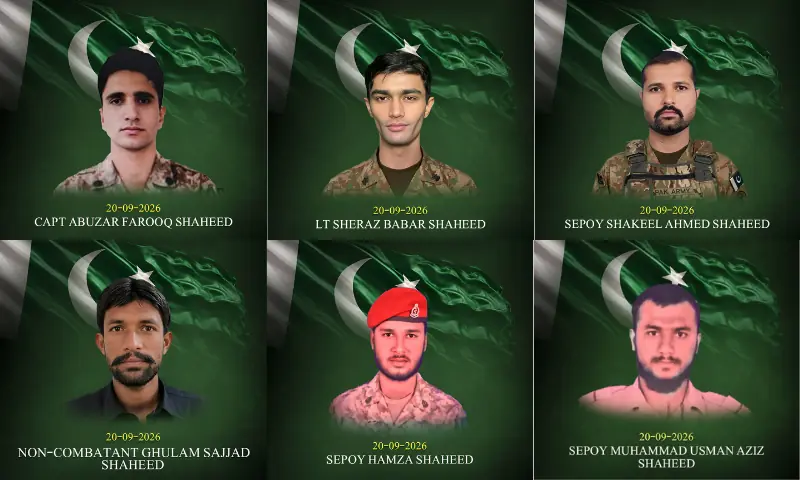
According to Inter-Services Public Relations, the military’s media wing, a security forces convoy exchanged fire with militants in Hangu on Sept. 20. The dead officers were Captain Abuzar Farooq, 23, of Gujranwala, and Lieutenant Sheraz Babar, 22, of Chakwal. The military said the two, “who were leading their troops from the front, fought gallantly and paid the ultimate sacrifice.”
Four others died with them. Photographs released by the military identified them as Sepoy Shakeel Ahmed, Sepoy Hamza, Sepoy Muhammad Usman Aziz and a noncombatant, Ghulam Sajjad.
The military said eight militants from “Fitna al-Khawarij,” the state’s designation for the banned Tehreek-e-Taliban Pakistan, or TTP, were killed. It described the group as Indian-sponsored. “Eight Khwarij belonging to Indian-sponsored Fitna al Khwarij were sent to hell due to effective engagement by own troops.” A sanitisation operation was continuing to eliminate any other militants in the area, the military said.
President Asif Ali Zardari and Prime Minister Shehbaz Sharif expressed grief over the deaths and extended condolences to the families. Sharif said the sacrifices “would not go in vain” and that operations under the Azm-e-Istehkam counterterrorism framework would continue until terrorism was eliminated.
The fighting followed a week of mounting losses. The military reported killing 10 militants in multiple engagements in Khyber Pakhtunkhwa between Sept. 15 and 17, during which six soldiers were also killed.
On Friday, during midday prayers, militants struck the Old Police Lines in Kohat, which houses counterterrorism and Special Branch offices. A car packed with explosives was rammed into the entrance of a mosque inside the police headquarters. Gunmen then stormed the compound, and security forces fought them through the night; eight attackers were ultimately killed. Pakistani officials put it at 23, including 17 police personnel and six civilians.
A faction of the Pakistani Taliban, Ittehadul Mujahideen, which is linked to the commander Hafiz Gul Bahadur, claimed responsibility. The TTP itself denied involvement.
Islamabad has used the attack to press its case against Kabul. Security sources identified one suicide bomber as an Afghan national, Mutee-Ullah, while the second attacker’s identity was still being verified. In what the local media called a veiled warning to Afghanistan, Pakistan said Saturday it had the “will and capability” to eliminate terror threats “wherever they are.” The Information Ministry said the attackers had roots in Afghanistan and accused the Taliban government of failing to take credible, verifiable action against militant groups.
Kabul’s response was mixed. The Taliban’s Foreign Ministry condemned the attack as “unjustifiable” and expressed condolences. But the Taliban spokesman, Zabihullah Mujahid, warned of a “crushing response” to any Pakistani military action on Afghan soil, and has rejected Islamabad’s accusations that militants are sheltered there. Pakistan said condemnation “must be matched by concrete action.”
Hangu has been a recurring flash point. As the source reporting noted, on Aug. 7, a captain and seven militants died in an intelligence-based operation there. On July 30, a deputy superintendent of police was among nine officers killed and 28 wounded when militants attacked the Khazina Banda checkpost.
Monthly data compiled by the Pakistan Institute for Conflict and Security Studies showed attacks in Khyber Pakhtunkhwa rose in August compared with July. And Pakistan has seen a surge in militant activity in the province and in Balochistan since the Taliban returned to power in Afghanistan in 2021. According to the Armed Conflict Location & Event Data project, attacks nationwide have risen every year since 2022, from 658 that year to 2,425 in 2025.
Copyright © 2021 Independent Pakistan | All rights reserved