By Staff Reporter
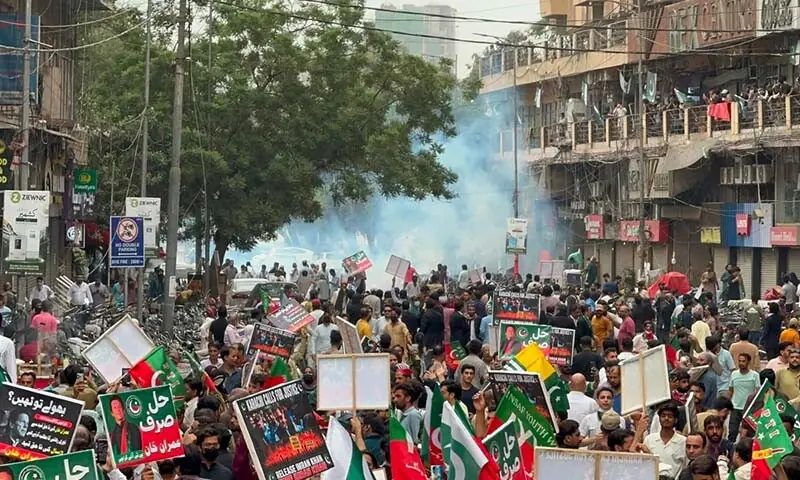
KARACHI: Police fired tear gas and baton-charged demonstrators in Karachi on Wednesday as supporters of Imran Khan’s Pakistan Tehreek-e-Insaf took to the streets across the country to mark three years since the former prime minister’s imprisonment, in scenes that brought parts of the port city to a standstill.
The clashes erupted near Fawara Chowk on Abdullah Haroon Road after police blocked roads leading to the Karachi Press Club with shipping containers, sealing off the area and preventing protesters from reaching their intended destination. Officers moved in with tear gas and batons after PTI activists began pelting them with stones, in confrontations that left several workers injured and led to the arrest of more than a dozen party figures, including Sindh general secretary Dr Masroor Sial.
The unrest triggered severe congestion across central Karachi, with queues backing up around Governor House, the Metropole Hotel and Shaheen Complex. Shops in the surrounding streets shut their doors as the disruption spread, leaving commuters stranded for hours in the summer heat.
Sindh chief minister Murad Ali Shah intervened as the gridlock worsened, ordering police chiefs to clear the roads “immediately” and deploy extra traffic officers to key junctions including Saddar, the Old City area, MA Jinnah Road and Zainab Market. Roads around Napier Road, Regal Chowk and Bolton Market were also to be cleared, he said, while Sindh home minister Ziaul Hassan Lanjar demanded a full report on what had caused the chaos and ordered district police to assist their traffic colleagues in restoring order. By evening, the roads had reopened to traffic.
PTI said in a statement that its Sindh president, Haleem Adil Sheikh, Karachi president Raja Azhar, and other senior figures had attempted to lead workers to the press club before being blocked. Workers instead staged a sit-in near Zaibunnisa Street and Fawara Chowk, the party said, accusing police of turning on peaceful demonstrators. Beyond Karachi, PTI said six workers had been detained in Pano Aqil and fifteen in Kandhkot, with criminal cases lodged against them.
“Sindh police took action against democratic values,” Sheikh said, condemning the arrests. He later wrote on X that the press club “is neither a Red Zone nor a sensitive security area”, accusing the provincial government led by the Pakistan Peoples Party of blocking public access and violating the constitutional right to peaceful assembly. Azhar said the party had formally sought police permission for the demonstration in advance, only for officers to resort to what he called unlawful force regardless.
Away from Karachi, the picture was markedly calmer. In Islamabad, PTI staged a single demonstration on Karnal Sher Khan Shaheed Road, led by regional president Amir Mughal, who said the location had been chosen deliberately as “a show of power” in the capital. Placards at the rally referenced not only Khan’s imprisonment but inflation, unemployment and the situation in Indian-administered Kashmir.
In Hyderabad, a joint rally by PTI and the Tehreek Tahfuz Aayeen-e-Pakistan passed off without incident. Demonstrators gathered at Hyder Chowk before marching to the local press club, where they held a sit-in, played party songs and broadcast a recording of one of Khan’s earlier speeches. PTI Hyderabad president Mohsin Ghumman said police had prevented protesters from pitching camps but had made no arrests.
Growing international pressure
The scenes on the streets came as Amnesty International renewed its call for Khan’s “unconditional” access to his family and lawyers to be restored, describing elements of his detention as unlawful.
In a statement issued ahead of the anniversary, the human rights organisation said Khan and his wife, Bushra Bibi, must be given adequate medical care and that their solitary confinement should end “immediately”. Isabelle Lassee, Amnesty’s acting regional director for South Asia, said Pakistani authorities had “systematically denied Imran Khan the right to a fair trial” for three years, subjecting him to prolonged isolation and restricting his medical treatment and family visits.
“He has not been allowed to meet his family for more than eight months and his vision has reportedly deteriorated significantly,” Lassee said, adding that both Khan and his wife had been denied regular access to legal counsel since December 2025.
Sayed Zulfikar Bukhari, a close aide to Khan, told The Independent the past three years had achieved little for Pakistan. “What has these three years achieved? Has Pakistan progressed in any sector or not regressed?” he said. “Imran Khan today is more popular than he has ever been and the people of Pakistan recognise his stance is for them and a democratic Pakistan, despite all brutalities.”
Amnesty also urged authorities to allow peaceful protest and avoid a repeat of previous crackdowns as Khan’s family, party and supporters staged gatherings to mark the anniversary — a call that appeared to go unheeded in Karachi hours later.
A worsening health picture
Concerns over the 72-year-old’s health have mounted steadily during his third year in Adiala Jail, where he is held on the outskirts of Rawalpindi. He was diagnosed earlier this year with central retinal vein occlusion, a blockage that can cause serious and permanent vision loss. His legal team has said delays in treatment left him with only around 15 per cent vision in the affected eye, though a government medical board later reported some improvement.
Khan received five injections at a government hospital between January and June this year, while his family has continued pressing for his own doctors to be allowed to examine him. The Islamabad High Court has already dismissed a petition from his lawyers seeking his transfer to Shifa International Hospital for specialised treatment, despite the same court having separately ordered that family visits take place every Tuesday and Thursday. His sister, Uzma Khanum, last saw him in December — a gap of more than eight months that his sisters have protested weekly since, also demanding proper treatment for his eye condition.
His sister Aleema Khan has meanwhile been touring towns across Khyber Pakhtunkhwa to build support for Wednesday’s march on Adiala Jail.
Government and opposition figures remain locked in dispute over responsibility for the state of Khan’s care, with PTI accusing officials of withholding transparency and blocking his personal physicians, allegations the government denies.
Khan has been in custody since 5 August 2023, having been jailed initially over allegations he concealed the sale of state gifts received through the Toshakhana scheme during his time in office. He is currently serving a 14-year sentence over a corruption case linked to the Al-Qadir Trust, valued at an estimated £190 million, and was sentenced alongside his wife in a separate case in December 2025 concerning state gifts. Both convictions remain under appeal, and Khan denies any wrongdoing. He has been acquitted in several other cases, including those relating to official secrets and to his marriage.
Three years after his removal from office in a no-confidence vote, and despite his continued imprisonment, analysts say Khan’s political standing has, if anything, grown. Nikkei Asia reported that his time in custody has reinforced his image among supporters — particularly younger Pakistanis — as a symbol of resistance to military influence over the country’s politics.
Copyright © 2021 Independent Pakistan | All rights reserved