By Staff Reporter
ISLAMABAD: Pakistan’s political landscape shifted on two fronts on Wednesday, as the Pakistan Peoples Party moved to repair ties with the opposition even as it sharpened its warning to its own coalition partner, the PML-N.
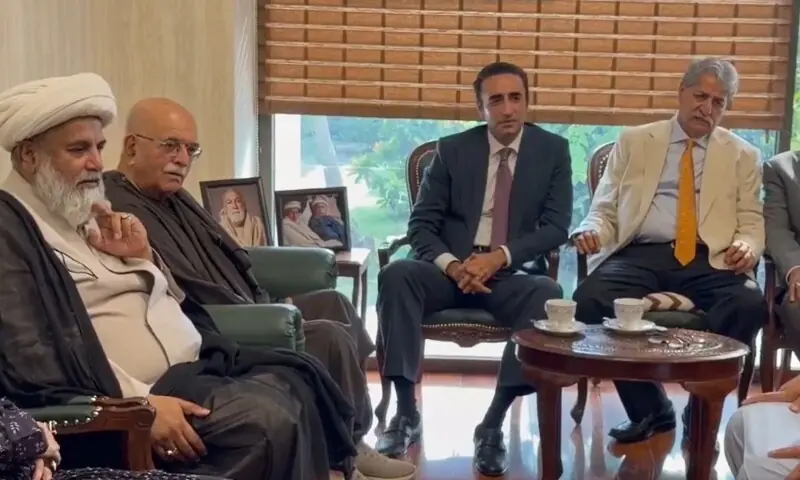
At a meeting inside Parliament House, PPP chairman Bilawal Bhutto Zardari sat down with Mahmood Khan Achakzai, the leader of the opposition in the National Assembly, and Allama Raja Nasir Abbas, his counterpart in the Senate. The two sides agreed to maintain closer contact and cooperate on legislative matters — a modest but symbolically significant thaw in relations that have been largely frozen since the opposition’s boycott of parliamentary proceedings.
But within hours, at a press conference held in the same building, Bilawal delivered a considerably sharper message aimed not at the opposition but at his own governing coalition. The PPP, he said, would not continue “cooperation, coordination and legislation” with the PML-N-led government until a list of grievances — chief among them the conduct of last month’s Azad Jammu and Kashmir elections — were properly addressed.
“My party has decided that PPP’s cooperation, coordination and legislation with the PML-N on general issues cannot continue until our legitimate concerns are addressed,” Bilawal told reporters.
A meeting with the opposition
The talks with opposition figures, held in the National Assembly opposition leader’s chamber, brought together a wide cast of senior political figures. PTI was represented by secretary general Salman Akram Raja, Tehreek-i-Tahaffuz Ayeen-i-Pakistan secretary general Asad Qaiser, vice chairman Mustafa Nawaz Khokhar, and Aamir Dogar, along with Adil Bazai and Akhwanzada Hussain Yousafzai. Bilawal was flanked by senior PPP figures Raja Pervez Ashraf, Sherry Rehman, Naveed Qamar and Nadeem Afzal Chan.
According to a joint communique issued afterwards, the two sides discussed parliamentary affairs and the broader political situation, with Bilawal specifically asking opposition leaders to rejoin parliamentary standing committees and take an active role in their work. The opposition side responded that any such move would first require consultation with PTI founder Imran Khan.
The communique noted that both sides had agreed to increase contact on legislative matters, and that the PPP leadership had pressed the opposition to engage on electoral reform. It also recorded that the PPP welcomed the Supreme Court’s recent ruling ordering Khan’s transfer to hospital for medical treatment.
Speaking to Salman Akram Raja after the meeting, the PTI secretary general described the visit as a “goodwill” gesture, noting that the PPP had welcomed the court’s decision and asked the opposition to resume contacts.
Briefing journalists afterwards, Bilawal called the meeting a “good start” and said his party wanted to see a functioning parliament in which lawmakers played the role assigned to them by voters.
“If we want our parliament to be functional and its institutions or dignitaries to work, then the opposition should review their decision of boycotting the parliamentary process,” he said.
He framed electoral reform as an issue on which government and opposition alike had a shared interest, regardless of which side of the aisle they occupied.
“Whether you are sitting on opposition benches or treasury benches, everyone complains about the electoral process; then it is our responsibility to make reforms in our electoral process,” he said, adding that a party’s enthusiasm for reform tended to depend entirely on whether it had won or lost the last election. “When a party wins elections, it celebrates, and when a party loses elections, it complains; we don’t want this.”
He said the meeting had narrowed the “communication gap” that had opened up between his party and the opposition, and that discussions had begun on what he called the “low-hanging fruits” — electoral reform chief among them.
Bilawal turns on his coalition partner
It was the second half of the briefing, however, that carried the sharper political charge. Bilawal used the platform to formally put the PML-N on notice, listing a set of grievances that he said had gone unaddressed by the government despite repeated warnings from his party.
He said PPP had raised concerns with the coalition in every budget cycle “for the sake of Pakistan and the provinces” and questioned whether any of those concerns had actually been acted upon. Members of his party, he warned, would not back the government’s legislative agenda while those reservations stood — though he left the door open to cooperation on matters of genuine national importance.
Asked whether the government had reached out to address PPP’s objections, Bilawal said it had not contacted either the party or its parliamentary committee, and argued that political disputes of this kind ought to be resolved through dialogue between the parties involved rather than left to fester.
He was careful, though, to distance the warning from speculation about an in-house change of government, saying his focus remained on parliament performing its constitutional function rather than on any manoeuvre to unseat the prime minister. Pressed on recent references he had made to the 26th and 27th constitutional amendments, he said no specific proposal on any new amendment had yet been put to him. “If a point is presented, we will discuss it in the national interest,” he said. Asked separately about the prospect of a 28th amendment, Bilawal said there had been no discussions between PPP and PML-N on the subject.
Anger over the AJK elections
The most pointed criticism was reserved for the recent Azad Jammu and Kashmir elections, which Bilawal alleged had been marred by rigging that cost his party seats it should otherwise have won.
He said PPP had flagged security concerns before the vote and pointed to an attack on a candidate in Muzaffarabad, alleging that two PPP workers had been killed during the Mirpur phase of the polling. He further alleged that the party’s government in Poonch had been defeated through rigging, and criticised the decision to spread the election across six separate phases, arguing that the process had, in effect, still not been brought to a close.
“If the PML-N wanted such a controversial election, then congratulations to them,” he said, arguing that a government installed through a disputed vote would lack the legitimacy needed to make progress on Kashmir’s underlying problems. What the region needed, he said, was an administration carrying a genuine public mandate.
He questioned whether a coalition partner ought to be treated the way PPP had been treated through the AJK process, noting that his party’s representatives had stayed within the parliamentary fold throughout, despite what he described as violence directed against them. He added that, in light of what had unfolded during the election, he would now find it difficult to persuade PPP members in AJK to accept any power-sharing arrangement with the PML-N.
Imran Khan’s hospital transfer
Bilawal also addressed the Supreme Court’s decision to order Imran Khan’s transfer to hospital for treatment, a ruling PPP had welcomed both privately in the meeting with opposition leaders and publicly at the press conference.
He said he hoped the former prime minister would receive proper medical care and recover, but suggested the situation should never have required judicial intervention in the first place — remarking that it would have been better had the government acted on its own before the court’s ruling was handed down, given that ministers and senior politicians alike had gone on to welcome the decision once it came.
Asked about the government’s relationship with the security establishment, Bilawal said he had addressed the matter previously as a political worker and suggested that, if anything were amiss, it would eventually come to light — offering the idiom that if there was “something wrong in the lentils,” it would in time become apparent. He said he believed the prime minister’s own intentions were sound, but suggested that those around him were making the situation worse.
He closed by calling on parliament to begin exercising its own responsibilities, criticising what he characterised as premature celebration following what he alleged was manipulation of election results.
New provinces
Bilawal also addressed the long-running debate over the creation of new provinces, insisting that PPP’s position had been consistent and pushing back on any suggestion that the party stood opposed to the idea.
“Where there is consensus, the decision should be taken through consensus. Where there is no consensus, any political party that wants to discuss the issue should come forward,” he said, adding that he had personally promised a province to the people of Gilgit-Baltistan and to South Punjab, and that the wishes of those seeking provincial status ought to be respected wherever consensus existed. He said he was not in a position to oppose the creation of a province so long as the relevant assembly had not rejected the proposal.
Turning to Sindh, he asked pointedly how many resolutions calling for new provinces had actually been passed there, saying it fell to the government to answer that question. “I cannot even imagine conspiring against Punjab,” he added, insisting that any decision on the matter had to rest on popular consensus rather than being imposed from above. “We did not accept coercion yesterday, and we will never accept it,” he said.
Speaker holds separate consultations
Away from Bilawal’s engagements, National Assembly Speaker Ayaz Sadiq held his own round of consultations on Wednesday, meeting opposition figures including Asad Qaiser and Junaid Akbar in his chamber alongside law minister Azam Nazir Tarar. Former PTI leader Asad Umar also attended.
Asad Qaiser said afterwards that the purpose of the meeting had been to discuss implementation of the Supreme Court’s orders concerning Imran Khan’s medical treatment.
Wednesday’s developments followed reports that emerged on Tuesday of PPP reaching out to the opposition alliance to seek cooperation, with sources indicating the aim was to strengthen parliament and its committee structure. A senior PTI leader, speaking to Dawn on Tuesday, suggested the PPP’s overture was in part an attempt to “raise its value” politically, while noting that PTI would back any party genuinely committed to free and fair elections and to ending the use of Form 47 in disputed results.
Political insiders have suggested that while PPP is unlikely to formally walk out of the coalition government at the centre, it retains the option of making life difficult for the PML-N-led administration as a way of registering its displeasure over the AJK result. Over recent weeks, senior figures within PPP — including Bilawal himself — have repeatedly accused the ruling party of rigging and manipulating election outcomes in the region.
Copyright © 2021 Independent Pakistan | All rights reserved