By Staff Reporter
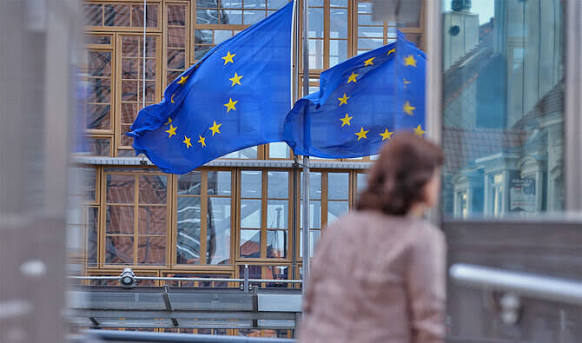
ISLAMABAD: Pakistan cannot assume its preferential access to European Union markets will continue, the bloc’s ambassador to Islamabad said, as the two sides engage in high-stakes talks over a trading arrangement worth billions of euros to the South Asian nation’s export economy.
EU Ambassador Raimundas Karoblis told Dawn newspaper that Pakistan must show tangible improvement on human rights and governance shortcomings identified by Brussels, both to preserve its current benefits and to qualify for a successor scheme with tougher conditions. The comments, reported Monday, come as the EU’s Generalised Scheme of Preferences framework, which grants Pakistan reduced tariffs in exchange for adherence to international conventions, is due to expire at year-end.
“The government will need to take steps towards improving the situation, which will also be very important in the reapplication process,” Karoblis said. “The situation is not certain. And, of course, GSP+ preferences cannot be taken for granted.”
Transition Without Guarantees
A new GSP+ framework takes effect at the start of next year, and Pakistan — along with other existing beneficiaries — will keep receiving preferences through a two-year transition period running to Dec. 31, 2028. But that transition is not automatic, according to Karoblis, nor does it guarantee a roll-over into the new scheme.
The distinction matters because a European Commission assessment covering 2023 to 2025, published in July, found that Pakistan had fallen short on its obligations, regressed in several areas and delivered only limited improvement. The report acknowledged legislative and administrative steps taken by Islamabad but said most of that progress had not yet shown up in practice.
Areas of particular concern included enforced disappearances and extrajudicial killings, restrictions on freedom of expression, threats to journalists and minority rights, judicial independence, access to justice and forced labor.
“There are areas of regression, and of course, this means that the government needs to address them,” Karoblis said, noting that the requirement applies both to Pakistan’s compliance under the current agreement and its bid to join the new one.
Islamabad Pushes Back on Narrative
Pakistani officials have signalled awareness of the stakes without fully endorsing the EU’s characterisation of the country’s record. Tahir Andrabi, the outgoing Foreign Office spokesperson, told reporters at a briefing last week that Pakistan welcomed the commission’s recognition of its continued compliance under 27 international conventions but argued the broader report lacked balance.
“GSP+ remains central to Pakistan’s economic relationship with the European Union, and we will remain constructively engaged with the EU and remain committed to the effective implementation of the international conventions underpinning the GSP framework,” Andrabi said.
Dawn sought comment last week from Pakistan’s federal ministers for information, law and commerce, given that GSP+ obligations cut across multiple policy areas. None of the ministries responded.
A Two-Front Challenge
Pakistan’s position is complicated by the need to satisfy two separate requirements simultaneously: securing entry into the new framework while preventing the deteriorations flagged in the commission’s July report from undermining its standing during the transition period.
Karoblis said the commission harbors genuine reservations about Pakistan’s follow-through. “Indeed, both from reading the report and from discussions with experts, there are serious doubts within the European Commission about the effective implementation of these conventions,” he said.
The financial exposure is substantial. Pakistan has been a GSP+ beneficiary since 2014 and is the program’s largest participant. In 2024, the country received close to €732 million in tariff exemptions under the scheme, with €7.115 billion of its exports making use of preferential access. Of Pakistan’s total €8.275 billion in exports to the EU that year, €7.482 billion qualified for GSP+ treatment.
The EU represents roughly 28% of Pakistan’s total exports, and about 90% of what it sells into the bloc enters under GSP+ terms. The textile and clothing sector is especially exposed, accounting for 70% to 76% of Pakistan’s exports to Europe. Leather goods, prepared foods and beverages also rely heavily on the arrangement.
Losing preferential status would strip Pakistani goods of a competitive edge in one of the country’s most important markets — a risk that is not merely theoretical. The GSP+ mechanism allows for partial or full suspension of benefits in cases of serious non-compliance, and the EU has applied that penalty before: Bolivia faced a partial withdrawal, while Sri Lanka lost its preferences entirely.
Karoblis said no such determination has been made regarding Pakistan. “So far, it requires further investigation as to whether the regression in these specific areas has already reached the threshold concerning the implementation of the regulation, and whether it has reached the level that could trigger a partial or full temporary suspension,” he said.
He added, however, that the lack of a formal finding should not be mistaken for a clean bill of health. “If the government is ready for cooperation and to make progress, let’s expect that the current conditions, situation and findings will not trigger this mechanism,” he said.
Higher Bar Ahead
The successor scheme raises the compliance bar further, expanding the list of relevant international conventions from 27 to 32. Karoblis said Pakistan has already ratified the five additional conventions required, meaning it faces no legal obstacle on paper — but he stressed that implementation, not ratification, is what will determine the outcome.
“As far as the benchmark is concerned, both the current GSP regulation and the new one set two substantive conditions that a country needs to meet,” he said. The first is a measure of economic vulnerability: Pakistan’s relatively low level of development is what makes it eligible for the program in the first place. The second is adherence to the expanded roster of conventions.
“But the main emphasis is on implementation,” Karoblis said. “Both under the present regulation and in the future, the important condition is the absence of serious failure to implement the United Nations conventions in these areas. That is the benchmark, actually.”
He said Pakistan’s application for the new scheme will need to go beyond political statements of intent. “There is also a procedural requirement. For the reapplication, there should be an action plan of the country,” he said. “This means that the emphasis is first of all on implementation, not only on reapplication, with very concrete measures, timelines and performance indicators.”
Rights Record Under the Microscope
Several specific issues are expected to dominate EU-Pakistan discussions going forward, including enforced disappearances, curbs on free expression, blasphemy-related cases and the broader state of the rule of law.
The commission’s latest assessment was pointed in its criticism of Pakistan’s human rights record, finding that enforced disappearances and extrajudicial killings had risen without accountability for those responsible. It also flagged legislative measures that could compromise judicial independence and the right to a fair trial. Karoblis said Brussels continues to engage Islamabad on rule-of-law issues more broadly.
On press freedom, the ambassador pointed to specific legislation he said raises concerns about Pakistan’s compliance obligations. “Looking at the mechanisms, it is indeed the laws we have mentioned, including the recent amendments to the PECA law and the Punjab Defamation Act, among others,” he said. “It is about the right to freedom of expression.”
Blasphemy-related cases remain on the EU’s agenda as well, notwithstanding the Pakistani government’s claims that it has cracked down on individuals using blasphemy allegations to harass or persecute others. Karoblis acknowledged that case numbers have fallen from levels seen several years ago and noted the release on bail of more than 100 people in Islamabad who had been detained in connection with so-called “blasphemy gangs.”
“But there are still issues and concerns for us,” he said, adding that hundreds of people remain imprisoned in Punjab in blasphemy-related cases.
Copyright © 2021 Independent Pakistan | All rights reserved