By Staff Reporter
ISLAMABAD: The government is considering reinstating austerity measures first imposed in March, as renewed conflict in the Middle East threatens to strain public finances already stretched by a new fuel subsidy program.
Information Minister Ataullah Tarar told reporters on Monday that Prime Minister Shehbaz Sharif has ordered consultations on which elements of the earlier austerity package should be revived. The original measures, announced March 9 in response to the US-Iran war, included a 50% cut to fuel allowances for official vehicles, pay reductions for lawmakers, and a partial work-from-home mandate across the public sector. Most were phased out by June 19, though restricted market hours have remained in place.
“Austerity measures previously taken were being reviewed to assess which of the previous measures need to be revived in the present situation,” Tarar said, adding that a decision would come soon.
The renewed scrutiny follows reports in July that officials were already weighing a return to fuel-conservation policies. It also comes as fighting in the Gulf disrupts key oil-shipping corridors, including the Strait of Hormuz and, increasingly, the Bab al-Mandab strait — a route that has become critical to Saudi crude exports and is now facing mounting threats from Houthi forces in Yemen.
Petrol in Pakistan currently sells for Rs375.82 a liter, with high-speed diesel priced at Rs403.32 a liter — the result of a series of increases in recent weeks, the latest on Friday. Brent crude has traded above $105 a barrel amid the supply concerns.
Subsidy carries steep price tag
The austerity review comes a day after Sharif launched a targeted fuel-relief program aimed at cushioning lower-income motorists from the price surge. Petroleum Minister Ali Pervaiz Malik estimated the scheme would cost between Rs25 billion and Rs30 billion a month — potentially reaching Rs300 billion if extended over 10 months — and said the prime minister has directed officials to mobilize additional funding.
Under the program, riders of motorcycles, rickshaws and qingqis will receive a Rs100-per-liter discount on up to 20 liters of petrol monthly, while owners of vehicles with engines up to 800cc qualify for the same discount on up to 30 liters. The subsidy takes effect in Islamabad from Monday night, before rolling out nationwide — including Azad Jammu and Kashmir and Gilgit-Baltistan — from Wednesday night.
Malik said beneficiaries would pay roughly what fuel cost before the war began, even as the government purchases petroleum at twice that price. He said private refiners had agreed to adjust pricing formulas for refined products and that officials met for an hour Monday to plan for potential supply disruptions in the coming months.
“The government is trying to make sure that there are no dry-outs,” Malik said, adding that authorities want to shield salaried and middle-class households “in a dignified manner.”
Sharif has also directed Deputy Prime Minister and Foreign Minister Ishaq Dar to ensure public transport fares do not rise once the subsidy takes hold — a concern Malik echoed, noting that most transit vehicles run on diesel. A steering committee overseeing the program will include chief secretaries from all four provinces, AJK and Gilgit-Baltistan, alongside a dedicated war room and call center for monitoring.
Registration process detailed
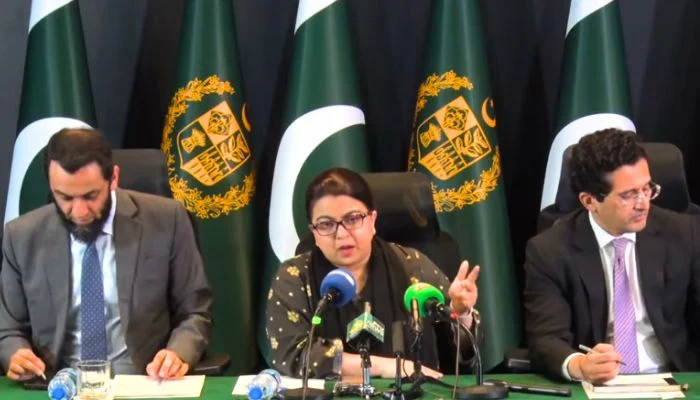
IT Minister Shaza Fatima Khawaja outlined the registration process, which requires applicants to text their CNIC number — sent from a SIM registered under their own name — to 9771, followed by their vehicle’s registration number, province and registration date. Once registered, users can request a fuel token by texting “TOK” to the same number at the pump.
Khawaja said the government had eased ownership requirements for two- and three-wheelers, noting that many such vehicles in Pakistan change hands informally. “We have delinked the owner for two-wheeler and three-wheeler. It is still necessary for the car,” she said. Registration for cars will still require proof tied to the vehicle’s registered owner.
She cautioned citizens against sharing CNIC numbers or other personal data, stressing that the government would never request additional information or charge a fee, and said authorities were working with social media platforms to guard against fraud. Khawaja said the rollout could take a week to ten days to stabilize and that the system would be refined as issues surface.
It is the second fuel subsidy Islamabad has introduced this year. In April, federal and provincial governments rolled out a broader package of relief measures — including fare freezes and free transport in some areas — as the war’s early stages first pushed up global oil prices.
Copyright © 2021 Independent Pakistan | All rights reserved