By Staff Reporter
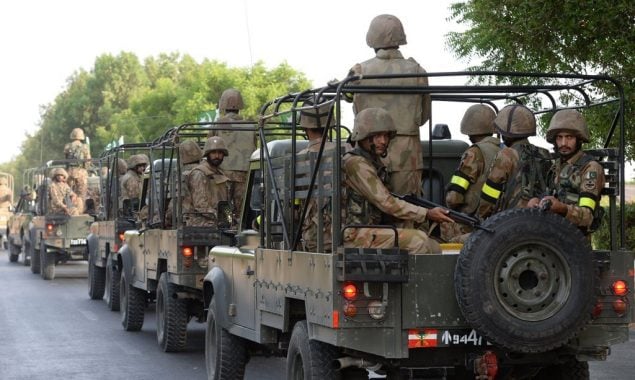
ISLAMABAD: Six soldiers were martyred on Wednesday when an improvised explosive device struck their convoy in the northwestern province of Khyber Pakhtunkhwa, the military said, the latest in a wave of attacks that has made the region bordering Afghanistan the epicentre of Pakistan’s militant crisis.
The army’s media wing, the Inter-Services Public Relations directorate, said the blast happened on 17 September but did not specify the exact location. No group has claimed responsibility.
In a statement issued on late Thursday, the ISPR said the “six brave sons of soil rendered the ultimate sacrifice and embraced Shahadat” — using the Islamic term for martyrdom that has become standard in Pakistani military communications following attacks on security personnel.
The attack came as the army disclosed that ten militants had been killed in two separate operations elsewhere in the province over the preceding three days. Six were killed in North Waziristan, a former stronghold of militant groups near the Afghan frontier, after intelligence reports indicated fighters were present in the area. The ISPR said troops “effectively engaged” the militants’ position, and that an intense exchange of fire followed before all six were killed. A further four militants died in a separate encounter in Hangu district. Weapons and ammunition were recovered from the dead in both operations, and the military said mopping-up operations were continuing to clear any remaining fighters from the areas.
The military described those killed as members of “Fitna al-Khawarij” — the term Pakistani authorities now use to refer to the Pakistani Taliban, formally known as Tehreek-e-Taliban Pakistan, and its affiliated factions. The ISPR statement went further, describing the group as “Indian-sponsored” and accusing New Delhi of backing the militants responsible for the recent unrest.
Khyber Pakhtunkhwa has for years borne the heaviest burden of a militant insurgency that intensified sharply after the Tehreek-e-Taliban Pakistan abandoned a ceasefire with Islamabad in late 2022. Pakistani officials maintain that TTP commanders plan and direct attacks from safe havens across the border in Afghanistan, and have repeatedly pressed the Taliban regime to move against them. The government in Kabul has consistently denied that Afghan territory is being used to stage attacks on Pakistan, a dispute that has poisoned relations between the two neighbours and triggered periodic cross-border military action.
The violence has continued largely unabated despite the mounting death toll on both sides. Pakistan endured its bloodiest year in more than a decade in 2025, with 3,413 people killed in conflict-related violence nationwide, according to figures compiled by the Islamabad-based Pakistan Institute for Conflict and Security Studies. That toll included 667 members of the security forces — the highest annual figure recorded since 2011 — alongside 580 civilians and 2,138 militants.
This year has brought little respite. Fifteen security personnel were killed in July when a suicide bomber and gunmen attacked a checkpoint in Tank district, while eleven police officers died last month in an assault on a police post in Hangu — the same district where militants were killed in this week’s operations.
Separate research published by the Centre for Research and Security Studies found that Khyber Pakhtunkhwa and the neighbouring province of Balochistan accounted for nearly 96 per cent of all violence-related deaths recorded nationally in the second quarter of 2026, with Khyber Pakhtunkhwa the worst affected of the two. More than 61 per cent of the quarter’s fatalities — 475 deaths — were recorded in the province, compared with 34 per cent, or 265 deaths, in Balochistan. Khyber Pakhtunkhwa also recorded the highest number of violent incidents nationally, with 151 cases amounting to 57 per cent of the total, ahead of Balochistan’s 94 incidents, or 35 per cent.
Analysts and security researchers have linked the deterioration to the Taliban’s return to power in Afghanistan in 2021, which is widely seen to have emboldened militant groups operating along the porous border and given them greater freedom of movement.
The ISPR said the campaign against militancy would continue “at full pace” under what the military calls Azm-e-Istehkam, a counter-terrorism framework approved by the Federal Apex Committee on the National Action Plan, Pakistan’s principal civil-military body for coordinating the fight against extremism. The operation is intended, the statement said, to eliminate “foreign-sponsored and supported terrorism” from the country. The military added that the deaths of the six soldiers had reinforced the armed forces’ “unwavering commitment” to defending the country.
Copyright © 2021 Independent Pakistan | All rights reserved