By Staff Reporter
ISLAMABAD: Pakistan has carried out airstrikes on eastern Afghanistan, killing at least three, in a move that threatens to reignite conflict between the neighbours after nearly three months of relative calm, Reuters reported on Monday.
The strikes, which came in the early hours of Monday, destroyed a house in Kunar province, killing three and wounding four others. Hamdullah Fitrat, the Taliban’s deputy spokesperson, said two further locations in Barmal district of Paktika province were also bombed, destroying a shop and an unoccupied house. No casualties were reported there.
Pakistan’s military did not immediately respond to a request for comment. Afghan media said the Kunar strike hit the Nurgal district. Kabul’s authorities condemned the attack and said they would respond “at an appropriate time and place”, according to reports.
The strikes came days after a devastating assault on a police compound in Kohat, in Pakistan’s north-western Khyber Pakhtunkhwa province, and after Islamabad publicly warned Kabul that it had “both the will and the capability to eliminate terrorist threats wherever they are”.
On Friday, an explosives-laden vehicle was driven into the gate of the Old Police Lines in Kohat as worshippers gathered for prayers at a mosque inside the compound. Gunmen then stormed the complex, which houses the district police headquarters as well as offices of the Counter Terrorism Department and the Special Branch. A second suicide bomb was detonated near the Special Branch building during the ensuing gun battle.
Security forces ended the siege on Saturday after roughly 20 hours, killing eight attackers. Officials gave differing casualty figures. Pakistani authorities put the death toll at 23, including 17 police personnel and six civilians, and one local report on Monday said it had risen to 24. An AFP report, citing a senior police official speaking anonymously, said at least 31 people had died. More than 100 people were injured, most of them police officers.
Among the dead were a superintendent of police, a deputy superintendent and an inspector. The Additional Inspector General of the Counter Terrorism Department, who led the operation, was injured when militants threw a grenade at him.
Ittehad-ul-Mujahideen Pakistan, a group linked to the commander Hafiz Gul Bahadur and to the Pakistani Taliban (TTP), claimed responsibility. Pakistani security sources said one of the suicide bombers had been identified as an Afghan national, Mutee-Ullah; the identity of the second was still being verified.
In a statement on Saturday, Pakistan’s information ministry called on the Taliban government to dismantle militant sanctuaries, recruitment and training networks on Afghan soil. It said the Taliban could not evade its counter-terrorism obligations under the 2020 Doha Agreement, and that “condemnation must be matched by concrete action”.
A deteriorating relationship
Relations between the former allies have been strained since February, when the two sides fought their worst clashes in years. The fighting followed a suicide bombing at a checkpoint in Bajaur district, in which 11 security personnel and a child were killed, and a series of Pakistani strikes on Afghan provinces. By the end of that month Pakistan’s defence minister had described the situation as “open war”.
Ceasefire talks in China in early April reduced the violence, though incidents did not stop entirely. Afghanistan launched drones against Pakistan in July, which Islamabad said its forces intercepted and shot down.
The escalation came as security forces reported a run of operations across the country.
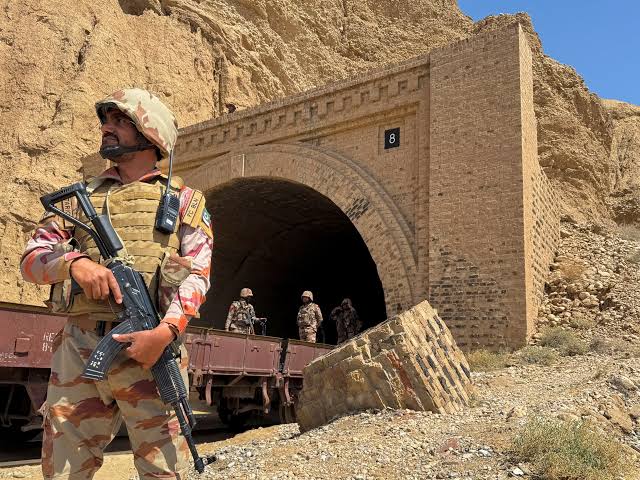
In Balochistan’s Panjgur district, security forces killed four militants in the Aphan-e-Koh and Prom areas on Monday, security sources said. They said a large cache of weapons and ammunition was recovered and that forces would continue operations “until the last terrorist is eliminated”. The operation was carried out under Operation Radd-ul-Fitna 3, the current campaign in the province. The sources described the dead as members of “Fitna al-Hindustan”, the Pakistani state’s term for Baloch militants, whom it accuses of acting on behalf of India.
On Sunday, the military’s media wing, the Inter-Services Public Relations (ISPR), said security forces had killed five militants and freed 23 hostages near Kalat, after militants set up a checkpoint on the N-25 highway, which links Karachi with Quetta and Chaman, overnight on 18-19 September. The ISPR said the group had intended to abduct travellers, extort money and seize vehicles. Six trucks, three buses and two cars were recovered, along with weapons, ammunition and explosives. Prime Minister Shehbaz Sharif praised the operation.
In Khyber Pakhtunkhwa’s Hangu district, eight militants were killed on Sunday in an exchange of fire with a security forces convoy, the ISPR said. Six soldiers also died, among them Captain Abuzar Farooq, 23, from Gujranwala, and Lieutenant Sheraz Babar, 22, from Chakwal, whom the military said were leading their troops from the front. The ISPR described the militants as belonging to “Fitna al-Khawarij”, its designation for the TTP.
Pakistan has seen a surge in militant violence, particularly in Khyber Pakhtunkhwa and Balochistan, since the Taliban returned to power in Afghanistan in 2021.
Figures from the Pakistan Institute for Conflict and Security Studies (PICSS) show that mainland Khyber Pakhtunkhwa, excluding the merged districts, recorded 54 militant attacks in August, up from 36 in July, an increase of 50 per cent. Deaths from those attacks fell from 69 to 44, and injuries from 96 to 70, a decrease of 27 per cent.
July was the deadliest month of 2026, according to the think tank, with at least 606 people killed. Balochistan remained the worst-affected province in August, though its overall death toll fell by 48 per cent.
Copyright © 2021 Independent Pakistan | All rights reserved