By Staff Reporter
ISLAMABAD: Pakistan has joined seven other Muslim-majority nations in issuing a stark warning to Israel, demanding it “immediately fulfil its outstanding commitments” under the first phase of the US-brokered plan to end the war in Gaza, as the fragile truce shows mounting signs of collapse.
The joint statement, released on Tuesday and attributed to the foreign ministers of Pakistan, Egypt, Turkey, Indonesia, Jordan, Qatar, Saudi Arabia and the United Arab Emirates, was issued after the ministers gathered on the sidelines of the 81st session of the UN General Assembly in New York. It represents one of the most coordinated diplomatic interventions yet from the bloc since the ceasefire took hold nearly a year ago.
The eight ministers called on Israel to guarantee the “immediate, safe and unhindered” delivery of humanitarian aid and early recovery supplies, and to facilitate the rehabilitation of Gaza’s shattered infrastructure. They stressed what they called the “imperative of preserving the ceasefire and ending all violations” — language that reflects growing alarm at how far the truce has drifted from its original terms.
The intervention comes almost a year after Donald Trump unveiled his 20-point peace plan in October last year, following a ceasefire deal that halted, on paper at least, two years of devastating Israeli bombardment that began after the Hamas-led attacks of 7 October 2023. That plan envisaged the phased delivery of humanitarian aid, civilian administration of Gaza by Palestinian technocrats, the disarming of Hamas and a full Israeli military withdrawal.
Almost twelve months on, much of that vision remains unrealised. The body of technocrats tasked with administering Gaza, known as the National Committee for the Administration of Gaza, has yet to set foot in the territory it is meant to govern. In August, Israel rejected a follow-up plan — endorsed by Hamas the previous month — under which the group would have surrendered its weapons to a nascent Palestinian governing authority. Israeli prime minister Benjamin Netanyahu, facing pressure from his right-wing coalition partners ahead of elections, told his cabinet that the military “will not carry out any withdrawal until Hamas is genuinely disarmed” and would “continue to thwart threats against our forces and our citizens”.
The ministers’ statement made clear that they regard the stalled road map — covering decommissioning, the deployment of an International Stabilisation Force, the handover of administrative responsibility to the National Committee, and the launch of reconstruction — as inseparable from the wider plan, rather than a discretionary add-on that Israel can decline at will.
Violence on the ground
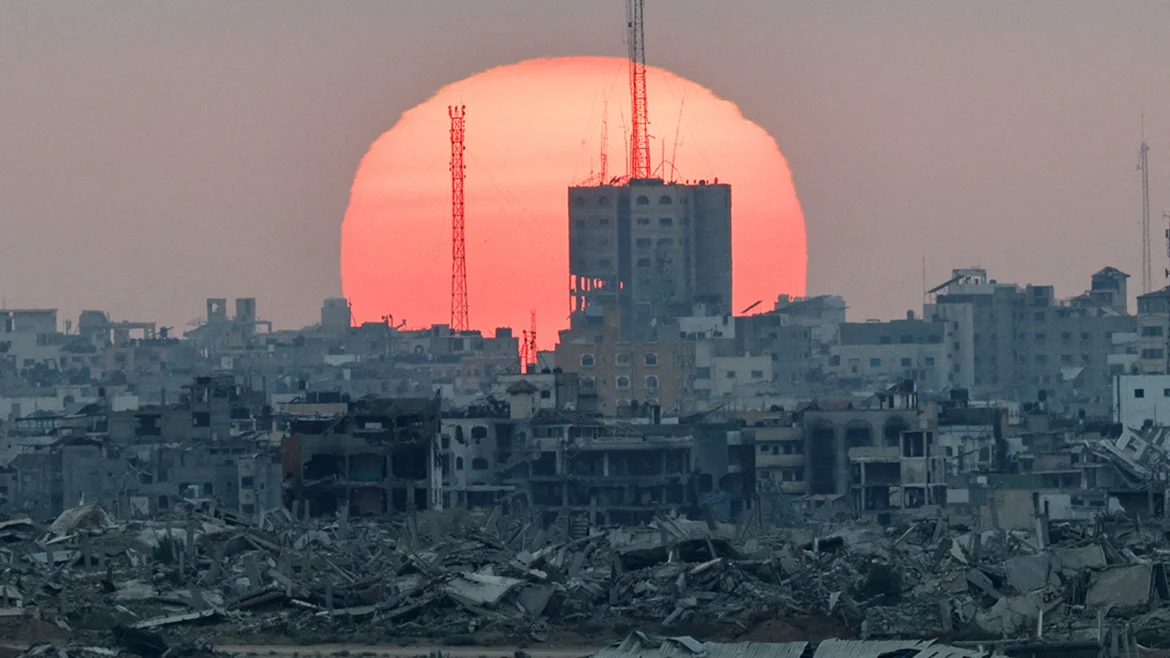
The diplomatic pressure comes against a backdrop of continuing bloodshed. Gaza’s health ministry says Israeli fire has killed more than 1,300 Palestinians since the October ceasefire took effect — a toll that includes children killed in strikes on displacement camps and residential areas, and which continues to climb by the week. The ministry’s most recent figures put the overall death toll since October 2023 at close to 74,000, with tens of thousands more wounded. Aid organisations operating in the territory say they continue to face severe obstacles in getting relief supplies to a population that remains almost entirely displaced.
The ministers reserved some of their strongest language for developments in the occupied West Bank, reiterating their “categorical rejection” of any effort to expel or forcibly displace Palestinians, or to alter the territorial and demographic character of the Occupied Palestinian Territory. They condemned what they described as “illegal measures aimed at consolidating Israeli control and annexation” — namely accelerating settlement expansion, land confiscation, home demolitions, and settler violence — and demanded their “immediate reversal”.
The statement also voiced “grave concern” over actions the ministers said were undermining the historic status quo governing Muslim and Christian holy sites in Jerusalem, a sensitive flashpoint that has repeatedly threatened to widen the conflict beyond Gaza.
In a rare note of approval for Western policy, the ministers welcomed recent measures taken by the United Kingdom in response to settlement activity, alongside what they termed “broader national and European efforts” to restrict trade with settlements — and called for further action to hold those responsible for settler violence to account.
Despite the criticism of Israel’s conduct, the statement struck a notably different tone towards Washington. The ministers commended the “leadership” of President Trump and the role of the United States in driving the Comprehensive Plan forward, calling for “sustained and active” American engagement to ensure all parties meet their obligations and that obstacles to the road map’s implementation are overcome.
“Tangible progress on the ground will strengthen the credibility of the Board of Peace and the authority of the plan and create deeply needed momentum,” the statement said.
The eight nations reaffirmed their intention to keep working with Washington, the Board of Peace, the Palestinian Authority and other relevant parties to advance the plan, describing the eventual goal as a “credible and irreversible pathway” toward Palestinian self-determination and a “sovereign, viable and independent Palestinian State with East Jerusalem as its capital” — the long-standing two-state formula that continues to underpin international mediation efforts, even as facts on the ground move in the opposite direction.
Dar presses case at OIC gathering
Pakistan’s deputy prime minister and foreign minister, Ishaq Dar, had made a similar case a day earlier at a meeting of the Organisation of Islamic Cooperation’s Committee of Six on Palestine, also held in New York. Describing Israeli settler violence, annexation policies in the West Bank and violations of the Gaza ceasefire as “flagrant violations of international law”, Dar told the gathering that the Palestinian cause remained “central to the OIC and the collective conscience of the Muslim Ummah”.
He said the ceasefire in Gaza was being breached “on an almost daily basis” and warned that the humanitarian situation across the occupied Palestinian territories remained dire, with the security environment “extremely fragile”. While crediting the diplomatic efforts of the United States, Egypt, Qatar and Turkey in advancing the Comprehensive Plan — endorsed by UN Security Council Resolution 2803 — Dar cautioned that “serious challenges still remain”.
He reserved particular criticism for developments in the West Bank, where he said settlement activity, settler violence and annexation policies continued to threaten the “territorial integrity and contiguity” of the Occupied Palestinian Territory and undermine the prospects for a viable Palestinian state. Pakistan, he said, continued to “strongly condemn” Israeli actions at al-Aqsa Mosque and al-Haram al-Sharif, including incursions by settlers he characterised as extremist.
Dar set out six priorities he said should guide the OIC’s continuing engagement: preserving the status quo at Jerusalem’s holy sites; rejecting settlement expansion and forced displacement; supporting full implementation of the Gaza peace plan and Resolution 2803; ensuring Gaza’s reconstruction remains Palestinian-led with the Palestinian Authority at its centre; backing accountability for violations of international law; and sustaining a “credible, irreversible and time-bound” political process toward Palestinian statehood based on pre-1967 borders, with Jerusalem as its capital, alongside support for full Palestinian membership of the United Nations.
Dar’s remarks came against a backdrop of accelerating Israeli settlement activity in the West Bank. Israel has recently approved 2,167 additional housing units under its contentious E1 settlement plan, bringing the total number of planned units in the scheme to 3,401 — a move Palestinians and a number of governments say threatens to sever the territorial contiguity that any future Palestinian state would depend on.
The United Nations has separately documented a sharp escalation in settler violence, recording more than 1,600 incidents resulting in Palestinian casualties or property damage across 275 communities between January and mid-September, with more than 2,600 Palestinians displaced as a direct result of settler attacks and related restrictions on movement.
Copyright © 2021 Independent Pakistan | All rights reserved