By Staff Reporter
ISLAMABAD: Prime Minister Shehbaz Sharif has renewed Pakistan’s pledge to defend Saudi Arabia “to any extent” against Houthi attacks, using a message marking the kingdom’s National Day to underline a defence partnership that is being tested by the most serious escalation in the Yemen conflict in years.
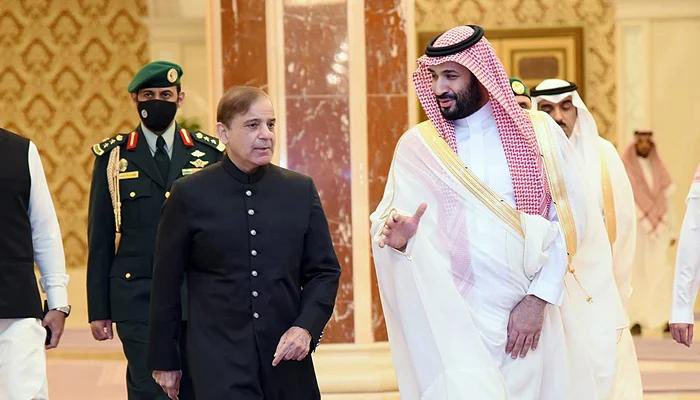
Sharif’s message, posted on Wednesday from New York, where he is attending the 81st session of the UN General Assembly, congratulated Saudi Arabia on its “remarkable journey of progress and transformation” as the kingdom marked 96 years since its unification under King Abdulaziz. But the tone shifted quickly from celebration to solidarity, with the prime minister condemning what he called a “reprehensible” attempted drone attack by the Houthis on Mecca and declaring that Pakistan stood “unwaveringly, shoulder to shoulder” with Riyadh in protecting its sovereignty.
“Any threat to the sanctity and security of the Haramain Sharifain deeply wounds the sentiments of Muslims across the world,” Sharif wrote, using the honorific term for the two holy mosques in Mecca and Medina.
The drone incident he referred to took place on 15 September, when the Saudi-led coalition said its air defences intercepted and destroyed a Houthi drone south of Mecca before it could enter the city’s restricted airspace. Coalition spokesman Major General Turki al-Malki described it as only the second attempt by the group to target the holy city, after a ballistic missile launch in 2017, and warned that the security of the two mosques was a “red line” the kingdom would defend by whatever means necessary. The Houthis rejected the accusation outright, with a senior official on the group’s Supreme Political Council dismissing it as a fabrication designed to discredit the movement politically, while their military spokesman said the group’s targets that week had been Saudi oil facilities and military bases “far removed from the holy places.”
Whatever the truth of that particular claim, the exchange came amid a rapid and unmistakable escalation in hostilities between the Houthis and Saudi Arabia. Ballistic missile and drone strikes on the Saudi cities of Khamis Mushait, Abha and Taif injured 13 civilians the day before the Mecca incident. Days later, in the early hours of 20 September, Houthi forces struck King Khalid International Airport in Riyadh itself, igniting a fuel depot and sending a column of black smoke over the Saudi capital in the first direct targeting of the city since the fighting intensified. The group said the strike, along with a claimed attack on an Aramco facility at Yanbu, was retaliation for a Saudi assault on Sanaa. No casualties were reported, but the psychological impact of a strike on one of the region’s busiest airports was considerable, prompting the US embassies in Jerusalem, Oman and Iraq to issue security alerts for American nationals over fears of wider escalation.
The renewed fighting has a strategic dimension well beyond the immediate exchange of fire. The Houthis, who control much of northern Yemen and are aligned with Iran, have in recent months seized territory along the Red Sea coast including the port of Mokha, tightening their grip on the Bab al-Mandeb Strait, a chokepoint that has become critical to Saudi oil exports since Iran’s restrictions on the Strait of Hormuz forced Riyadh to reroute crude through the Red Sea. A blockade declared by the group against Saudi shipping in July, combined with the loss of the East-West pipeline after a separate attack blamed on an Iran-backed militia in Iraq, has already pushed oil prices sharply higher and placed millions of barrels a day of Saudi export capacity at risk.
It is against this backdrop that Pakistan’s defence commitments to Saudi Arabia have taken on new significance. Islamabad and Riyadh signed the Strategic Mutual Defence Agreement in September last year, under which an attack on either country is to be treated as aggression against both. That bilateral arrangement was widened last month into the Makkah Joint Defence Agreement, signed on 7 August by Pakistan, Saudi Arabia and Turkey, which commits all three states to regard an armed attack on any one of them as an attack on all. The precise operational detail of either pact — what military support would actually be triggered, and under what circumstances — has not been made public, and Sharif’s message on Wednesday did not announce any new deployment or say whether Riyadh had formally requested Pakistani assistance.
That has not stopped senior figures in Islamabad from speaking in increasingly firm terms. Lieutenant General Ahmed Sharif Chaudhry, the director general of Inter-Services Public Relations, said on 18 September that Pakistan would go “to any extent” to defend Saudi Arabia and described the country’s commitment to the kingdom’s security as unconditional, adding that Pakistan stood with Riyadh “both diplomatically and physically.” Defence Minister Khawaja Asif has likewise said Pakistan would act “practically and diplomatically” alongside Saudi Arabia should the confrontation with the Houthis worsen further. Turkey, too, has signalled it stands ready to assist militarily under the trilateral pact, with foreign minister Hakan Fidan noting that Riyadh may have genuine defence needs given the scale of the attacks it is absorbing.
Sharif’s message also praised the “dynamic and visionary leadership” of Crown Prince Mohammed bin Salman, under whom he said Saudi Arabia continued to make “impressive strides towards greater prosperity, modernisation and innovation,” a reference to the kingdom’s Vision 2030 development programme. He framed the two defence agreements as evidence that the historic brotherhood between the two countries was maturing into “an even stronger strategic partnership, underpinned by our shared commitment to peace, security and the unity of the Muslim Ummah,” and closed his message with the phrase “long live Pakistan-Saudi Arabia brotherhood.”
President Asif Ali Zardari sent his own message of congratulations on Wednesday, in letters addressed separately to King Salman bin Abdulaziz and Crown Prince Mohammed bin Salman. According to a statement from the presidency, Zardari described the two defence pacts as milestones that had “further strengthened the strategic dimension of the longstanding Pakistan-Saudi partnership” and said the relationship between the two countries was built on “deep-rooted ties of faith, shared history, friendship, mutual trust and solidarity.” He added that he expected the relationship to “continue to deepen and expand across diverse areas of mutual interest” in the years ahead.
The diplomatic messaging coincided with a meeting on Tuesday at the United Nations, where foreign ministers from Pakistan, Saudi Arabia, Turkey and Egypt issued a joint statement affirming Riyadh’s right under international law to defend itself, while calling for the wider regional crisis to be resolved through diplomacy rather than further military escalation.
The conflict Pakistan has now bound itself to through treaty forms one strand of a considerably larger regional confrontation that has unfolded since US and Israeli strikes on Iran in February reshaped the security picture across the Gulf and the Red Sea. Saudi Arabia has found itself simultaneously managing disruption to the Strait of Hormuz, an emboldened Houthi movement on its southern border, and now direct strikes on its own capital — a combination that has left Riyadh notably more willing to formalise external defence guarantees than at any point in recent memory. Whether Pakistan’s pledge to stand “shoulder to shoulder” with the kingdom will be tested by anything beyond rhetoric remains, for now, an open question.
Copyright © 2021 Independent Pakistan | All rights reserved