By Staff Reporter
ISLAMABAD: The United Nations Security Council has condemned last week’s twin terrorist attack on a police compound in north-west Pakistan, demanding that those responsible be tracked down and brought to justice, as the country’s military pressed ahead with retaliatory strikes against suspected militant hideouts across the Afghan border.
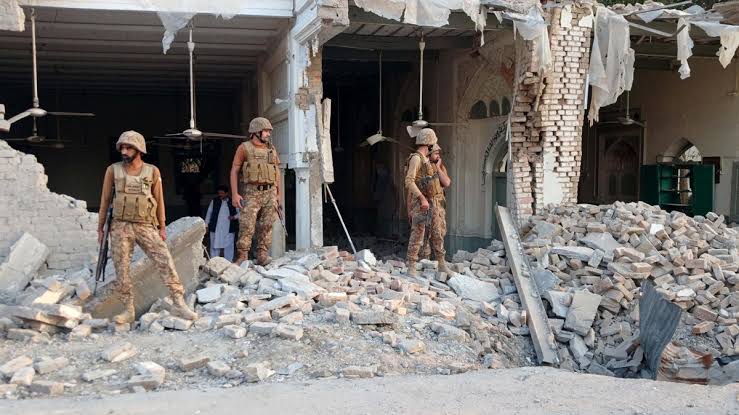
In a statement released on Wednesday, the 15-member council described the September 18 assault in Kohat, Khyber Pakhtunkhwa, as a “heinous and cowardly” act, condemning it “in the strongest terms”. The attack, which struck a mosque inside the city’s Police Lines compound during Friday prayers, killed at least 23 people, among them 17 police officers and six civilians, and left scores more wounded.
The council’s statement was issued by its president for September, Jérôme Bonnafont, France’s permanent representative to the UN, on behalf of all member states.
A coordinated assault during Friday prayers
According to police accounts, the attack began when militants detonated an explosives-laden vehicle close to a mosque inside the old Police Lines complex as worshippers gathered for Friday prayers. Gunmen then forced their way into the compound, opening fire on police facilities in scenes that unfolded over several hours before security forces regained control.
Khyber Pakhtunkhwa police said eight attackers were killed in the fighting that followed, as officers, Elite Force commandos and Counterterrorism Department teams fought to clear the site. A clearance operation launched in the aftermath of the attack was declared complete on Saturday, with police confirming that key parts of the compound’s buildings had been secured.
Responsibility was claimed by Ittehadul Mujahideen, a militant faction led by Hafiz Gul Bahadur that has been linked by authorities to networks affiliated with the outlawed Tehrik-i-Taliban Pakistan.
The province’s chief minister, Sohail Afridi, had called for a detailed report into the incident on the day it occurred, describing the targeting of civilians as “deeply regrettable and unacceptable”.
Council calls for accountability
In its statement, the Security Council underlined the need to hold the “perpetrators, organisers, financiers and sponsors” of the attack accountable, and urged all states to cooperate actively with the Pakistani government in bringing them to justice, in line with their obligations under international law and relevant council resolutions.
Members offered their condolences to the families of those killed and to the government and people of Pakistan, and wished a swift recovery to those wounded in the blast.
The council reiterated its long-standing position that terrorism “in all its forms and manifestations” represents one of the gravest threats to international peace and security, and that no act of terrorism can be justified “regardless of its motivation, wherever, whenever and by whomsoever committed”. It reaffirmed the obligation of all states to combat such threats by every means available under the UN Charter, while upholding international human rights, refugee and humanitarian law.
The council’s intervention echoes past statements issued after major attacks on Pakistani soil, and comes against the backdrop of a marked rise in militant violence in Khyber Pakhtunkhwa over the past two years.
Wednesday’s condemnation revived memories of an earlier atrocity at the same site. In 2010, a remote-controlled bomb tore through a police colony situated just behind the Kohat Police Lines, killing 20 people — most of them relatives of police officers — and injuring more than 90. That attack also struck during Ramadan, detonating as families gathered to break their fast at Iftar.
Pakistan strikes back across the border
The Kohat bombing has since triggered a rapid and forceful response from Islamabad. On Monday, Pakistan’s armed forces carried out airstrikes on what the information ministry described as terrorist camps and hideouts in the border region with Afghanistan, saying more than 28 militants, including several intended suicide bombers, had been killed.
Officials said the strikes followed a targeted ground operation conducted a day earlier in Kohat and Hangu districts, in which nine militants were reported killed. The ministry said the air campaign had destroyed three targets, among them what it described as a training centre for suicide bombers, along with substantial stockpiles of weapons and ammunition.
The strikes have not gone unanswered. Afghanistan’s Taliban administration said the raids, which it located in the eastern provinces of Kunar and Paktika, had killed three civilians and wounded four others, a toll subsequently corroborated by the United Nations. A spokesman for the Kabul government condemned the strikes and warned of a forthcoming response, deepening a cycle of cross-border hostility that has cost hundreds of lives since February, when Afghanistan carried out retaliatory strikes of its own following earlier Pakistani action inside its territory.
The exchange underscores a rapidly deteriorating relationship between the two neighbours. Islamabad has for years pressed the Taliban government to deny sanctuary to militant groups operating from Afghan soil, accusing Kabul of tolerating, if not actively sheltering, fighters who cross the border to strike Pakistani security forces. The Taliban administration has consistently denied the charge, insisting Afghan territory is not being used to stage attacks against Pakistan.
The violence has continued to claim lives on both sides of the border in the days since the Kohat attack. Six Pakistani security personnel, including two army officers, were killed on Sunday in a clash with militants in Hangu district, close to the frontier — one of several deadly skirmishes that have punctuated an already volatile fortnight for Pakistan’s north-west.
Military vows resolve
A day before the airstrikes were launched, Pakistan’s Chief of Defence Forces and Chief of Army Staff, Field Marshal Asim Munir, travelled to Peshawar to visit the army’s Corps Headquarters, where he was briefed on the security situation across Khyber Pakhtunkhwa and on the progress of ongoing counterterrorism operations.
According to a statement from the military’s media wing, the Inter-Services Public Relations directorate, the field marshal told commanders that the armed forces remained resolute in their determination to defeat terrorism and to secure lasting peace and stability in the province, a message that has been repeated by senior officers in the wake of successive attacks in the region.
The visit and the subsequent strikes reflect a broader pattern in Pakistan’s response to militant violence in recent years: swift, high-level military engagement in Khyber Pakhtunkhwa, followed by cross-border action against sites Islamabad blames for orchestrating attacks — even as questions persist over how far such strikes can curb a resurgent insurgency along one of the world’s most volatile frontiers.
Copyright © 2021 Independent Pakistan | All rights reserved