By Staff Reporter
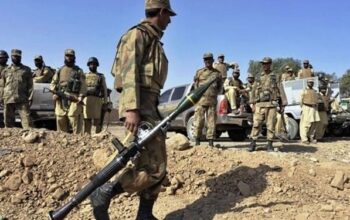
LAHORE: The Punjab government has asked Islamabad to deploy paramilitary Rangers across four districts in the province, as Pakistan’s security establishment braces for a mass opposition march on the capital that officials fear could draw as many as two million people onto the streets.
In a formal request to the federal interior ministry, the Punjab Home Department asked for Rangers companies to be stationed in Rawalpindi, Attock, Jhelum and Mianwali from 22 September until 5 October. The provincial government also separately requested army deployment in Rawalpindi, with both requests tied to the law-and-order concerns surrounding the long march.
The scale of the request is considerable: three Rangers companies for Rawalpindi, including one dedicated to the city itself and two for the garrison town of Taxila; five wings for Attock, the strategically vital district bordering Khyber Pakhtunkhwa; and one company apiece for Jhelum and Mianwali. The deployment has been sought under Article 245 of the constitution, alongside anti-terrorism legislation and the Pakistan Rangers Ordinance of 1959 — the same legal architecture used in the past to justify military involvement in civilian policing during periods of acute unrest.
The request follows a meeting of the Standing Committee of the Cabinet on Law and Order in Lahore on 20 September, at which officials reviewed intelligence assessments and an Islamabad High Court order connected to the anticipated protest. Having “considered threadbare” the security picture, the committee authorised the requisition to be sent to the interior ministry, with instructions that the ministry inform the Punjab Home Department once action had been taken.
A capital under siege
The trigger for this extraordinary mobilisation is a march called by Pakistan Tehreek-e-Insaf, the party founded by Imran Khan, for Saturday 27 September. The party says the demonstration is intended to press for Khan’s release from Adiala Jail in Rawalpindi, where he has been held since his conviction in 2023 on charges his supporters insist are politically motivated.
PTI leaders have suggested the march could draw close to two million participants, a figure that, if realised even in part, would represent one of the largest opposition mobilisations Pakistan has witnessed in years. The request from the Punjab Home Department for the deployment came as the party announced a nationwide march towards Islamabad in support of its demands, including the release and treatment of Khan.
The authorities’ response has been correspondingly vast. Rawalpindi Police has requested an additional 9,000 personnel to reinforce its local force, while more than 30,000 security personnel are being deployed in Attock alone — the district that forms the principal artery connecting Khyber Pakhtunkhwa, the province PTI governs, with the rest of Punjab and the capital. Islamabad Police, meanwhile, has requested 18,000 personnel from Punjab and Sindh, with 16,000 sought from Punjab Police and 2,000 from Sindh Police.
Preparations on the ground in Rawalpindi and Islamabad have taken on the character of a city readying for siege rather than a demonstration. Large spiked containers, fitted with eight-inch spikes, have been installed at entry points across the twin cities, including Faizabad, Chungi No. 26, Rawat, Chakri, Adiala Road, Pirwadhai, Bharakahu and the 17-Mile interchange, with entry routes being sealed off entirely. Authorities are supplementing physical barricades with aerial surveillance, having pledged that monitoring will also be carried out through drones.
The strain on public services has been immediate. Emergency measures have been imposed at all hospitals in the twin cities, with leave cancelled for doctors, nurses and paramedical staff, while fresh contingents of Rangers and Punjab Constabulary have been called in alongside thousands of rubber bullets and tear-gas shells supplied to Rawalpindi and Islamabad police. Attock police have separately been provided with heavy Rangers contingents, armoured vehicles, prison vans and heavy weapons. Schools, colleges, hotels, markets and transport terminals across the area are expected to close, with commercial and social activity in Rawalpindi effectively paralysed from 21 to 27 September, according to local trade bodies.
Security around Adiala Jail itself — where Khan remains detained and where the party’s grievance is most acute — has been reinforced with what sources describe as Red Zone-style measures, echoing the fortification typically reserved for Islamabad’s most sensitive diplomatic and government enclave. Hotels and guesthouses across both cities are reportedly being searched as part of the operation, and officials have not ruled out suspending mobile phone services should the security situation deteriorate.
Roads sealed, routes severed
The physical geography of the crackdown extends well beyond the twin cities. From Wednesday evening, Pakistan’s National Highways and Motorway Police began closing major roads linking Khyber Pakhtunkhwa with Islamabad and Punjab. “From Wednesday evening, September 23, the M-1 motorway will remain closed to all types of traffic in both directions between the Islamabad toll plaza and Chach Interchange,” the motorway police said in an advisory, with Islamabad Police confirming the closure would take effect from 11pm.
Chach Interchange sits in Attock district, close to the boundary with Khyber Pakhtunkhwa, meaning the closure effectively severs the principal motorway approach to the capital for traffic travelling from Peshawar. Further restrictions apply to the M-14, which links the Islamabad region with Dera Ismail Khan in southern Khyber Pakhtunkhwa, and to the N-5 highway at Attock Khurd, where the road crosses the Indus River between the two provinces. The Hazara Motorway serving the province’s north, along with the Rawalpindi–Kohat and Abbottabad–Hassanabdal roads, are also affected. Notably, the M-2 motorway connecting Islamabad with Lahore is understood to remain open, suggesting the restrictions are targeted specifically at severing the province from which the march is expected to originate rather than isolating the capital entirely.
None of the official advisories has stated explicitly why the roads are being closed, though the timing — immediately ahead of the planned march — has left little doubt among Pakistani commentators about the intended purpose.
Escalating rhetoric and a wave of arrests
The security build-up has been accompanied by a sharply deteriorating political atmosphere. Interior Minister Mohsin Naqvi has repeatedly and publicly warned PTI against proceeding, declaring at a press conference in Lahore this week that anyone attempting to “storm” Islamabad would be dealt with by an “iron hand”. Naqvi said the government would take “every possible action within the law” against those who tried to force their way into the capital, while urging the party that there remained time to step back “from the dead end”.
The minister’s warning has been paired with what PTI describes as a sweeping crackdown against its membership. Gohar Ali Khan, the party’s chairman, has alleged that five PTI members of the National Assembly, a senator and a Khyber Pakhtunkhwa provincial minister have been arrested, along with roughly 1,500 party workers, with further arrest lists reportedly being prepared. The party has characterised the scale of the detentions as unacceptable given that PTI currently governs Khyber Pakhtunkhwa province. Gohar has said his own recent talks with Naqvi collapsed after the minister insisted the party withdraw its call for the 27 September protest altogether — a demand PTI says only Khan himself has the standing to make.
The confrontation carries an especially heavy precedent. PTI’s last major push towards the capital, the Haqeeqi Azadi “Final Call” march of November 2024, ended in violence when a vehicle rammed into a crowd, killing at least six people, including four security personnel, amid clashes between demonstrators and police. The government denied that live ammunition had been used against protesters, and Naqvi has since used the anniversary of those deaths to criticise the Khyber Pakhtunkhwa government, saying no provincial minister had attended the funerals of the security personnel killed. That episode, still fresh in the public memory, has coloured much of the current build-up, with Naqvi’s warnings this week widely read as a signal that authorities intend to prevent any repeat of protesters breaching the capital’s approaches, whatever the cost.
A deployment already under way
Wednesday’s Rangers request builds on security measures already put in place over recent weeks. In August, the federal government authorised the deployment of three companies of the Pakistan Army to Rawalpindi for a six-month period to perform what officials described as “sensitive security duties” and to respond to unforeseen developments — a decision taken more than a month before PTI formally announced its march date. Under that arrangement, army units were placed at the disposal of the Rawalpindi district administration, tasked with duties as assigned by civilian authorities.
Such requests are not without precedent in Punjab. Provincial administrations have previously invoked Article 245 to bring in army assistance during Muharram religious processions, election periods and moments of heightened terrorism alerts. What distinguishes the current mobilisation is its scale and its explicit, stated purpose: containing a specific, named political demonstration rather than responding to a security threat of uncertain origin.
Copyright © 2021 Independent Pakistan | All rights reserved