By Staff Reporter
ISLAMABAD: The government has authorised the deployment of Pakistan Rangers across Islamabad Capital Territory and several districts of Punjab, running from 20 September to 5 October, in anticipation of a nationwide protest called by Pakistan Tehreek-e-Insaf (PTI), the party founded by the jailed former prime minister Imran Khan. The move comes as major motorways linking the capital to the rest of the country remain closed, supporters and relatives of Khan are held in detention, and the government and opposition trade accusations over secret talks that neither side will fully confirm.
According to a notification issued by the Ministry of Interior and Narcotics Control, the Rangers deployment was authorised pursuant to requests from the Chief Commissioner of Islamabad Capital Territory and the Home Department of the Government of Punjab, under Sections 7(b) and 10 of the Pakistan Rangers Ordinance, 1959, and Sections 4 and 5 of the Anti-Terrorism Act, 1997. The notification states that troops may respond in self-defence to any threats or violent activity encountered in the course of their duties, in line with existing rules and regulations. The interior ministry has separately directed that Rangers and police take all necessary counter-action, in self-defence, should disruptive or armed groups mount attacks.
Punjab’s provincial government had asked Islamabad on Wednesday to extend the Rangers deployment into Rawalpindi, Attock, Jhelum and Mianwali, to help police maintain order between 22 September and 5 October.
PTI has called for protests across the country on Saturday, culminating in a march on the capital, to demand Khan’s release from jail and what it describes as the restoration of constitutional government. The 73-year-old former prime minister has been imprisoned since 2023 and faces a string of legal cases; his party has spent much of the intervening period campaigning, largely without success, for his release.
Roads cut, gatherings banned
The authorities’ response has, by any measure, been sweeping. Punjab has imposed a 13-day ban on public gatherings across the province and prohibited the incitement of “unlawful assembly.” A parallel ban under Section 144 of the penal code has been in force in Islamabad for two months, while gatherings in the federal capital are separately barred under the Peaceful Assembly and Public Order Act 2024 — legislation pushed through the National Assembly last year amid opposition protests over an earlier PTI rally.
Punjab’s government has also written to the federal interior ministry asking for mobile and internet services to be downgraded or jammed at specific locations in Rawalpindi and Attock on the day of the march, citing the “expected law and order situation.”
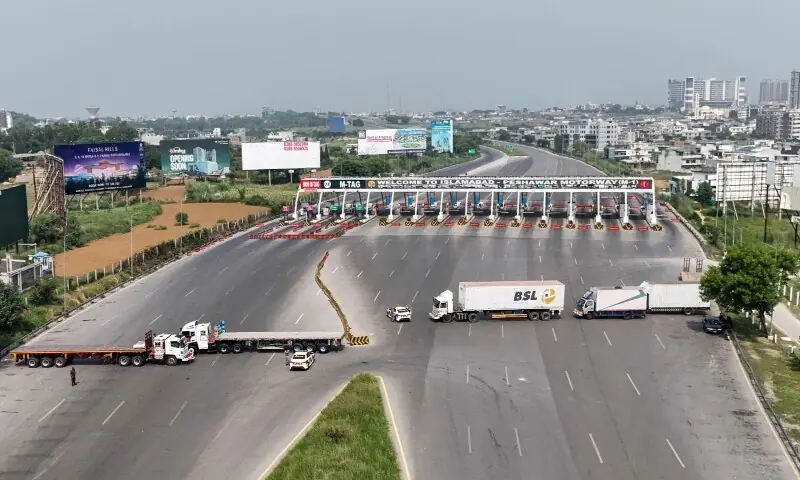
On the roads, the disruption is already substantial and, by Thursday, the subject of open dispute between officials and reporters on the ground. The National Highways and Motorway Police confirmed that the M-1 motorway has been closed in both directions between Swabi and the Islamabad Toll Plaza, with southbound traffic diverted at the Swabi Interchange, while the E-35 Hazara Motorway was also closed in both directions between Jharikas and Burhan due to the “law-and-order situation.” The M-14 motorway has been shut along its entire Hakla-to-Yarik stretch, the M-2 has seen heavy vehicles barred from travelling north into Islamabad from Kot Momin, and restrictions on the N-5 Grand Trunk Road at Attock Khurd have forced diversions through side routes.
Motorway police put the overall security effort at more than 22,000 personnel in the capital, with roughly 1,200 shipping containers stationed at key junctions and entry points, and reinforcements — Rangers, Frontier Corps and police from other provinces — continuing to arrive. In Rawalpindi alone, more than 10,000 additional police have reportedly been assigned to checkpoints and blocking positions along routes into the twin cities.
Commuters in Haripur, Taxila, Hassan Abdal, Attock and along the Rawalpindi–Islamabad corridor have borne the brunt of the disruption, with routes blocked by containers and lengthy queues reported at several chokepoints. The Islamabad–Peshawar motorway was pictured on Thursday blocked by rows of trucks positioned by the authorities.
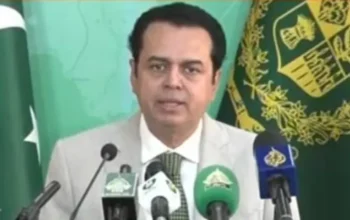
The scale of the closures has, however, become a point of contention in itself. At a press conference on Thursday, the Minister of State for Interior, Talal Chaudhry, insisted that all 125 roads into Islamabad remained open and dismissed reporters’ references to closures as based on outdated information. “You must have seen some WhatsApp status update, not the original situation,” he told journalists, adding that “no road was closed” and that “attackers cannot be allowed to attack here.” Fact-checks published by Pakistani outlets on Thursday found the claim did not hold up: motorway police records showed the M-1, M-14 and sections of the N-5 GT Road all still listed as closed at the time Chaudhry spoke.
Detentions and raids
PTI has meanwhile accused the authorities of a broader campaign against its members in the run-up to the march. The party says the homes and offices of local leaders have been targeted; in Mandi Bahauddin, it alleges police and plain-clothed personnel raided the residence of district senior vice-president Faisal Imran Gondal, damaging furniture, doors, windows and campaign material. PTI has also condemned what it calls a raid on the hujra, or guesthouse, of the former party leader Murad Saeed, alleging damage to property and harassment of his family. None of these allegations has been independently verified.
In Khyber Pakhtunkhwa, the only province PTI governs, the party says a wave of raids and arrests has hit lawmakers and provincial ministers. The party’s chairman, Barrister Gohar Ali Khan, told reporters in Lahore this week that four members of Khan’s family and eight PTI members of the National Assembly were under arrest, with several provincial ministers unaccounted for — a state of affairs he likened to governor’s rule in the province, despite no formal declaration to that effect. Asked about footage appearing to show a provincial minister being taken into custody by police, Chaudhry turned the question back on the provincial government, saying it had failed to protect its own minister. “If there are dozens of incidents every day, an incident involving a minister or anyone else can happen,” he said.
Among the most contentious detentions has been that of Aleema Khan, one of the former prime minister’s sisters, who was held in Lahore on 20 September under Section 3 of the Punjab Maintenance of Public Order Ordinance, 1960. The Lahore deputy commissioner’s order, citing police and intelligence reports, stated that her presence at any public place would pose “a grave threat to the public safety” and directed that she be detained for 30 days at Kot Lakhpat jail. Two more of Khan’s sisters, Uzma Khan and Noreen Niazi, were separately detained for 30 days under the same ordinance.
Denials, contacts and warnings
Whether the government and PTI are talking to each other at all has become almost as contested as the march itself. Gohar Ali Khan told reporters on Thursday that no formal negotiating committee exists and that reports of back-channel contact were untrue, though he added that opposition figures Allama Raja Nasir Abbas and Mahmood Khan Achakzai were free to pursue their own conversations with the government. “We do not have any formal committee for negotiations,” he said, while adding that given the “serious circumstances” surrounding the planned march, discussion with the government would be welcome. He rejected the government’s public framing of PTI’s intentions. “We have guaranteed that we will be peaceful,” he said. “But despite this, you are portraying us as attackers, as people who are coming to launch a raid.” He also pressed the government on why court-ordered family and medical visits to Khan in prison were still being blocked.
Gohar separately met Abbas, the Senate’s opposition leader, for talks that an X post described as covering Khyber Pakhtunkhwa’s “provincial autonomy” and the wider opposition’s future political strategy.
Government figures have offered a mixed picture. The Prime Minister’s adviser on political affairs, Rana Sanaullah, said on Thursday that backdoor contact with PTI’s leadership was continuing, but that no formal talks could proceed until the march itself was called off, and predicted that “practically no march would take place.” The federal interior minister, Mohsin Naqvi, has taken a harder public line, warning PTI against attempting to march on the capital or block its roads and cautioning the party “not to enter a dead-end street” — a phrase widely read in Islamabad as a hint at more severe measures should the protest go ahead as planned.
Copyright © 2021 Independent Pakistan | All rights reserved