By Staff Reporter
ISLAMABAD: Talks between the coalition government of Prime Minister Shehbaz Sharif and the opposition aimed at stopping a mass march on Islamabad by supporters of the jailed former prime minister Imran Khan ended in deadlock before dawn on Sunday, hours before the protest was due to set off.
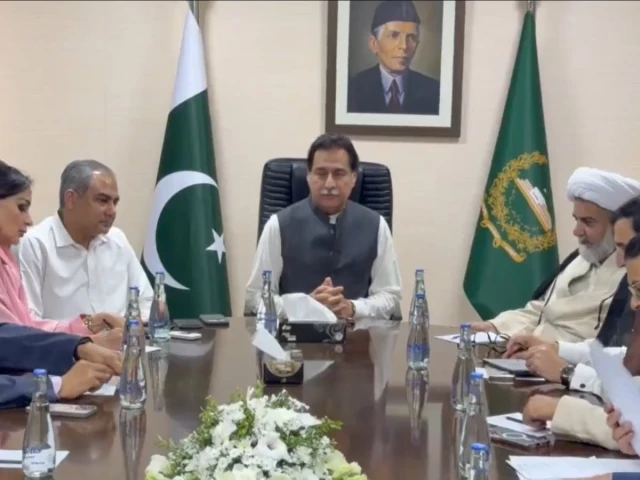
Negotiators left Parliament House in the capital after 2am, following a second round of talks that began on Saturday afternoon and ran for hours. Senate opposition leader Allama Raja Nasir Abbas, part of the opposition delegation, told reporters waiting outside shortly before 3am that the talks had failed. “Deadlock,” he said, in footage aired by local television channels.
Asked what divided the sides, Abbas described the sticking points as “small things”. He said the issue of meetings with Khan could not be resolved, and that the two sides were also split over Khan’s access to his personal physicians and over how to tackle terrorism in Khyber Pakhtunkhwa (KP), the north-western province run by Khan’s Pakistan Tehreek-e-Insaf (PTI) party. He said a detailed press conference would follow.
The failure came after hours of conflicting reports. Sources had said that around 95 percent of the issues under discussion had been settled, with only one or two points outstanding. Interior Minister Mohsin Naqvi was filmed leaving Parliament House after 9:30pm carrying a document, with media reports suggesting he was going to consult the president. He returned more than an hour later and declined to answer reporters’ questions.
On Sunday, Rana Sanaullah, the prime minister’s adviser on political affairs, said the federal government would not allow the march to enter Islamabad, and that any attempt to create disorder would be met with the force of law. He said the talks failed because the KP government would not assure the centre of its cooperation in the fight against terrorism. “There can be no retreat from the war against terrorism,” he said.
Sanaullah said the government had told the opposition that Khan’s meetings and medical treatment were already being handled under the law and jail rules. He called those matters minor. “If you do not use the meetings for political purposes, we will not create any hurdle,” he said.
He said no date had been set for another round, but that the government would resume talks if the PTI and the KP government were prepared to cooperate on counterterrorism. “They can come today, tomorrow or the day after,” he said. He added that other options remained open and that the government would decide after consulting stakeholders.
Talal Chaudhry, the minister of state for interior, also blamed the KP government. He said it “could not assure whether they would cooperate in the fight against terrorism in the future” and accused it of being unwilling to implement the National Action Plan, the country’s counterterrorism strategy. He said agreement had been reached on every other matter. Asked what the government might do next, he said the “Constitution has several options”, an apparent reference to governor’s rule or an emergency in KP.
The PTI rejected that account. Barrister Gohar Khan, the party’s chairman, said the long march was “intact” and would go ahead, and that governor’s rule or an emergency was not the answer to it. He said no date had been agreed for further talks. He described the opposition’s demands as “simple”, chiefly meetings with Khan and his wife, Bushra Bibi, and said the negotiations had become “stuck” over a few issues relating to terrorism.
Asad Qaiser, a PTI member of the National Assembly, said the party’s primary demand was a meeting with Khan, and that this had to happen before the talks could move on. “We want peace in our province,” he said. Salman Akram Raja, the PTI’s secretary general, said the two sides had no consensus on “foundational issues”. Sources on both sides had earlier told Dawn that the PTI wanted Khan moved from jail to hospital, while the government wanted the march called off.
Sherry Rehman of the Pakistan Peoples Party (PPP), a coalition partner that took part as a mediating party, said the draft agreement had been changed four times after it was agreed. “They have refused to do an agreement,” she said. She said terrorism was “not a small matter” and that there could be no compromise on it. Sanaullah said the drafts had been changed two or three times. The accounts of who made the changes differ.
Mehmood Khan Achakzai, who leads the opposition alliance Tehreek Tahaffuz-e-Ayeen-e-Pakistan (TTAP), had insisted that the march would not be called off until Khan was met. He said any decision should come after consultation with Khan and that a joint decision would be accepted. He also said Sohail Afridi, the KP chief minister, should be allowed to see Khan, and promised that Afridi would not speak to the media afterwards. Local media reported that opposition leaders had said they would try to persuade Khan to settle the issues through negotiation.
Afridi, meanwhile, remained firm on the march. He posted at 12:46am on X that supporters from Tank, Dera Ismail Khan, South and North Waziristan, Bannu and Lakki Marwat would gather at Gandi Chowk in Lakki Marwat at 1pm on Sunday. The convoy will stop for the night near Karak, move on to Kohat, then Peshawar and Charsadda over the following days, and gather at Khairabad on 8 October. He said the next phase would be announced there.
On Saturday he said the party would “neither allow May 9 to happen again nor allow anyone else to repeat it”, a reference to the violence that followed Khan’s arrest in 2023. Tariq Fazal Chaudhry, the parliamentary affairs minister, said Afridi’s language was “extremely indecent and reprehensible” and could damage the talks.
Defence Minister Khawaja Asif had earlier asked on X whether the PTI and the KP government had hired terrorists to cause unrest under cover of the protest. He questioned who was paying for vehicles, food and other costs for convoys from Waziristan, which he said was an area of widespread poverty and unemployment. Qaiser called his tone “extremely inappropriate”.
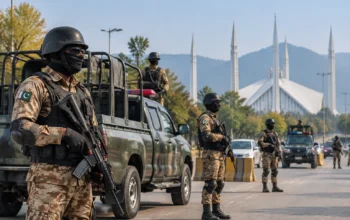
The government has hardened its position in recent days. Rangers deployments in Islamabad and parts of Punjab have been extended to 15 October, sources said, at the request of the capital’s chief commissioner and the Punjab Home Department. On Friday the army’s top brass warned that any “May 9-like situation” would be met with “decisive force”. Federal ministers had earlier said the centre might have to impose governor’s rule or an emergency in KP, which the PTI said would have dire consequences.
Bilawal Bhutto-Zardari, the PPP chairman, urged the PTI to call off the march. He said his party had pushed for dialogue while the federal government had “made up its mind” on imposing governor’s rule or an emergency in KP.
The talks were the first formal contact between the federal government and the PTI in almost three years. The PTI first announced the march for 27 September before postponing it to 4 October.
Copyright © 2021 Independent Pakistan | All rights reserved