By Staff Reporter
ISLAMABAD: Pakistan Tehreek-e-Insaf (PTI) has declared that it cannot reconcile with the government unless its jailed founder, Imran Khan, is included in the dialogue, a day after weekend talks collapsed and the party’s chief minister in Khyber Pakhtunkhwa (K-P) set off on a long march towards Islamabad.
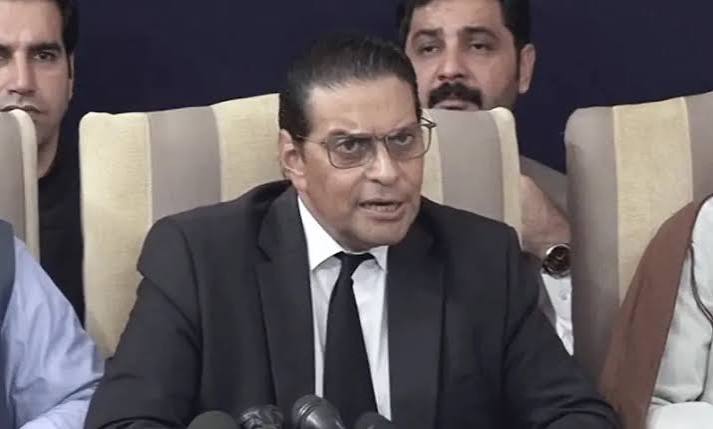
Salman Akram Raja, the party’s secretary general, told a press conference at Khyber Pakhtunkhwa House in the capital on Monday that Khan was the only person able to repair relations between the state and the public. “Only [Imran] has the capability to bridge the gulf that has developed between the state and the nation,” he said.
“Imran Khan is very important for us and we had every right to seek his opinion, but it was not allowed,” Raja added.
Two rounds of negotiations, held on Friday and Saturday, ended without agreement. The two issues that wrecked them were access to the former prime minister and the handling of counterterrorism policy in K-P.
Raja said the PTI had entered the talks sincerely and had hoped a further round on the second day would “streamline things”. He said the two sides had been close to resolving their differences before “suddenly that closeness was turned into distance”.
The government, he claimed, had pressed the PTI to endorse every counterterrorism action taken in K-P. “We were being pushed to support the government over every action being taken regarding terrorism in KP,” he said.
The party had asked ministers to respect the recommendations of a jirga held by the K-P Assembly, which brought together political parties and other stakeholders, and to consider the views of tribal leaders. It had also proposed that the agreement state that decisions on terrorism would be taken collectively. According to Raja, the government refused to put that in writing.
“We were told that a unanimous strategy against terrorism would not be developed and it would not be included in the agreement,” he said, accusing ministers of deliberately complicating the situation.
On access to Khan, the party leader said the PTI had been prepared to drop its other demands in exchange for immediate consultations with him, but the government had declined to make this part of the proposed agreement. He also said the government’s negotiators had refused to allow personal physicians to see the jailed leader and had rejected a mutually agreed course of action. “Then what are we supposed to do?” he said. A separate report of the press conference attributed to him a claim that the government had refused to put Khan’s own doctor, Dr Faisal Sultan, on a medical panel.
The same report quoted Raja as saying the PTI had been told that, had a deal been struck, lawyers and Khan’s sisters would have been allowed to see him on Tuesday and regular meetings would have resumed.
The party, he said, would keep pressing for “love, respect, the rule of law and the Constitution, and peace”.
Government ministers have given a different account. Mohsin Naqvi, the interior minister, who sat on the negotiating team, singled out Sohail Afridi, the K-P chief minister, saying he had altered the agreement. Naqvi said the provincial government had backed away from commitments in the final stage, including cooperation with the centre on counterterrorism, operations in the merged districts and implementation of the National Action Plan. He has said the political part of a proposed settlement had been agreed and that only counterterrorism remained in dispute.
Sherry Rehman of the Pakistan Peoples Party, also on the government side, said the talks failed because the K-P government refused to sign a draft already agreed by both negotiating teams. Attaullah Tarar, the information minister, said PTI representatives had come to the table but were unwilling to give up their “double standards and hypocrisy”. Amir Muqam, the minister for Kashmir Affairs and Gilgit-Baltistan, said on Monday that the government’s delegation had suggested both sides “be on the same page” on terrorism.
The talks began on Friday in an attempt to defuse tensions over the PTI’s long march, planned for October 4. The government wanted it called off, while the opposition wanted consensus on its demands and said the protest would go ahead unless they were met. A second round on Saturday, chaired by National Assembly Speaker Ayaz Sadiq, ran for several hours. The sides first agreed a five-point framework covering legal facilities for Mr Khan and his wife, early hearings of pending cases, and meetings with their lawyers and family. The negotiations then stalled over provisions on counterterrorism operations in K-P and ended without agreement in the early hours of Sunday.
The PTI launched the first phase of its march on Sunday from Gandi Chowk in Lakki Marwat, with Afridi leading it, despite repeated federal warnings. Rana Sanaullah, the prime minister’s adviser on political affairs, said the march would not be allowed to enter Islamabad. Mr Afridi has said the party will decide its next move on Thursday, once the convoy reaches Khairabad. Raja said on Monday that Afridi was leading the march and that the party would stand by him.
Separately, Babar Swati, the K-P Assembly speaker, said he would summon another meeting of the assembly’s special committee on security, set up after a peace jirga in November last year. “I am again summoning a meeting of the special committee. I wish for the relevant authorities and institutions to sit together on this important matter,” he said on X.
Swati said the committee had already been briefed by the provincial police chief, the Counterterrorism Department, the Home Department, the chief secretary and other provincial bodies. Only the Peshawar corps commander remained, he said. “I had spoken to the Peshawar corps commander and he had assured me of his participation. However, the meeting has yet to take place.”
He said letters had been sent to the prime minister, the Senate chairman, the National Assembly speaker and the interior minister to tell them the assembly was working towards parliamentary recommendations. Those recommendations would go to the assembly for approval and then to the provincial and federal governments, he said, “so that responsibility, policy and practical measures are clearly [stated]”.
He urged the centre to consider the process before holding the provincial assembly responsible for the law and order situation. The people of K-P wanted peace, Mr Swati said, and a collective solution had to be found “while collectively implementing the National Action Plan”.
Copyright © 2021 Independent Pakistan | All rights reserved