By Staff Reporter
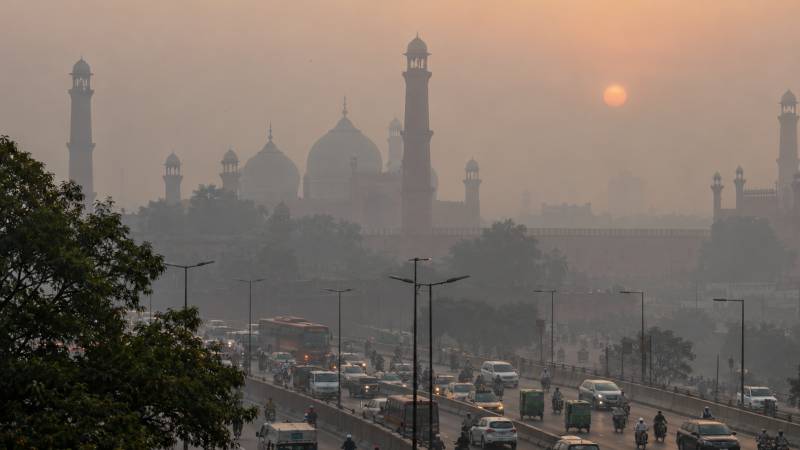
LAHORE: Lahore was shrouded in hazardous smog on Monday, with its air quality index passing 530 and satellite data showing a sharp rise in crop-stubble fires across Punjab.
At 8am, the Swiss monitoring platform IQAir recorded an Air Quality Index (AQI) of 535 in the city, placing it firmly in the hazardous category. Concentrations of fine particulate matter (PM2.5), tiny particles that can penetrate deep into the lungs and enter the bloodstream, stood at 343 micrograms per cubic metre. Hourly readings had entered the hazardous range in the early hours of the morning.
The deterioration was not confined to the provincial capital. IQAir’s live ranking of Pakistani cities on Monday placed five Punjab cities among the country’s six most polluted. Gujranwala topped the list with an AQI of 606, followed by Lahore at 509, Faisalabad and Multan at 310 each, and Sialkot at 260. Peshawar was sixth with 216. Readings shifted through the morning, with Gujranwala later recording 675 and Lahore 535.
Conditions were far worse in parts of Lahore. The Daily Pakistan website reported an AQI of 836 at a monitoring station in Allama Iqbal Town in the morning, and Dunya News later put the same area at 912. Dunya also reported readings of 698 on Burki Road, 619 in Gulberg, 569 in DHA Phase 5 and 471 in Model Town.
Sunday had already been bad. According to the Punjab government’s air quality report, Gujranwala recorded an AQI of 500 that morning, Lahore 478 and Sheikhupura 336.
The worsening air coincides with a sharp rise in agricultural fires across the province.
An analysis by the environmental monitoring website HamariHawa found that Nasa satellites detected 13,241 fire spots in Pakistani Punjab between 1 and 29 October. The figure for Indian Punjab over the same period was 3,158, making the Pakistani side’s total 4.2 times as high.
About 92 percent of the fires detected in Pakistani Punjab were on farmland and were likely linked to the burning of crop residue. Some 6,655 of them, about half the monthly total, were detected in the last seven days of October. The single worst day was 29 October, with 1,327 detections.
Okara recorded the most fire spots, at 2,144, followed by Gujranwala with 1,011 and Nankana Sahib with 1,003. The findings point to extensive burning in the rice-growing belt around Lahore. Smoke from the fires adds to emissions from vehicles, industry and other sources, and weak winds and atmospheric inversions can trap pollutants close to the ground.
A separate analysis has cast doubt on how much Lahore’s air actually improved last month. The government has said the city had its cleanest October in five years.
The Pakistan Air Quality Initiative (PAQI) found that average PM2.5 concentrations in October 2026 were 27 per cent lower than in the same month last year, across 26 monitoring sites. After adjusting for weather, however, the improvement shrank to about 4 per cent.
PAQI attributed a substantial part of the decline to a deeper nighttime atmospheric mixing layer, which gave pollutants more room to disperse. The remainder reflected a combination of government measures, changes in agricultural burning and other sources. The analysis said it could not establish how much each factor contributed.
PM2.5 concentrations exceeded Pakistan’s prescribed daily limit on every day of October, according to PAQI.
The provincial government has presented a more favourable picture. Punjab Senior Minister Marriyum Aurangzeb shared data with Dawn in October showing that Lahore’s average US AQI (PM2.5) was 180.5 for the month, against 204.6 in 2025 and 213 in 2024. Figures for 2022 and 2023 were about 193 to 195. Her data showed October 2026 was the only one of the five years in which the city never recorded an AQI above 300. The highest reading was 262, on 31 October.
Monday’s readings were roughly double that peak.
Punjab authorities have deployed anti-smog guns, which spray fine water droplets, on busy roads, in industrial zones and in areas affected by construction dust. Daily Pakistan reported that enforcement teams inspected 35 industrial establishments across the province in the past 24 hours and imposed fines totalling Rs600,000. Inspectors visited 66 brick kilns and sealed one. Drone teams, night squads and field personnel are monitoring for violations, and officials reported inspections at 24 locations in a crackdown on substandard plastic products, resulting in the seizure of 18kg of material.
Doctors and experts have advised residents to avoid unnecessary time outdoors and to wear masks. They have urged particular care for children, older people and those with respiratory conditions.
Dunya News reported that more than 35,000 patients with flu, Covid-19 and influenza-like symptoms visited six major government hospitals in Lahore in the past week. More than 11,000 attended Mayo Hospital, over 9,800 Services Hospital and more than 1,000 Jinnah Hospital. Not all of those cases are attributable to the smog. Professor Shahbaz Ghauri said Covid-19, influenza and smog can produce similar respiratory symptoms, and he urged people to seek medical examination rather than diagnose themselves.
PAQI’s forecast, issued on 1 November, projected that PM2.5 concentrations would rise to 149µg/m³ by Wednesday, 4 November. That is about 49 per cent above October’s average.
Copyright © 2021 Independent Pakistan | All rights reserved