By Staff Reporter
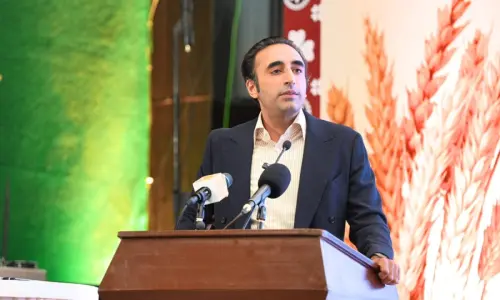
KARACHI: Bilawal Bhutto-Zardari, whose Pakistan Peoples Party backs the coalition government, said on Friday he wanted Prime Minister Shehbaz Sharif to become the first premier in Pakistan’s history to complete a five-year term, three days after a speech that badly strained the alliance.
No elected prime minister has served a full term since the country came into being in 1947. Speaking at the Sindh Wheat Growers Support Programme 2026 in Karachi, the PPP chairman said he intended to strengthen Sharif’s hand while the economy suffers from the war involving Iran, Israel and the United States.
“My objective is that I want to strengthen the hand of the prime minister [..] usually politicians create difficulties or plot his fall and secure the seat for themselves. I will not do that […] I am saying that I want Shehbaz Sharif to be the first prime minister […] to complete a five-year term,” Bhutto-Zardari said.
He placed much of the blame for the government’s difficulties on its own ministers. The prime minister, he said, had not been “given the chance” to concentrate on the economy. “What can he do? Whenever he [PM Shehbaz] makes a plan, some federal minister objects and presents their own agenda to divert the topic at hand.”
The economic picture he painted was bleak. “Every citizen of Pakistan is bearing the economic burden of the war on their shoulders,” he said. “I have not seen such a difficult economic time in my life.” He said no peace agreement between the US and Iran was in sight and that recovery would take considerable time. He acknowledged that the government had averted default and stabilised key indicators, but said the regional conflict had pulled its attention from growth and jobs.
Bhutto-Zardari dismissed the argument over new provinces as a distraction. “Whether one province is created or a 1,000, the only worry the public has is having access to meals twice a day,” he said, invoking his party’s “roti, kapra, makan” slogan.
The pledge of support follows a week of open hostility. In a speech at the Karachi Press Club on Tuesday, Bhutto-Zardari warned that a bloodbath was imminent if Sindh were administratively divided. He hinted that the government was weighing a 28th constitutional amendment, said the 27th had been forced on PPP lawmakers, and rejected Interior Minister Mohsin Naqvi’s suggestion of a referendum on new administrative units. “In our history, a referendum has always been carried out for an undemocratic act and never a democratic one,” he said.
The PPP chairman also said the system had not collapsed but had been “made to collapse”, a reply to Naqvi’s July statement that it had failed and needed a “reset”. Rana Sanaullah, the prime minister’s adviser on political affairs, said the remarks could lead to disqualification. “They were fully involved in the 26th Amendment. For the 27th Amendment, they ensured that every single vote was accounted for, and now they are calling it brute force,” he said. Defence Minister Khawaja Asif questioned Bhutto-Zardari’s moral standing, pointing to the PPP’s 18 years in power in Sindh.
Bhutto-Zardari then toured television studios on Wednesday. He said his party remained with the government and wanted the prime minister to succeed, but that backing the government carried a political cost for him, and that he had no particular interest in either the treasury or opposition benches.
The next day Sharif and Naqvi met President Asif Ali Zardari, the PPP chairman’s father, at Aiwan-e-Sadr. “It was stated during the meeting that all matters will be resolved through dialogue,” the Presidency said, adding that the earlier constitutional amendments had been introduced through consultation among all coalition parties. Neither side disclosed more. Observers described the meeting as damage control.
Bhutto-Zardari also argued on Friday that the government could not manage the crisis alone. “While I am praying for the success of the prime minister, I also believe that if we are to face the real issues of the country, one or two political parties alone cannot achieve this. It has to be a national effort,” he said.
That, he said, meant engaging the opposition, including Imran Khan’s Pakistan Tehreek-e-Insaf (PTI). It did not matter whether the government liked Maulana Fazlur Rehman of the Jamiat Ulema-e-Islam-Fazl or Khan, who he said had had President Zardari and his sister Faryal Talpur jailed. “My political differences with Khan sahib and his own mistakes aside, his party still has a majority representation in the opposition. And if we have to face these issues collectively then we will have to engage them, entice them and request them to play their role in [parliamentary] committees,” he said. He said he would not practise politics “based on ego and personal vendettas”.
He left the decision with the prime minister. “We cannot force someone, but it is my right to present my stance, and it is the prime minister’s right to decide whether he wants to take into account my suggestion.”
The conciliatory words did not amount to a retreat on Sindh. After Thursday’s meeting, a senior PPP leader told local media the talks were positive but the party would not compromise on Sindh’s division, though it could support a new province in Punjab if the PML-N wanted one. Another PPP leader warned that party members holding constitutional offices could resign at a moment’s notice. Analysts said the PPP is seeking more influence over coalition decisions without immediately threatening the government’s survival.
The new-provinces debate gathered pace on 31 July, when Naqvi told an economic summit in Islamabad that the governance system had “collapsed”. The Muttahida Qaumi Movement-Pakistan (MQM-P), a coalition partner that has long argued for carving new provinces from Sindh, welcomed the idea. On 4 September the Sindh Assembly passed a resolution rejecting any division of the province, and Chief Minister Syed Murad Ali Shah said there would be no compromise on its geographical unity.
Copyright © 2021 Independent Pakistan | All rights reserved