By Staff Reporter
KARACHI: An 11-year-old boy has been charged with negligently starting a fire that killed 72 people and destroyed more than 1,100 shops at a crowded commercial plaza here, according to a charge sheet filed in court Saturday — a document that also accuses building managers of locking emergency exits and never calling for help as the blaze consumed the structure.
The charge sheet, submitted by investigating officer Pervez Ahmed Bhutto through in-charge district prosecutor Abdul Razzaq Gujjar, names the boy, identified as Huzaifa, along with his father and four members of the building’s management committee. All six are listed as absconders, meaning none have been taken into custody.
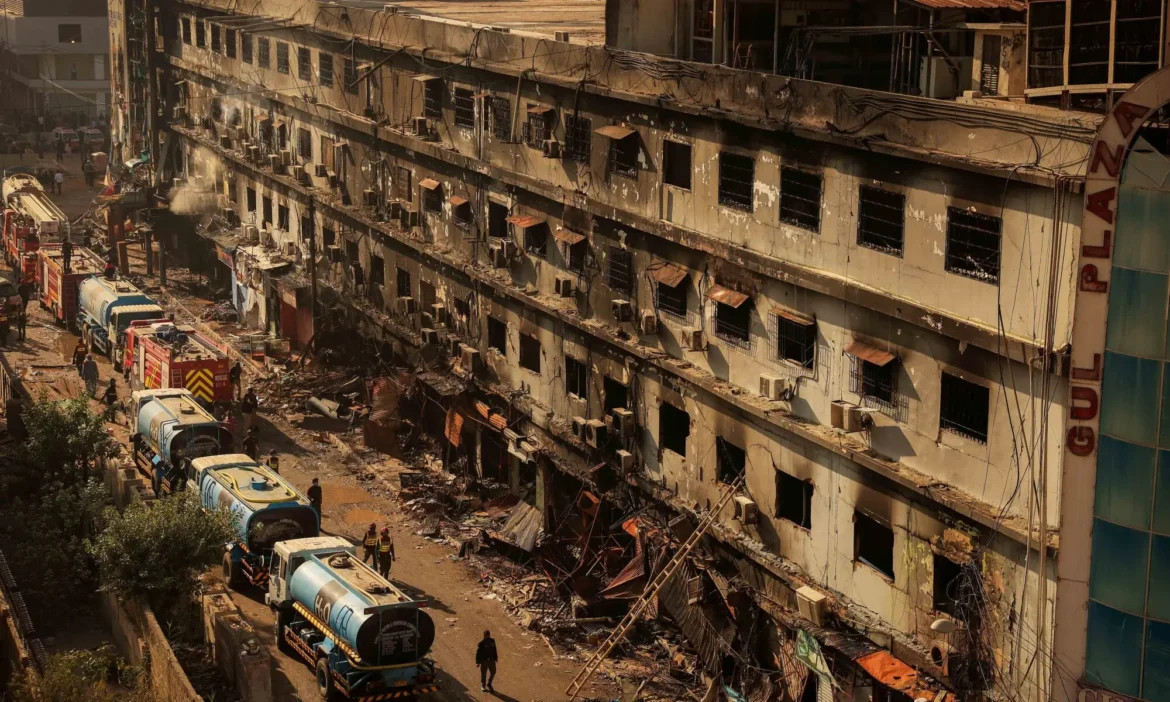
The Jan. 17 fire at Gul Plaza Shopping Centre killed 72 people and injured eight others, investigators found, while gutting 1,153 shops in one of the deadliest commercial fires in the city’s recent history.
According to the charge sheet, the blaze began in an artificial flower shop owned by Huzaifa’s father, Naimatullah, who was not present when the fire started. Witness testimony gathered by investigators paints a picture of a business routinely left in the hands of a child: A 13-year-old friend of Huzaifa’s, identified in court documents as Aryan, testified that he was at the shop when Huzaifa began playing with matchsticks, moments before the fire broke out. Two other witnesses, Mohammad Talha and Hamza Amir, told investigators that Naimatullah regularly left the shop under his young son’s supervision. Cellphone records reviewed by investigators confirmed Naimatullah was elsewhere at the time.
The charge sheet does not merely lay blame with the father and son. It also accuses the plaza’s management committee of a pattern of negligence that turned a contained fire into a mass casualty event. Investigators say the committee took no action against Naimatullah despite knowing, or having reason to know, that a minor was routinely running the shop unsupervised.
More damning, according to the charge sheet, were the building’s safety failures: Exit points were found locked or blocked at the time of the fire, hampering escape. Fire extinguishers and other safety equipment were inadequate, no fire hydrant system had been installed, and there was no backup lighting to guide people out after electricity to the building was cut once the fire took hold. Investigators also reviewed call records belonging to management committee members and found no evidence that anyone had contacted the fire brigade or other emergency responders as the building burned.
Because Huzaifa is a minor, the charge sheet against him will be filed separately before a juvenile court, the investigating officer said. The other five defendants — his father, Naimatullah, and management committee members Tanveer Pasta, Amar Ismail, Muhammad Ramazan and Muhammad Ameen — face charges under sections of the Pakistan Penal Code covering negligent conduct with fire or combustible material, manslaughter, causing hurt through rash or negligent acts, mischief by fire with intent to destroy property, and acting with common intention. In total, prosecutors have listed 42 witnesses in the case.
The path to Saturday’s filing was not straightforward. Bhutto, the investigating officer, had tried three times previously to submit the charge sheet, only to have it sent back by deputy district prosecutors Muhammad Arif Sitai and Asadullah Maitlo, who cited defects that needed correction. As recently as Friday, a separate prosecutor returned the document again, this time asking that it include findings from a judicial commission empaneled to examine the fire.
Prosecutors reviewing earlier drafts had also flagged a more substantive gap: the absence of any named officials from relevant regulatory departments, or from the previous union administration overseeing the area, despite what investigators describe as widespread lapses in enforcement. They directed Bhutto to obtain certified copies of both the judicial commission’s report and the findings of a joint investigation team the Sindh government had convened to examine the disaster, and to attach both to the charge sheet before resubmitting it.
In the end, none of that happened. Gujjar, the in-charge district prosecutor who ultimately signed off on the filing Saturday, allowed the charge sheet to proceed without those materials, telling the investigating officer that the judicial commission’s report could be submitted separately at a later stage of the proceedings. It remains unclear when that report, or the joint investigation team’s findings, will be made part of the court record — or what, if anything, they might add to a case that has already stretched the limits of the initial filing deadline.
Copyright © 2021 Independent Pakistan | All rights reserved