By Staff Reporter
ISLAMABAD: Pakistan and Turkey on Saturday recommitted to a long-standing goal of raising bilateral trade to $5 billion, as Prime Minister Shehbaz Sharif and Turkish President Recep Tayyip Erdoğan used a day of meetings here to widen cooperation on energy, mining, technology, and regional diplomacy.
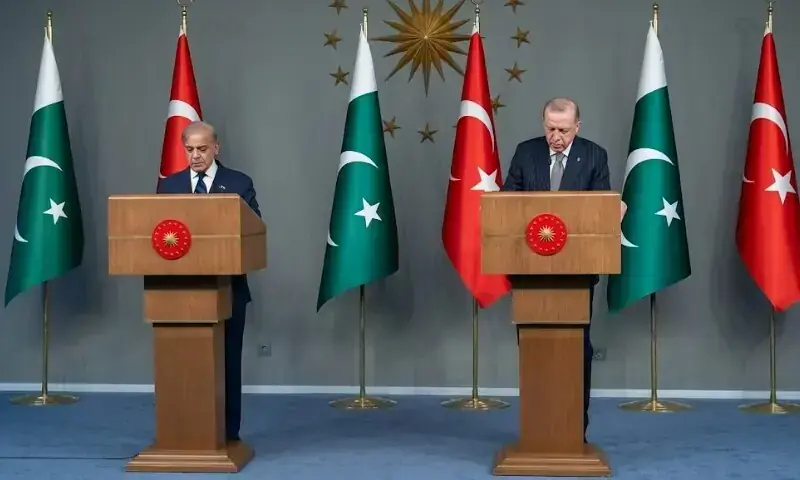
Sharif travelled to Istanbul at Erdoğan’s invitation for a schedule that included a business conference aimed at Turkish investors, private talks with the Turkish president, and a joint news conference in which both leaders framed the relationship in terms that went beyond economics.
“We always stand by each other,” Erdoğan told reporters, describing a pace of bilateral relations he said had left him satisfied.
The trade target is not new — Islamabad and Ankara have cited the $5 billion figure before — but Saturday’s remarks suggested new institutional muscle behind it. Erdoğan said trade ministries in both countries are now working specifically on a special economic zone earmarked for Turkish businesspeople in Karachi, part of what he described as an effort to translate diplomatic goodwill into concrete investment.
“Our respective Ministries of Trade are particularly working on the Special Economic Zone planned for our businesspeople in Karachi,” Erdoğan said. He added that he expects the business forum Sharif addressed earlier in the day to further the trade and investment relationship, and said Turkey is encouraging its own investors to pursue opportunities in Pakistan.
Sharif, in turn, credited Erdoğan’s tenure with reshaping Turkey’s economy and said Pakistan intends to draw lessons from it as it pushes overhauls meant to shift growth toward the private sector.
“Türkiye has undergone a remarkable transformation economically, technologically and strategically,” Sharif said, adding that his conversations with Turkish officials throughout the day centered on expanding economic collaboration.
“We expressed satisfaction over the growing momentum in bilateral trade, investment and industrial cooperation while reviewing concrete steps to unlock the full potential of our economic partnership,” he said. “The tremendous reservoir of goodwill between our two countries provides us a unique and ideal opportunity to achieve our mutually agreed target of $5 billion in bilateral trade.”
A pitch to Turkish business
Hours before his sit-down with Erdoğan, Sharif addressed the Pakistan-Turkey Business Conference, pitching Turkish firms on Pakistan’s Special Economic Zones and pointing to openings in privatization, infrastructure, energy, and technology.
The prime minister announced that Pakistan has set aside a 1,000-acre parcel at Port Qasim in Karachi for a zone to be named after Erdoğan — the “President Tayyip Erdoğan Special Economic Zone” — dedicated to Turkish investment.
Pakistani ministers at the same conference laid out a broader privatization push, telling attendees that the government intends to sell off electricity distribution companies, airports, and other state assets, while offering investment openings in energy, mining, infrastructure, technology, and public-private partnerships as part of a wider campaign to draw foreign capital.
Sharif also pressed the case for Turkish technical help closer to home, saying Pakistan wants to lean on Turkish expertise as it privatizes power distribution companies and upgrades its electricity transmission system.
In his remarks to the conference, Sharif reached back nearly a century to explain the relationship, tracing its roots to the Khilafat Movement and recalling that the Ali Brothers and other Muslims of the subcontinent backed Turkey’s independence struggle at the time.
“Turkiye is Pakistan’s strong and sincere ally, and our relationship is historic,” Sharif said.
He also pointed to more recent history, telling the conference that Turkey, Saudi Arabia, and other allied nations backed Pakistan’s position during its armed conflict with India in May of last year.
Regional diplomacy takes center stage
Beyond trade, both leaders spent significant time Saturday on the diplomacy surrounding the U.S.-Iran ceasefire and the resulting Islamabad Memorandum of Understanding, with Erdoğan crediting Pakistan’s mediation and warning against efforts to unravel the agreement.
Erdoğan congratulated Sharif on Pakistan’s role in brokering the negotiations, saying the country’s “invaluable efforts played a major role” in reaching the memorandum, and he called the agreement significant for global peace. Sharif thanked Erdoğan for Ankara’s support, saying Pakistan’s diplomatic push would not have succeeded without backing from Turkey and other friendly nations.
Sharif described the mediation itself as arduous. “The difficult diplomatic mission was never easy,” he said, adding that with a ceasefire now in place, “it is essential to fully benefit from the opportunity of peace.”
Erdoğan went further in his own remarks, arguing that any lasting peace in the Middle East requires buy-in from countries in the region and cautioning against allowing the agreement to be undermined.
“No solution that does not take strength from the will and contributions of regional countries can be lasting,” Erdoğan said. He said Turkey is closely tracking what he called Israeli efforts to “dynamite” the U.S.-Iran deal, and used pointed language to describe the stakes.
“The current war-addicted Israeli government must not be allowed to drown our geography in the smell of gunpowder and blood again,” he said.
A relationship built over decades
Sharif used the news conference and his earlier business-conference remarks to underscore what he described as a decades-deep bond between the two nations, saying Turkey has stood by Pakistan through wars and natural disasters alike. He thanked Erdoğan for what he called a warm welcome and hospitality extended to his delegation throughout the visit.
Erdoğan, for his part, said his talks with Sharif spanned not just trade but broader regional and global affairs, and reiterated that Ankara intends to deepen cooperation with Islamabad across energy, transportation, critical minerals, information technology, and defense — all, he said, in service of the same $5 billion trade target both governments have now reaffirmed. He described defense cooperation in particular as a cornerstone of the economic relationship, one he said continues to grow through new joint projects.
Copyright © 2021 Independent Pakistan | All rights reserved