By Staff Reporter
ISLAMABAD: Iranian Foreign Minister Abbas Araghchi arrived in Russia on Monday after a frantic three-day shuttle through Pakistan and Oman, telling his Russian hosts that Tehran was prepared to resume indirect negotiations with the United States — but only on terms that protect Iran’s core interests in the Persian Gulf and its nuclear program.
In a statement posted on his Telegram channel and his remarks to Iranian state media upon landing in St. Petersburg, Araghchi described his back-to-back visits to Islamabad and Muscat as “bilateral” consultations with close partners. He said the trips were essential because the first round of US-Iran talks, held in Pakistan on April 11, had collapsed despite “progress,” owing to Washington’s “wrong approaches and excessive demands.” “As for Pakistan, this country has recently played an important role in mediating the negotiations between Iran and the United States, and it was necessary for us to discuss the latest developments,” Araghchi said. “We reviewed what has happened and talked about the path and conditions under which the negotiations can continue.”
He called the consultations with Pakistani officials “very successful” and said they had produced “good consultations” on how to revive the dialogue. Araghchi also referenced “40 days of heroic resistance of the Iranian people,” arguing that the endurance shown during the two-month conflict should now allow Tehran to secure “the rights of the Iranian people, their independence, and the interests of the country.”
The Iranian minister met in Islamabad with Prime Minister Shehbaz Sharif, Foreign Minister Ishaq Dar and Chief of Army Staff Field Marshal Asim Munir — the two Pakistani figures who have led mediation efforts since the fighting began. He made the trip twice in 48 hours, returning briefly to the Pakistani capital after a stop in Muscat before flying onward to Russia.
In Oman, Araghchi held talks with senior officials including Sultan Haitham bin Tariq Al Said, whom he described as a leader of a “friendly and close country” whose positions during the Middle East conflict had been “very good.” The discussions focused heavily on the Strait of Hormuz, the narrow waterway between Iran and Oman through which roughly one-fifth of global oil trade normally passes.
“It was necessary for us to have consultations regarding the Strait of Hormuz as Iran and Oman were the two coastal countries on the key waterway,” Araghchi said. “Safe passage through the Strait of Hormuz is an important and global issue, and we and Oman, as two countries overlooking this strait, need to have close coordination to ensure common interests.” He said the two sides had found “a lot of common ground” and agreed to continue expert-level talks.
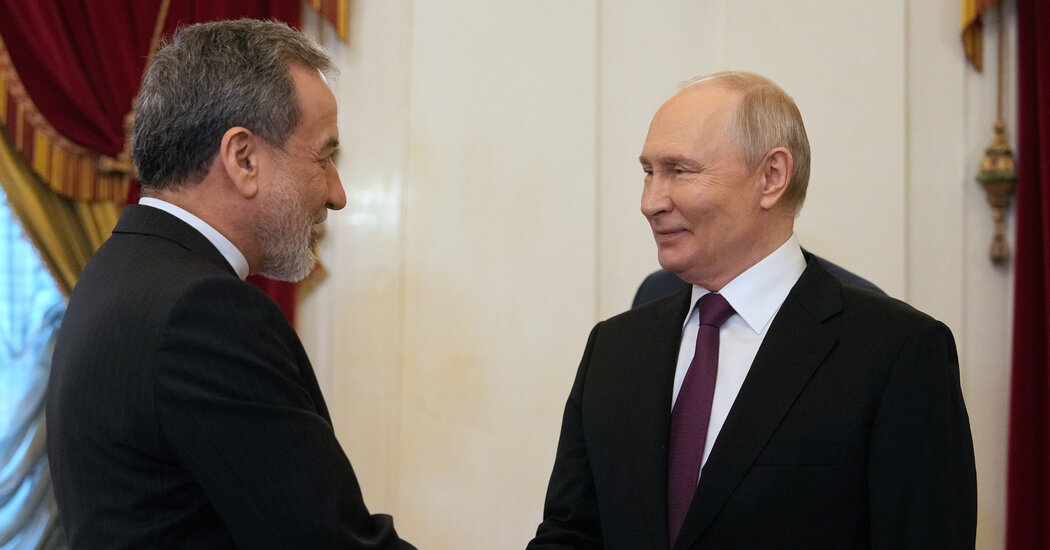
Araghchi’s arrival in Russia capped the regional tour. Iranian state media said he was scheduled to meet President Vladimir Putin later Monday. In an earlier exchange reported by Russian state media, Putin told the Iranian minister that Moscow would “do everything that serves your interests and the interests of all the peoples of the region to ensure that peace is achieved as quickly as possible.” Putin also thanked Araghchi for a recent message from Iran’s supreme leader and reaffirmed Russia’s commitment to the two countries’ “strategic relationship.”
Araghchi, for his part, told his Russian hosts that bilateral consultations had always been close and would now focus on “the developments related to the war during this period and the current situation.”
The diplomatic flurry comes after a weekend of setbacks for Pakistan’s mediation. On Saturday, President Donald Trump abruptly canceled a planned trip to Islamabad by his special envoy Steve Witkoff and senior adviser Jared Kushner. Trump said Iran had “offered a lot, but not enough” and that the Iranians could “come to us, or they can call us” if they wanted to talk.
A day later, Trump told Fox News that any agreement must include a firm Iranian commitment not to develop nuclear weapons. “They know what has to be in the agreement,” he said. “It’s very simple: They cannot have a nuclear weapon, otherwise there’s no reason to meet.” Iranian officials have long insisted that Tehran has the right to enrich uranium for peaceful purposes and have rejected any total rollback of its nuclear program as a precondition for talks.
According to Iranian state news agency IRNA and reports citing US officials, Tehran sent written messages through Pakistani channels outlining its red lines on nuclear issues and the Strait of Hormuz. One proposal conveyed to Washington, as reported by Axios and not denied by Iranian authorities, would reopen the strait in exchange for an end to the US blockade, while postponing nuclear negotiations to a later stage.
A ceasefire brokered by Pakistan and announced on April 8 has held for nearly three weeks, but tensions remain high. Iran closed the Strait of Hormuz at the outset of the conflict that began with US and Israeli strikes on Feb. 28, sharply curtailing shipments of oil, gas and fertilizer and driving up global energy prices. The United States responded with a naval blockade of Iranian ports; US Central Command said its forces had directed dozens of vessels to turn around. Iran’s Revolutionary Guards have declared that maintaining control of the strait and its “deterrent effects” remains a core strategy.
Pakistani officials, who have invested significant diplomatic capital in the process, expressed cautious hope that indirect channels could still produce a framework agreement involving not only Washington and Tehran but also Gulf states. The economic shock waves have been felt far beyond the region. Surging fuel prices have fueled inflation and raised fears of food insecurity in developing countries, including Pakistan itself. Trump faces mounting domestic pressure over rising US gasoline prices ahead of midterm elections in November.
Araghchi’s visit to Moscow showed Iran’s determination to broaden its diplomatic support. Russian officials have signaled that they see a continuing role for themselves in any long-term settlement — or, if diplomacy fails, in backing Tehran against further pressure.
Copyright © 2021 Independent Pakistan | All rights reserved