By Staff Reporter
PESHAWAR: The army chief has vowed to continue a campaign against “Indian sponsored terrorist outfits” and to “hit them hard wherever they are”, less than a fortnight after the government suspended the elected administration in Khyber Pakhtunkhwa.
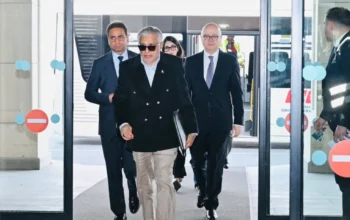
Field Marshal Asim Munir, who is chief of army staff and chief of defence forces, made the remarks during a visit to the army’s corps headquarters in Peshawar on Friday, according to the military’s media wing, Inter-Services Public Relations (ISPR).
He was briefed on the security situation, counterterrorism operations, border management and the readiness of troops deployed in the province, the ISPR said. He praised the morale and professionalism of officers and soldiers and directed them to maintain vigilance and a high state of operational readiness.
The field marshal also paid tribute to civilians and members of the security forces killed in the violence. The statement said he expressed confidence that, with public support, Pakistan would defeat the militants and their “perverted” ideology.
Pakistan blames much of the violence in Khyber Pakhtunkhwa on the Pakistani Taliban, known as Tehreek-e-Taliban Pakistan (TTP). Islamabad says the group’s fighters operate from neighbouring Afghanistan and accuses India of backing militants responsible for attacks inside Pakistan.
Munir’s visit followed a deadly day in the province. On Thursday, four police officers, including a senior officer in the Counter-Terrorism Department, were killed in a gunbattle with militants in the Karak district. Two militants were also killed. In a separate incident in Bannu, two civilians were injured by a remote-controlled bomb.
The federal government imposed emergency and governor’s rule in Khyber Pakhtunkhwa on 11 October, removing the elected government led by the party of Imran Khan, the jailed former prime minister. Executive powers passed to the governor, Faisal Karim Kundi, who is assisted by an advisory council, and emergency measures were imposed in 12 districts. President Asif Ali Zardari approved the decision under Articles 232 and 234 of the constitution on the recommendation of the federal cabinet.
The Centre cited the provincial government’s “deliberate disengagement” from the fight against terrorism. The move also followed a protest march by Khan’s Pakistan Tehreek-e-Insaf (PTI) party demanding his release.
Prime Minister Shehbaz Sharif travelled to Peshawar on Thursday on his first visit to the province since the takeover and chaired a meeting of the apex committee at Governor House. Munir attended, along with Kundi, Deputy Prime Minister Ishaq Dar and Interior Minister Mohsin Naqvi.
Sharif said the measures had been taken “under extreme compulsion” and that the constitution and the law empowered the government to introduce them. He thanked coalition partners for backing the move, naming Mr Zardari and Nawaz Sharif, the president of the Pakistan Muslim League-Nawaz.
He accused the previous provincial administration of failing on public safety. He said 5,000 police vacancies had gone unfilled during its tenure, that the Safe City project remained unfinished, and that more than 800 billion rupees had been provided to the province under the National Finance Commission Award for counterterrorism. He pledged to restore peace, prosperity and development.
The PTI rejects the government’s account and says its removal from power was politically motivated. Its chairman, Barrister Gohar Ali Khan, has petitioned the Peshawar High Court to declare the proclamation void, arguing that if security alone justified governor’s rule, it should also be imposed in Balochistan. Separate petitions have been filed by leaders of the National Democratic Movement, Mohsin Dawar and Bushra Gohar.
The court issued notices on Tuesday to the federal government and other authorities. Salman Akram Raja, the PTI’s secretary general, told the court that an emergency required a resolution of the provincial assembly and that governor’s rule could be justified only if the provincial government were unable to function.
Security assessments presented to the federal cabinet showed that terrorist incidents in Khyber Pakhtunkhwa rose by 195 per cent between March 2024 and September 2026, with police and security personnel bearing the brunt of the attacks.
Nationally, the Centre for Research and Security Studies reported an 83 per cent rise in violence-linked deaths in the third quarter of 2026, reversing a decline recorded in the first two quarters. Balochistan and Khyber Pakhtunkhwa together accounted for 98 per cent of the total. Balochistan recorded 829 deaths, nearly 59 percent of the national figure, and Khyber Pakhtunkhwa 556, or more than 39 percent.
Security forces have stepped up operations in Balochistan. On 19 October, an army major and four militants were killed in intelligence-based operations there. The previous day, security forces killed eight militants described as India-sponsored in the districts of Quetta, Nushki and Khuzdar.
Copyright © 2021 Independent Pakistan | All rights reserved