By Staff Reporter
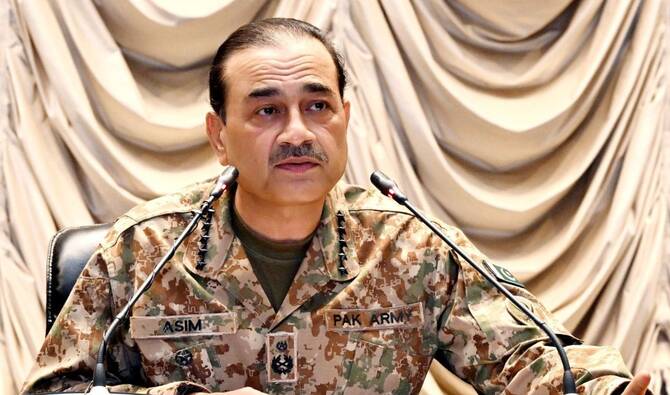
ISLAMABAD: Pakistan’s army chief on Monday dismissed Indian allegations that China provided real-time military support during the May 2025 clash between the two nuclear-armed rivals, calling the claims baseless and a tactic to mask India’s battlefield shortcomings.
Field Marshal Syed Asim Munir addressed the issue in a speech to graduating officers at the National Defence University in Islamabad.
His remarks countered statements made last week by Indian Army Deputy Chief Lt. Gen. Rahul Singh, who alleged at a New Delhi defence forum that China supplied Pakistan with “live inputs” on Indian military positions during the conflict.
Singh offered no concrete evidence to support the claim. The dispute stems from a brief but intense war in early May, triggered by an April 2025 attack on tourists in occupied Kashmir that killed several people.
India blamed Pakistan for the assault, a charge Islamabad rejected, leading to a four-day exchange of drones, missiles, and artillery fire. The fighting, the worst in decades between the two nations, ended with a US-mediated ceasefire.
Munir described India’s accusations as “factually incorrect” and politically driven.
“Insinuations regarding external support in Pakistan’s successful Operation Bunyanum Marsoos are irresponsible and factually incorrect and reflect a chronic reluctance to acknowledge indigenous capability and institutional resilience developed over decades of strategic prudence,” Munir was quoted as saying in a statement issued by the Inter-Services Public Relations (ISPR), military’s media wing.
“India’s inability to achieve its stated military objectives during Operation Sindoor—and the subsequent attempt to rationalize this shortfall through convoluted logic—speaks volumes about its lack of operational readiness and strategic foresight.”
He defended Pakistan’s Operation Bunyan Al Marsoos—a counteroffensive launched May 10 after Indian strikes hit civilian and military targets—as a product of homegrown capabilities, not foreign assistance.
“Naming other states as participants in the purely bilateral military conflagration is also a shoddy attempt at playing camp politics and desperately trying that India remains the beneficiary of larger geopolitical contestation as the so-called net security provider in a region which is getting increasingly weary of its hegemonic and extremist Hindutva ideology,” the field marshal said, accusing India of deflecting from its own failures in Operation Sindoor, New Delhi’s codename for the campaign.
“In contrast to India’s strategic behaviour resting on parochial self-alignment, Pakistan has forged lasting partnerships based on principled diplomacy, anchored in mutual respect and peace, establishing itself to be a stabilizer in the region.”
Munir warned that future aggression would prompt a “swift and resolute response,” placing responsibility for any escalation on India.
“COAS reiterated Pakistan’s principled stance that any misadventure or attempts to undermine Pakistan’s sovereignty or violation of territorial integrity will continue to be reflexively met with a swift, and resolute response without any constraints or inhibitions,” the ISPR statement said. “Any attempt to target our population centres, military bases, economic hubs and ports will instantly invoke a ‘deeply hurting and more than reciprocal response’. The onus of escalation will squarely lie on the strategically blind arrogant aggressor who fails to see the grave repercussions of such provocative actions against a sovereign nuclear state.”
New Delhi has frequently accused Pakistan of leaning on China to bolster its defences, a notion Islamabad has long denied.
Pakistani Defense Minister Khawaja Asif told Arab News last month that no direct Chinese military role existed in the May 7-10 fighting.
Copyright © 2021 Independent Pakistan | All rights reserved