By Staff Reporter
ISLAMABAD: An army officer was martyred on Saturday when security forces battled militants in North Waziristan, one of two intelligence-led operations in Pakistan’s restive western provinces that also left seven militants dead in Balochistan, including a would-be suicide bomber, according to the military’s media wing.
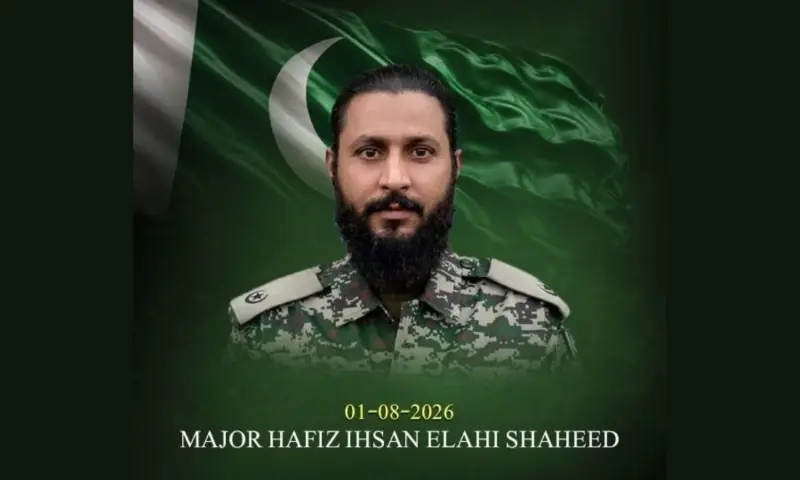
The Inter-Services Public Relations (ISPR) said Major Hafiz Ihsan Elahi, 34, from Mianwali district, was leading his troops from the front when he was caught in an intense exchange of fire during a raid on a militant hideout in the Razmak area. He fought gallantly before making what the ISPR called the ultimate sacrifice.
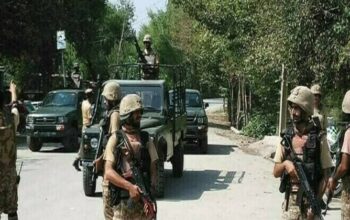
Five militants were killed in the same operation. The ISPR described them as belonging to Fitna al Khawarij, the state’s designation for the banned Tehreek-i-Taliban Pakistan (TTP), and said security forces recovered weapons and ammunition from the scene. The military said those killed had been actively involved in a string of attacks on security forces and law enforcement personnel, as well as in the deaths of civilians.
Sanitisation operations were continuing in the area on Saturday to root out any other militants who might remain, the ISPR said, adding that the broader counter-terrorism campaign under the government’s Azm-i-Istehkam strategy would press on at full pace against what it called foreign-sponsored terrorism.
“Such sacrifices of our brave soldiers further reinforce our unwavering commitment of safeguarding our nation at all costs,” the statement said.
Seven killed in overnight Nushki raid
In a separate statement issued the same day, the ISPR said security forces had killed seven militants overnight between July 30 and 31 during a raid in Nushki district, Balochistan, among them a suicide bomber who had yet to strike.
The military said the operation was launched after intelligence pointed to militants from Fitna al Hindustan, the term the state applies to Baloch separatist groups, holed up in the district. Troops located and monitored the hideout before what the ISPR called a prompt surgical action, in which all seven were killed. Ammunition and improvised explosive devices found at the site were destroyed on the spot, the statement added.
As in North Waziristan, the military said sanitisation operations were under way in Nushki to clear the area of any remaining militants.
Escalating violence in the west
The twin operations come against a backdrop of intensifying militancy in Khyber Pakhtunkhwa and Balochistan, where the TTP and the Baloch Liberation Army (BLA) have stepped up attacks on security forces, state infrastructure and civilians in recent years. Pakistan has accused Afghanistan of harbouring both groups and India of funding them, allegations denied by Kabul and New Delhi alike.
Violence has climbed sharply since the TTP tore up its ceasefire with Islamabad in November 2022, promising a wave of fresh attacks. Field Marshal Asim Munir, the army chief and Chief of Defence Forces, said last month that any terrorism directed from across Pakistan’s borders would be crushed with the full might of the state, a pledge made in the aftermath of a series of major attacks in Balochistan.
On 29 July, the ISPR reported that security forces had killed 32 militants in operations spanning Khyber Pakhtunkhwa and Balochistan. A day before Saturday’s Nushki raid, Balochistan’s chief minister, Mir Sarfraz Bugti, said the province would not retreat “even an inch” in its confrontation with militancy.
The scale of the crackdown in Balochistan has been considerable this year. Security forces killed at least 16 militants during Operation Al-Azm in Mastung district last month, launched after gunmen attacked a Karachi-bound passenger coach, killing three people and wounding five. That followed a run of major attacks across the province in early July that triggered a wider counter-terrorism push, including Operation Shaban, in which security sources cited by state media said 91 militants were killed between 5 and 16 July alone — bringing the total killed in Balochistan operations that fortnight to 129.
Prime Minister Shehbaz Sharif said earlier this week that his government was pursuing a comprehensive strategy to eliminate the threat posed by Fitna al Hindustan, Fitna al Khawarij and other banned groups. Violence in both provinces has risen markedly since 2021, when the Taliban returned to power in neighbouring Afghanistan.
Copyright © 2021 Independent Pakistan | All rights reserved