By Staff Reporter
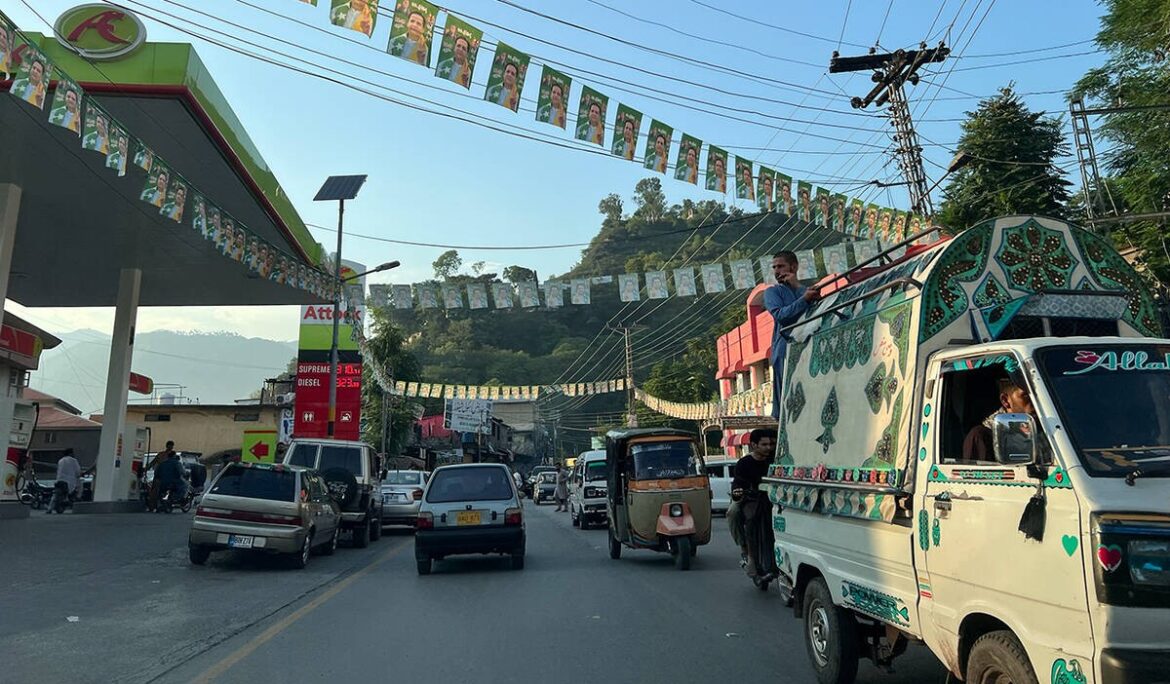
MUZAFFARABAD: Senior leaders from Pakistan’s two governing coalition partners sat down again on Saturday in an attempt to calm a rapidly escalating row over allegations of vote-rigging in the first phase of elections in Azad Jammu and Kashmir, hours before polling opens in the region’s second phase on Sunday.
The talks were the third round in three days between the Pakistan Muslim League-Nawaz and the Pakistan Peoples Party, whose alliance at the federal level has come under mounting strain since preliminary results from Mirpur division showed the PML-N winning nine of the division’s 13 seats. The PPP has accused its coalition partner of rigging the vote in four constituencies and is demanding fresh polling.
Saturday’s meeting followed an initial sit-down at a hotel on Thursday night and a further session before noon on Friday. The PML-N was represented by Rana Sanaullah, adviser to the prime minister, Kashmir Affairs Minister Amir Muqam, and Chaudhry Tariq Farooq, the party’s AJK chapter secretary general and an MLA-elect. For the PPP, former Senate chairman Nayyar Bokhari, ex-federal minister Qamar Zaman Kaira and AJK Prime Minister Faisal Mumtaz Rathore — who doubles as the party’s regional secretary general — sat across the table. Nadeem Afzal Chan, who had attended Friday’s meeting, was not present on Saturday.
Much of the discussion centred on security preparations for Sunday’s vote in nine constituencies of Muzaffarabad division, with both sides pressing the Election Commission and local administration to guard against any lapses that might prevent people from voting freely. A third phase, covering all 12 seats reserved for refugees from Indian-administered Kashmir and 11 constituencies in Poonch division, is due on 10 August.
But according to sources familiar with the talks, the rigging allegations dominated. The PML-N side maintained that neither the federal government nor any state institution had orchestrated fraud, and that any irregularities recorded at individual polling stations reflected local imbalances in support rather than a coordinated operation.
“It was not planned or pre-planned rigging but isolated acts at places where supporters of one candidate enjoyed numerical dominance over their opponents,” one source quoted PML-N leaders as telling their PPP counterparts, adding that such episodes had featured in the region’s elections before.
PML-N figures also argued that their party had simply organised earlier and more thoroughly, while the PPP had operated on the assumption — which proved mistaken — that the polls would be delayed by a year and the 12 refugee seats abolished, leaving it under-prepared.
The PPP’s objections, initially spanning four constituencies — Charhoi and Sehnsa in Kotli, Nakyal, also in Kotli, and Barnala in Bhimber — have narrowed considerably. The party has since dropped its complaints over Sehnsa and Barnala, leaving Saturday’s talks focused on two seats: Charhoi, where PPP’s AJK president Chaudhry Yasin lost to the PML-N’s Raja Riasat, and Nakyal, where the PML-N’s Raja Ayaz Ahmed defeated the PPP’s Javed Iqbal Budhanvi.
The PML-N delegation presented a breakdown of results it said showed the pattern cut both ways: in some polling stations its own candidates had taken more than 80 percent of the vote, while in others the PPP had done the same. “If any irregularities occurred, they occurred on both sides, and a mechanism has been discussed to address them, legally and politically,” one PML-N leader said.
The two sides agreed that Rathore and Farooq, as their respective regional secretaries general, would approach the Election Commission jointly to seek a legal route out of the impasse. A further meeting planned for Saturday afternoon did not go ahead after Sanaullah and Muqam were called back to Islamabad on other business.
A coalition trading barbs — and history lessons
Even as their negotiators worked to lower the temperature behind closed doors, PPP and PML-N figures continued sniping at each other in public on Saturday, with the argument spilling well beyond the current election into each party’s record in government going back decades.
Sanaullah, addressing a gathering in Jhelum Valley alongside Muqam, turned PPP chairman Bilawal Bhutto-Zardari’s own language back on him. Bhutto-Zardari had accused Prime Minister Shehbaz Sharif and Punjab Chief Minister Maryam Nawaz of owing their offices to “Form-47” — a reference to the official election result form that has become shorthand in Pakistani politics for alleged rigging — rather than genuine public support.
“If you call the votes secured by the prime minister votes of Forms-47, then on what forms has the president gotten votes on?” Sanaullah asked, a pointed reference to Asif Ali Zardari, the PPP co-chairman who holds the presidency.
Sanaullah went further, invoking the party’s founder. “If you say to Mian Nawaz Sharif that he became the prime minister for the first time or every time through rigging… then remember, it is also discussed here that someone also became the prime minister for the first time after breaking apart the country,” he said — an allusion to Zulfikar Ali Bhutto, who took power as president after the 1971 secession of what became Bangladesh, before being sworn in as prime minister in 1973 under the new constitution.
He also took aim at Interior Minister Mohsin Naqvi over recent remarks that have reopened debate about creating new provinces, describing Naqvi as a “blessed one” of President Zardari who had “made the journey of 30 years in three-and-a-half years.” Muqam, for his part, criticised the PPP’s record governing Sindh and argued that the Benazir Income Support Programme — a scheme the PPP frequently claims credit for — belonged to “the government,” not any one party.
The PPP hit back hours later. At a press conference in Karachi, Sindh labour minister Saeed Ghani rejected the suggestion that his party was in no position to lecture others on democracy, a jibe he attributed to a PML-N figure. “If you do not want to give the PPP the right to speak on democracy, then will you give it to Gen Musharraf or Gen Zia, or the leaders created by them?” he asked.
Ghani had opened his press conference by addressing calls from two Punjab ministers for new provinces to be carved out of Sindh, arguing that any such move required the backing of elected representatives in the assembly concerned. He noted that Sindh’s assembly had expressed no appetite for further provinces, whereas the Punjab Assembly and the Senate had passed resolutions over a decade ago backing two new provinces within Punjab — a position he said the PPP supported precisely because Punjab’s own elected representatives wanted it. Sindh’s ministers, he suggested, were essentially repeating whatever Maryam Nawaz told them: “They are restricted within a circle called Maryam Nawaz. They only see and say what she tells them, shows them and explains to them.”
The public sparring follows a bruising few days between the coalition partners since the first phase of voting concluded. In a televised address, Maryam Nawaz hailed what she called the PML-N’s “outstanding victory” in Mirpur and called on the PPP to concede gracefully. “The PPP should have accepted its defeat by affirming the spirit of democracy, but I felt aggrieved by the kind of words used by PPP leaders,” she said, adding: “The state does not decide election results; only the people make this decision.”
Bhutto-Zardari had struck a considerably sharper note on Thursday, warning that a stolen election in AJK would trigger consequences for the federal government in Islamabad. “If you steal [the election]… write it down, take my guarantee, that a countdown will start for your federal government,” he said. “If you steal my mandate, I will come for your throne.”
Truth and reconciliation proposal moves forward
Separately on Saturday, Bhutto-Zardari said he had received a response from the banned Joint Awami Action Committee to a letter he had sent proposing a Truth and Reconciliation Commission, and that the PPP would now consult stakeholders on how to proceed. The proposal is aimed at the wider unrest that has gripped AJK over the past month, centred on the committee’s demand to abolish the 12 assembly seats reserved for refugees from Indian-administered Kashmir who settled in Pakistan after 1947 — a dispute that has fuelled sustained protests across the region.
Writing on X, Bhutto-Zardari welcomed the committee’s “willingness to engage with the proposed commission,” noting the idea has already been endorsed by the AJK Legislative Assembly. “The loss of every precious life is a national tragedy,” he wrote, describing bringing the crisis to an end as his “foremost priority.” He said he intends to consult AJK Prime Minister Faisal Mumtaz Rathore, who will in turn sound out the federal government and other stakeholders to gauge whether enough common ground exists to move ahead with a joint proposal.
The Joint Awami Action Committee was formally proscribed by the regional government on 5 June and placed on the First Schedule of AJK’s anti-terrorism legislation, with the Home Department accusing it of engaging in terrorism and acting in a manner “prejudicial to peace and security.” Authorities have since arrested numerous members of the group. On 28 July, Information Minister Attaullah Tarar went further, alleging that militant elements were operating within the committee and that it was pursuing a foreign, India-backed agenda — a claim he made alongside assertions from AJK’s information secretary and a senior police official that a significant number of protesters at recent JAAC demonstrations had links to Fitna al-Khawarij.
Copyright © 2021 Independent Pakistan | All rights reserved