By Staff Reporter
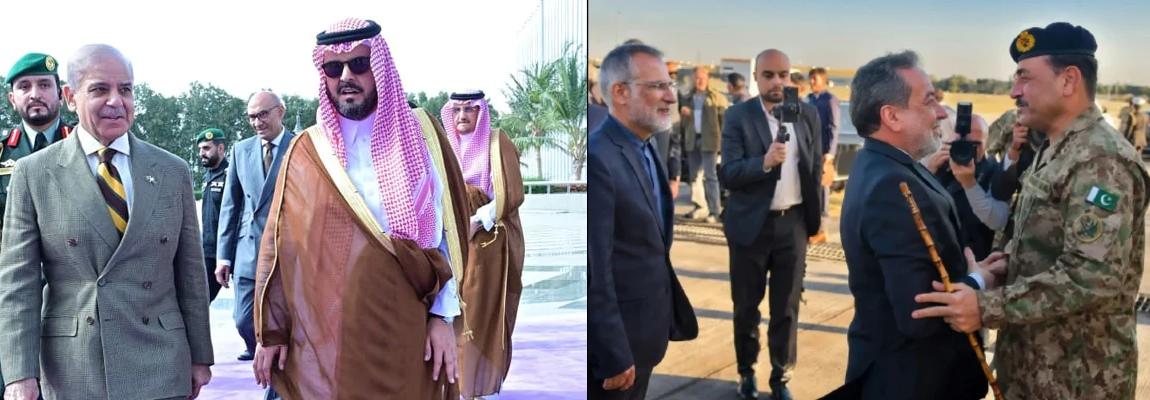
ISLAMABAD: Prime Minister Shehbaz Sharif Landed in Jeddah on Wednesday for talks with the kingdom’s leadership, even as the army chief, Field Marshal Asim Munir, reached Tehran carrying what Iranian officials said a new message from Washington aimed at salvaging a fragile ceasefire between the United States and Iran.
The twin missions — one diplomatic, the other military-diplomatic — showed Islamabad’s unusually central role in the effort to prevent the seven-week-old Middle East conflict from reigniting. Sharif’s three-nation tour, which will also take him to Qatar and Turkey through Friday, reflects Pakistan’s longstanding ties to key regional players. At the same time, Field Marshal Munir’s visit to Tehran, announced hours earlier by Pakistan’s military, represents an urgent attempt to revive direct negotiations between Washington and Tehran after marathon talks in Islamabad last week ended without agreement.
The prime minister was scheduled to meet Crown Prince Mohammed bin Salman, Saudi Arabia’s de facto ruler and prime minister, later on Wednesday. The two leaders planned to discuss strengthening bilateral relations and the broader regional situation, according to a statement from Sharif’s office. Pakistan and Saudi Arabia have long maintained a close partnership rooted in military cooperation, economic assistance and shared Islamic heritage, with Riyadh providing critical financial aid and oil supplies to Islamabad over the years.
Pakistan’s Foreign Office said the stops in Saudi Arabia and Qatar will focus on bilateral cooperation and consultations on regional peace and security. In Turkey, Sharif is expected to participate in the fifth Antalya Diplomacy Forum, where he will join a leaders’ panel and hold separate bilateral meetings, including with President Recep Tayyip Erdogan.
The diplomatic activity intensify as a cease-fire brokered on April 8 is set to expire on April 22 and is already under strain. The United States has imposed a naval blockade on Iranian ports, which Tehran has labeled a violation of the truce. Iran has effectively closed the Strait of Hormuz — a vital artery for one-fifth of the world’s oil in peacetime — disrupting global shipping and sending oil prices soaring before a modest easing this week.
The war, which began on Feb. 28 with largescale Israeli and American strikes on Iran, has killed more than 3,000 people in Iran, more than 2,100 in Lebanon, 23 in Israel, more than a dozen in Gulf Arab states and 13 American service members. Iran responded with attacks on Gulf states that it said targeted American and Israeli sites. The economic fallout has been felt worldwide, with oil prices falling Wednesday on hopes that diplomacy might yet prevent a resumption of hostilities, even as American stocks surged toward records set in January.
Pakistan has emerged as a key intermediary since the earliest days of the crisis, maintaining close coordination with Riyadh, Doha and Ankara while condemning Iranian strikes on Gulf states. On April 11, Islamabad hosted the highest-level direct American-Iranian talks in more than a decade. The sessions, which stretched more than 20 hours over two days, brought together Vice President JD Vance of the United States and senior Iranian officials, including Foreign Minister Abbas Araghchi and Parliamentary Speaker Mohammad Bagher Qalibaf. No agreement was reached amid deep divisions over Iran’s nuclear program, sanctions relief and the reopening of the Strait of Hormuz.
The American side pressed for strict limits on uranium enrichment, including a proposed 20-year moratorium, while Iran insisted on its right to enrich uranium “in accordance with its needs” and demanded the lifting of sanctions and the unfreezing of assets. Iranian officials also sought broader guarantees on the scope of the ceasefire.
President Trump said Tuesday that he would prefer any follow-up talks to be held in Pakistan, praising Field Marshal Munir’s efforts. “The Field Marshal is doing a great job,” Trump told The New York Post. “He’s fantastic, and therefore it’s more likely that we go back there.” On Wednesday, Trump told Fox News that the war was “very close to over.”
Field Marshal Munir’s delegation, which included Interior Minister Mohsin Naqvi, arrived in Tehran on Wednesday, according to a statement from Pakistan’s military media wing that included a photograph of the army chief’s welcome. Iranian state media reported that the group was carrying a fresh American message and would meet Iranian officials to discuss future negotiations.
Esmaeil Baqaei, a spokesman for Iran’s Foreign Ministry, confirmed in a weekly briefing in Tehran that “several messages have been exchanged through Pakistan” since the Iranian delegation returned from Islamabad on Sunday. He said a Pakistani delegation was expected that day “as a continuation of the discussions in Islamabad.” Baqaei reiterated that Iran’s right to uranium enrichment was “indisputable,” though he described the level and type of enrichment as “negotiable.” He called some American demands “unreasonable and unrealistic” and insisted that Iran’s right to peaceful nuclear energy “could not be taken away under pressure or through war.”
Regional officials and people briefed on the talks, speaking on condition of anonymity, said the United States and Iran had reached an “in principle agreement” to extend the ceasefire by two weeks to allow more time for diplomacy. Mediators are also trying to organise technical-level discussions on reopening the Strait of Hormuz and resolving disputes over enrichment. Back-channel communications have shown progress, according to American officials cited by Axios. One official said Trump’s team — including Vance, White House envoy Steve Witkoff and senior adviser Jared Kushner — had continued “making calls and exchanging draft proposals with the Iranians and mediators.”
The latest Pakistani outreach follows a series of regional consultations, including a quadrilateral meeting last month in Islamabad of the foreign ministers of Pakistan, Saudi Arabia, Turkey and Egypt. Senior officials from the four countries reconvened in Islamabad this week, with their discussions expected to inform a follow-up meeting of foreign ministers scheduled for Thursday in Antalya on the sidelines of the diplomacy forum.
Copyright © 2021 Independent Pakistan | All rights reserved