By Staff Reporter
ISLAMABAD: Pakistan issued an urgent appeal for restraint on Sunday as the United States and Iran exchanged their heaviest fire in months, with strikes and counterstrikes spreading across the Persian Gulf and threatening to unravel a fragile peace agreement Islamabad spent months helping to negotiate.
In a statement, the Foreign Office said it was following “with deep concern the recent incidents that are further escalating the regional tensions,” and called on “all sides to exercise restraint, take immediate steps towards de-escalation, and uphold respective commitments” under the Islamabad Memorandum of Understanding — the interim peace framework Pakistan brokered between Washington and Tehran last month.
“Pakistan remains committed to providing all support towards achieving lasting peace and stability in the region through dialogue and diplomacy,” the statement said.
The appeal came as the conflict, which began in late February when the United States and Israel launched an assault on Iran, showed signs of reigniting after weeks of uneasy calm. The United States carried out a third round of strikes against Iranian military targets over the weekend, U.S. Central Command said, after Iran’s Islamic Revolutionary Guard Corps attacked a Cyprus-flagged container ship, the M/V GFS Galaxy, as it transited the Strait of Hormuz. One crew member was reported missing after the vessel caught fire and suffered what CENTCOM described as significant engine-room damage; the rest of the crew abandoned ship and were recovered by lifeboat, according to the U.K. Maritime Trade Operations agency.
Iran’s navy said it had fired warning shots at the vessel for attempting to use what it called an “unauthorized route” through the strait, and the Revolutionary Guard’s naval arm declared the waterway closed “until further notice” — the second time in recent weeks Tehran has announced a closure of a passage through which roughly a fifth of the world’s seaborne oil and natural gas normally flows.
CENTCOM disputed that the strait was shut. In a statement, the command said U.S. forces were “positioned and prepared to ensure that freedom of navigation remains available,” adding that commercial traffic continued to move through the waterway despite what it called “unwarranted Iranian aggression.” Separately, U.S. Central Command said American forces had struck roughly 140 Iranian military targets overnight, bringing the total to more than 300 over three nights of strikes intended, the command said, “to degrade Iran’s ability to attack civilian mariners and commercial vessels freely transiting the strait.” President Trump, appearing on NBC’s “Meet the Press,” said the strait remained open to commercial traffic.
Retaliation reaches new corners of the Gulf
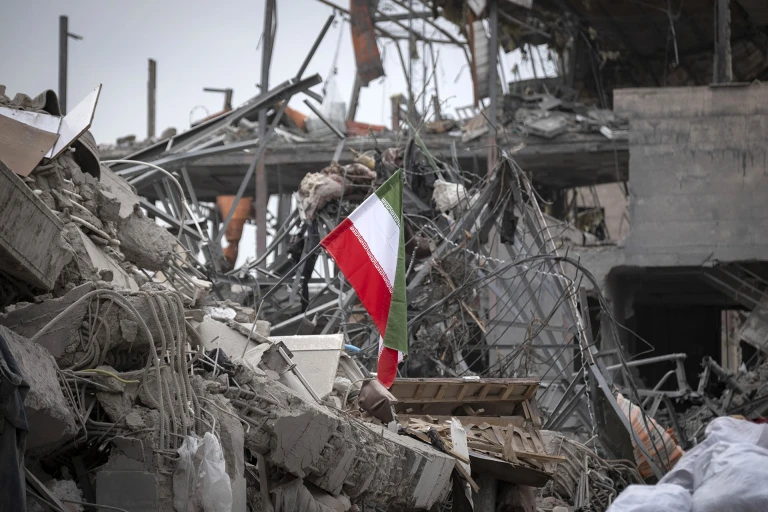
Iran’s response marked a sharp widening of the conflict’s geography. The Revolutionary Guard said it had struck a command-and-control center and drone hangars at Prince Hassan Air Base in Jordan, a U.S. ally; hit a radar installation, air-defense system, and ammunition depot in Kuwait; struck refuelling and logistics facilities used by U.S. aircraft carriers at the port of Duqm in Oman; and hit a fighter-jet maintenance center and command facility at Al Udeid Air Base in Qatar. The Guard also said it disabled a second vessel in the strait.
Qatar and the United Arab Emirates, both of which had gone months without being targeted directly, reported intercepting incoming fire. Qatar’s Interior Ministry said three people, including a child, were injured by falling debris from interception operations, and the country’s Defense Ministry said its forces had brought down a missile aimed at the country. The U.A.E.’s Defense Ministry said its air-defense systems engaged Iranian missiles and drones, characterizing explosions heard across the country as the sound of successful intercepts rather than impacts. Sirens sounded repeatedly in Bahrain, where the Interior Ministry urged residents to seek shelter, and explosions were reported in Doha.
Smaller-scale strikes were also reported in Jordan, where the army said three Iranian missiles caused only minor material damage and no casualties, and in Oman’s Musandam Governorate, where the state news agency reported a drone strike that the government condemned. Inside Iran, authorities in the southern province of Kerman said two people were injured when a communications tower was hit in the U.S. strikes; officials in Lorestan and Khuzestan provinces reported additional strikes on military and infrastructure sites, with no casualties reported in Lorestan.
A deal already under strain
The exchange represents the most serious test yet of the Islamabad Memorandum of Understanding, the 14-point framework Pakistan helped negotiate between Washington and Tehran, which was signed on June 18 and included a 60-day ceasefire, a path toward reopening the strait, and terms for further negotiations over Iran’s nuclear program. The agreement had offered some relief to a global economy strained by months of disrupted oil and gas shipments through the corridor.
That relief has proven short-lived. A series of strikes and counterstrikes over the past week led Trump to describe the ceasefire as effectively over, though he has left open the possibility of renewed negotiations. Iran’s foreign minister, Abbas Araghchi, accused the United States on social media of violating the truce, writing that “there can only be mutual compliance.” Mohammad Bagher Ghalibaf, the speaker of Iran’s Parliament and one of its lead negotiators in the original talks, wrote separately that “the era of one-sided deals is OVER,” accompanying the post with an image of the section of the memorandum addressing the strait’s reopening.
Pakistan’s deputy prime minister and foreign minister, Ishaq Dar, spoke by phone Sunday with Araghchi, urging both sides to return to the terms of the memorandum. Dar “stressed upon the parties to follow the path of de-escalation and show restraint, as agreed in the Islamabad MoU,” and said dialogue remained “the only viable path to resolving disputes and achieving lasting peace and stability in the region,” according to the Foreign Office. The two agreed to stay in close contact, the ministry said. Dar held a similar call Saturday with Saudi Arabia’s foreign minister, Prince Faisal bin Farhan, in which the two “expressed deep concern” over the renewed fighting.
Separately, Iranian and Omani officials met in Muscat to discuss arrangements for managing shipping through the strait, according to Iran’s Foreign Ministry, with a Qatari delegation also participating given Doha’s role as a mediator between Washington and Tehran. A Foreign Ministry spokesman, Esmaeil Baghaei, said Iran had told its Omani counterparts that future arrangements for the waterway needed to be worked out jointly between the two countries bordering it.
Regional condemnation and a search at sea
The attacks drew swift condemnation from several of Iran’s neighbours. Kuwait’s foreign ministry called the strikes on its territory “a dangerous escalation” and “a grave violation” of its sovereignty, saying the country reserved the right to take whatever measures were necessary to protect itself under international law. Saudi Arabia’s foreign ministry accused Tehran of violating “the principles of international law, the Charter of the United Nations” and the norms of regional relations, and said repeated attacks on commercial vessels threatened freedom of navigation in the Gulf.
India’s government said it was seeking information on one of its nationals who remained unaccounted for after an attack on a commercial vessel off the coast of Oman; the country’s Ministry of External Affairs said its embassy in Muscat was coordinating with Omani authorities on the search. New Delhi called the pattern of attacks on commercial shipping “deeply worrisome” and renewed its call for “immediate de-escalation” and a diplomatic resolution.
The renewed hostilities have also reopened economic anxieties that eased somewhat after last month’s agreement. The Strait of Hormuz normally carries about a fifth of the world’s traded oil and natural gas, and Iran’s earlier disruption of shipping through the corridor helped drive a global energy-price shock earlier this year. Higher fuel prices remain a politically delicate issue for the Trump administration ahead of November’s congressional elections.
The latest exchange also followed a tense period domestically in Iran. The country buried its supreme leader, Ayatollah Ali Khamenei, in funeral ceremonies Thursday, following his death in the war’s opening strikes in February. In a written statement issued Saturday, his son and successor, Ayatollah Mojtaba Khamenei — who has not appeared in public since the war began and did not attend his father’s funeral — vowed retribution for his death, writing: “We pledge to avenge the blood of the martyred leader and all the martyrs.”
Copyright © 2021 Independent Pakistan | All rights reserved