By Staff Reporter
ISLAMABAD: A search and rescue operation was continuing in earnest on Friday for renowned Nepali mountaineer Nirmal Purja and nine fellow climbers who went missing after a huge avalanche tore through their expedition on Pakistan’s Broad Peak, with at least two of the group now confirmed dead.
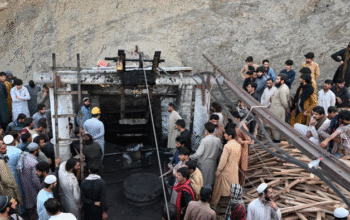
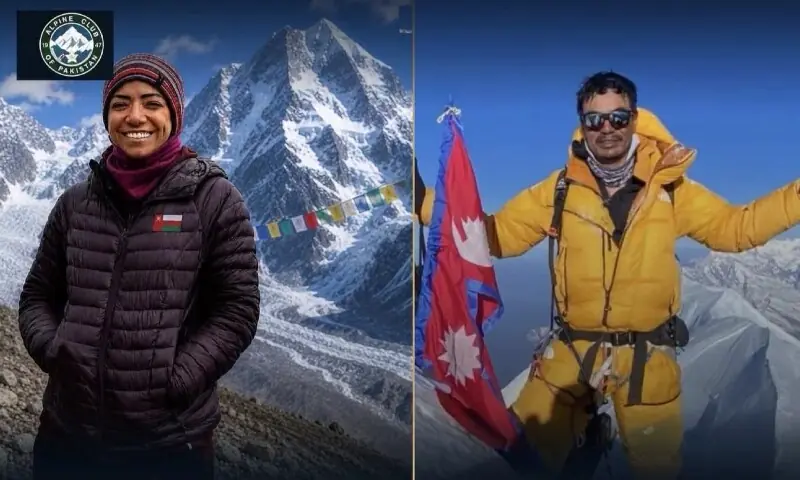
Ground teams recovered four bodies from the mountain on Friday, according to Irfan Arshad Khan, president of the Alpine Club of Pakistan, though only two have so far been identified with any certainty: Omani climber Nadhira Ahmed Abdullah Al Harthy and Nepali guide Pur Bahadur Gurung, known to colleagues as “Yukta”. Formal confirmation of the remaining bodies was still under way on Friday.
The avalanche struck shortly before midday on Thursday below Camp III, at an altitude of roughly 6,600 metres, sweeping a 10-strong international team hundreds of metres down the mountain. Those unaccounted for by Friday afternoon included Purja himself, along with Pakistani mountaineer Sohail Sakhi, American climber Mallory Geis, Chinese climber Wang Zhong, and Nepali guides Kili Pemba Sherpa, Nima Sherpa, Nawang Thindu Sherpa and Gyalu Sherpa.
The 8,047-metre Broad Peak, the world’s 12th-highest mountain, sits in the Karakoram range in Gilgit-Baltistan, on Pakistan’s northern border with China. It draws climbers from across the globe each summer, and is generally regarded as less technically demanding than its notorious neighbour K2 — though it remains highly exposed to sudden, severe weather.
The Alpine Club of Pakistan said it had received “deeply concerning reports” of the avalanche on Thursday, adding that the team had been out of contact ever since. Two Pakistan Army Aviation helicopters, carrying rescue personnel and specialised equipment, were dispatched to support the operation, while the club’s senior leadership, including Major General Khan, remained in constant contact with government authorities to expedite the response.
“Every possible effort is being made to ensure that helicopter support and all available rescue resources are mobilised at the earliest opportunity, subject to weather and operational conditions,” the club said in a statement, adding that it stood in solidarity with the climbers’ families and the wider mountaineering community.
Ayaz Ahmed Shigri, the club’s general secretary, said GPS data recovered from some of the missing climbers indicated the avalanche had carried the group roughly 1,000 metres down the mountainside, leaving them trapped. He said there were also concerns that local high-altitude porters working alongside the expedition may have been caught in the slide.
Tracking data reviewed by rescuers on Friday showed Purja’s satellite tracker had recorded his position at about 6,659 metres shortly before 9.40am on Thursday, before registering a rapid descent of some 800 metres to around 5,891 metres within 40 minutes. No further signal had been received from his device since. However, Mingma Gyabu Sherpa, Purja’s business partner at the expedition company Elite Exped, said on Friday that the tracker had shown renewed movement after the point at which the signal initially appeared to stop — a development he described as offering some hope. Separately, the operator Karakoram Expedition, which had two members of staff on the mountain, said a satellite tracker belonging to one of its climbers had also registered a faint movement signal since the avalanche.
Thaneshwar Guragain, general manager of Seven Summit Treks, one of three operators whose clients and guides were caught up in the disaster, struck a more sober note, telling reporters in Kathmandu that the chances of finding further survivors were slim. “The space for hope has become very narrow,” he said.
Rescuers, including Pakistan’s leading high-altitude climbers Sirbaz Khan and Sherzad Karim, were flown to the area on Friday with supplemental oxygen and specialist equipment to mount an aerial search, while ground teams continued working the debris field below the mountain. Rescuers said the scale of the avalanche, combined with unstable snow and punishing terrain above 6,000 metres, had made the search exceptionally difficult.
Nepal’s ambassador to Pakistan, Rita Dhital, said helicopters, drones and ground personnel had all been deployed from the town of Skardu to assist the operation. “Helicopters are being used for search operations, while drones are also monitoring the incident site,” she said.
Amjad Hussain Advocate, chief minister of Gilgit-Baltistan, the region in which Broad Peak lies, ordered all relevant departments onto high alert and directed authorities to draw on every available resource to protect the climbers, according to an official statement. He instructed that aerial and ground rescue teams remain on standby throughout, “despite adverse weather conditions”, so that assistance could reach the site the moment conditions allowed, and asked to be kept updated on the operation’s progress “moment by moment”.
The disaster ranks among the deadliest to strike the Karakoram in recent years. Broad Peak has claimed lives before: three Iranian climbers died descending the mountain in 2013, while a winter ascent bid in January 2021 ended in the death of Russian-American climber Alex Goldfarb. Pakistan’s worst modern mountaineering tragedy remains the 2008 disaster on K2, in which 11 climbers lost their lives following a separate avalanche.
Purja, 43, is one of the best-known figures in contemporary mountaineering. Born in Nepal, he served with Britain’s Brigade of Gurkhas before joining the Royal Marines’ Special Boat Service, going on to complete 16 years in the British armed forces. He turned to full-time climbing after a 2012 trek to Everest Base Camp, and in 2019 broke the record for climbing all 14 of the world’s peaks above 8,000 metres, completing the feat in just over six months — a challenge chronicled in the Netflix documentary 14 Peaks: Nothing Is Impossible. He later became the fastest person to climb all 14 without supplemental oxygen, and in 2021 took part in the first winter ascent of K2. He was appointed a Member of the Order of the British Empire in 2018 and founded the Nimsdai Foundation, which supports mountain communities in Nepal.
Sakhi, from Hunza in northern Pakistan, is regarded as one of the country’s foremost high-altitude climbers and a prominent advocate of oxygen-free ascents. He had summited Kanchenjunga, the world’s third-highest mountain, earlier this year, and had previously climbed K2, Nanga Parbat, Gasherbrum I and Gasherbrum II without supplemental oxygen. On this expedition he was said to be using bottled oxygen while guiding Geis, who was attempting her first peak above 8,000 metres after earlier climbs on Lobuche East and Mera Peak in Nepal.
Al Harthy, who became the first Omani woman to summit Everest in 2019, had been working towards climbing all 14 of the world’s 8,000-metre peaks and had also summited K2 and Manaslu. Wang, meanwhile, had reached his eleventh 8,000-metre peak earlier this month with an ascent of Gasherbrum II alongside Purja; Broad Peak would have been his thirteenth.
The search operation was continuing on Friday afternoon, with officials saying it remained subject to weather conditions at altitude.
Copyright © 2021 Independent Pakistan | All rights reserved