By Staff Reporter
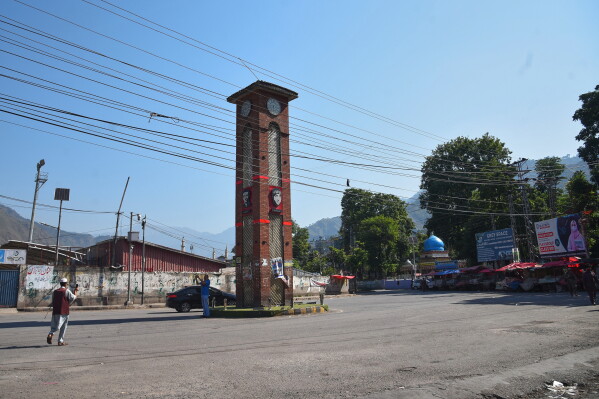
MUZAFFARABAD: Streets fell quiet and markets shuttered across Azad Kashmir on Tuesday as a recently banned civil rights alliance pressed ahead with a strike, while the regional government ordered sedition proceedings against two of its leaders and the prime minister appealed for a return to negotiations.
The Joint Awami Action Committee (JAAC), proscribed under anti-terrorism legislation last week, had called the work stoppage alongside a planned long march converging on the regional capital, Muzaffarabad. Riot police and paramilitary forces patrolled near-deserted streets there, though no demonstrations were reported in the city itself.
In Mirpur, hundreds gathered at the Quaid-i-Azam stadium as shops stayed closed and public transport remained off the roads. In the town of Kotli, witnesses said columns of marchers — hundreds strong — set out led by JAAC core member Imtiaz Aslam toward Poonch district via Tatta Pani, while a second contingent led by core member Khawaja Mehran arrived from Dadyal to join the onward march.
The territory’s legal community added its weight to the protest, with lawyers boycotting court proceedings on a call from the AJK Bar Council in response to the reported arrest of senior advocate and JAAC core member Amjad Ali Khan.
Sedition orders
The regional Home Department issued orders on Tuesday to initiate sedition proceedings against JAAC leaders Shaukat Nawaz Mir of Muzaffarabad and Mehran Arshad Khawaja of Mirpur, accusing both men of committing “sedition through their speeches, written material, videos and audios.” The department instructed senior superintendents of police in both cities to review available evidence under Section 196 of the Code of Criminal Procedure and register cases before submitting charge-sheets to court.
The moves deepened what has become one of the most serious bouts of unrest to grip the Pakistani part of Himalayan territory in years. At least 11 people were killed — seven civilians and four law enforcement personnel — and more than 70 injured in clashes in Rawalakot over the weekend, according to officials and media reports. The violence prompted Islamabad to dispatch federal paramilitary reinforcements, and authorities have advised intending visitors to postpone travel to the region until at least June 20. Internet services have been suspended in major cities.
Talks, not agitation
Regional Prime Minister Faisal Mumtaz Rathore, in posts on social media platform X, renewed his call for dialogue. “Please come back to the negotiating table. I’m requesting everyone on a daily basis to resolve matters through discussions instead of fire and blood,” the Pakistan Peoples Party leader wrote. He cautioned that “abusive comments, constant threats and senseless agitation” served no one’s interests in AJK, adding: “A political activist without the ability to debate and negotiate is like a pilot without the ability to fly an airplane. They both end up causing hurt and damage to people behind them.”
Rathore acknowledged that the PPP, the Pakistan Muslim League-Nawaz and the JAAC each held distinct positions on the central dispute — the future of 12 seats in the AJK Legislative Assembly reserved for refugees from Indian-occupied Kashmir and their descendants living in mainland Pakistan — but said space remained for a negotiated path forward. He noted that any constitutional amendment abolishing those seats would require a two-thirds parliamentary majority, something street protests alone could not deliver.
The JAAC contends the reserved seats allow Pakistan’s mainstream parties to disproportionately influence the formation of governments in Muzaffarabad. The regional government has countered that the matter is constitutional in nature and cannot be resolved unilaterally.
The AJK Supreme Court dealt the group’s campaign a setback on Sunday, ruling that the seats enjoy constitutional protection and cannot be abolished through executive or administrative action.
Panic buying
Away from the political confrontation, residents across the territory rushed to stock up on essentials. Shopkeeper Muneeb Haider said customers were buying in double the usual quantities. “Those who would normally buy 10 kilograms of an item are now buying 20 kilograms as a precaution. Because of the uncertainty, many people are trying to stock up on essential goods,” he told AFP, adding that prices had so far held steady. Resident Usman Ahmad said his household was preparing for disruptions that could stretch for weeks. “There is no idea how long it will last — it could even take a month,” he said.
The Human Rights Commission of Pakistan said it was “deeply concerned by the escalating confrontation” and called for immediate de-escalation and an impartial inquiry into all deaths and injuries. “The state must remember that proscribing popular movements invariably risks narrowing democratic space,” the HRCP said, urging that demands for constitutional change be pursued through “peaceful, representative and democratic processes.”
July elections
The JAAC, formed in 2003, first gained broad public support through campaigns against rising electricity tariffs and flour prices, winning concessions from authorities after protests last year that also turned violent. The group’s focus has since shifted to the electoral dispute, which has sharpened as campaigning intensifies ahead of assembly elections scheduled for July 27 — a vote the current legislature, whose term has expired, will not contest.
Azad Jammu and Kashmir is part of the broader Kashmir region, claimed in its entirety by both India and Pakistan, which have fought two wars over the territory since independence from British rule in 1947. The region is administered in parts by each country, with the Line of Control dividing Pakistani- and Indian-held portions.
Copyright © 2021 Independent Pakistan | All rights reserved