By Staff Reporter
RAWALPINDI: The commander of Bahrain’s National Guard held separate meetings with all three of Pakistan’s service chiefs on Tuesday, as Islamabad positioned itself at the centre of a busy round of military diplomacy with the Middle East against the backdrop of a fragile ceasefire in the US-Iran conflict.
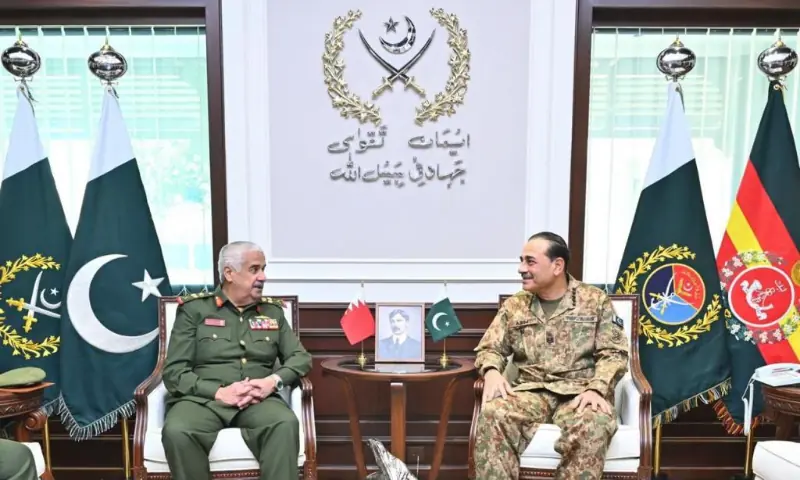
General Shaikh Mohammad bin Isa bin Salman Al Khalifa called on Field Marshal Syed Asim Munir, who holds the dual role of Chief of the Army Staff and Chief of Defence Forces, at General Headquarters in Rawalpindi, where the two discussed bilateral defence cooperation, the regional security environment and matters of mutual interest, the military’s media wing, Inter-Services Public Relations (ISPR), said in a statement.
“Both dignitaries expressed satisfaction over the longstanding brotherly relations between Pakistan and Bahrain and underscored the importance of further strengthening military-to-military collaboration,” the ISPR said.
Earlier in the day, General Shaikh Mohammad had separately called on Chief of the Naval Staff Admiral Naveed Ashraf and Chief of the Air Staff Air Chief Marshal Zaheer Ahmed Baber Sidhu — a sweep of all three service headquarters that underscored the breadth of defence engagement Manama is seeking with Islamabad.
At Naval Headquarters, discussions centred on bilateral defence collaboration and regional maritime security. The Bahraini commander praised the Pakistan Navy’s role as a “regional maritime security stabiliser,” commending its constructive engagement in cooperative security efforts across the region.
The meeting at Air Headquarters covered Pakistan Air Force modernisation, including capability enhancement, infrastructure development, indigenisation and advanced training. Talks also ranged across emerging technologies — drones, artificial intelligence, autonomous systems, advanced sensors and digital innovation — as well as evolving air defence challenges and integrated defence architectures, according to the statement.
Across all three meetings, the Bahraini commander lauded the professionalism, operational readiness and contributions of Pakistan’s armed forces to regional peace and stability, expressing interest in further cooperation in training, emerging technologies and capacity-building.
“The visit reflects the strong and enduring defence partnership between Pakistan and Bahrain and is expected to further advance bilateral military cooperation for the mutual benefit of both brotherly nations,” the ISPR said.
The Bahraini commander’s visit was one of two high-level military engagements hosted at GHQ on Tuesday. Field Marshal Munir also received Lebanese Armed Forces Commander-in-Chief General Rodolphe Haykal, where discussions focused on strengthening professional interactions, training cooperation and institutional linkages between the two countries’ armed forces.
Munir reaffirmed the importance Pakistan attaches to its longstanding ties with Lebanon and pledged to expand defence collaboration, the ISPR said. Haykal, in turn, acknowledged Pakistan’s contributions to regional peace and to United Nations peacekeeping efforts — an area of longstanding bilateral connection, given Pakistani troops have served in the UN Interim Force in Lebanon (UNIFIL) over many years.
Lebanon has remained at the centre of regional volatility linked to the broader Israel-Iran conflict, while Pakistani troops serving under UNIFIL have deepened Islamabad’s institutional familiarity with Lebanese security institutions.
Tuesday’s back-to-back engagements come as Pakistan has assumed an increasingly prominent role in Middle East diplomacy. A three-month conflict between the United States and Iran has been halted by a ceasefire widely described as fragile, and Pakistan has emerged as a sought-after interlocutor, having hosted a round of direct talks between the two sides in Islamabad in April. Those efforts have continued even after plans for a second round fell through.
The defence outreach builds on a broader diplomatic thread with Bahrain. President Asif Ali Zardari met King Hamad bin Isa Al Khalifa in Manama in January, reaffirming Pakistan’s commitment to expanding bilateral cooperation across political, economic, defence and cultural fields. Before that, Prime Minister Shehbaz Sharif had travelled to Bahrain in November on a two-day visit in which he similarly pledged to deepen ties with the kingdom.
Copyright © 2021 Independent Pakistan | All rights reserved