By Staff Reporter
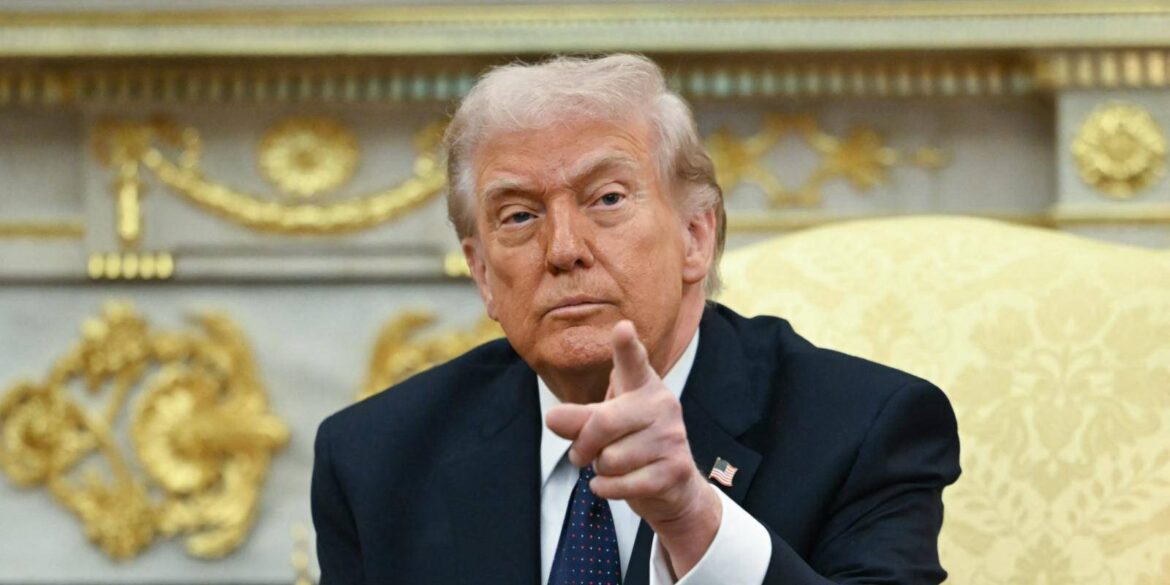
ISLAMABAD: President Donald Trump said on Sunday that senior US officials will arrive in Pakistan’s capital on Monday evening for a new round of negotiations with Iran, an 11th-hour effort to salvage a fragile two-week ceasefire that Tehran has accused Washington of violating and that appeared near collapse after Iranian forces fired on commercial vessels in the Strait of Hormuz.
The announcement came hours after Iran reversed an earlier pledge to reopen the narrow waterway — through which roughly one-fifth of the world’s seaborne oil passes in normal times — and after shipping data showed the strategic chokepoint had gone silent early Sunday following Saturday’s attacks on at least two vessels. Trump, in a series of posts on Truth Social, denounced the Iranian actions as “a total violation” of the ceasefire brokered on April 8 and renewed blunt threats to strike Iranian power plants and bridges if Tehran does not accept what he called “a very fair and reasonable DEAL.”
“We’re offering a very fair and reasonable DEAL, and I hope they take it because, if they don’t, the United States is going to knock out every single Power Plant, and every single Bridge, in Iran,” Trump wrote. “NO MORE MR. NICE GUY!”
The US president added in the same post: “Iran decided to fire bullets yesterday in the Strait of Hormuz — A Total Violation of our Ceasefire Agreement! … That wasn’t nice, was it?” He went on to say that Iran was “helping us without knowing” by closing the passage, costing itself $500 million a day while the United States “loses nothing.”
The developments mark the latest escalation in a conflict that began Feb. 28 with US-Israeli strikes on Iran and has now entered its eighth week. The ceasefire, which halted direct hostilities, is scheduled to expire early Wednesday unless extended. Only one round of face-to-face negotiations has occurred so far — a 21-hour session in Islamabad on April 11 that ended without agreement. The new talks represent what US officials described as an 11th-hour effort to salvage at least an extension of the truce, if not a broader peace accord.
The composition of the US delegation has been the subject of public confusion. Trump had initially indicated that his special Middle East envoy Steve Witkoff and his son-in-law Jared Kushner, who played a central role in past Middle East diplomacy during Trump’s first term, would travel to Islamabad. White House officials later told CNN and Axios that Vice President JD Vance would lead the next round, joining Witkoff and Kushner. The vice president had already participated in the first session of direct talks here on April 11, which ended without agreement.
A senior administration official, speaking on the condition of anonymity to describe internal deliberations, said only that “things changed” after Iran’s actions in the strait. Sources familiar with Secret Service policy noted that the agency routinely avoids placing the president and vice president in the same overseas venue amid elevated threats, and that any potential Trump trip to Pakistan would require Vance to return stateside first.
In a telephone interview on Sunday with The Washington Post, Trump left open the possibility of his own eventual travel to Pakistan but said he was “not getting ahead of the process” and would “probably come at a later date.” He ended the conversation abruptly, noting that military officials were waiting outside the White House.
The renewed crisis unfolded against the backdrop of a war that began Feb. 28 with U.S.-Israeli strikes on Iran and has now entered its eighth week. The ceasefire, reached after intensive shuttle diplomacy involving Pakistani, Turkey and Egyptian intermediaries, was always understood to be temporary.
At the heart of the negotiations remains Iran’s nuclear program. Trump has demanded the surrender of Iran’s remaining stockpile of near-weapons-grade enriched uranium — roughly 440 kilograms, according to his Friday remarks — and a long-term suspension of all nuclear activity. He has spoken of using “lots of excavators” to remove the material and has said the United States is monitoring Iranian nuclear sites via satellite, warning that Washington possesses “even better firepower” than what was used in the opening days of what he has called Operation Epic Fury.
Iranian officials have rejected any transfer of the stockpile, insisting it has never been on the negotiating table and that Tehran will not surrender its “legal right” to a nuclear program, as President Masoud Pezeshkian put it on Sunday. Iran’s Parliament Speaker and senior negotiator, Mohammad Bagher Ghalibaf, told state media Saturday night that the two sides were “still far from the final discussion.” Foreign Ministry spokesman Esmaeil Baqaei called the US blockade a ceasefire violation. A statement from Supreme Leader Ayatollah Mojtaba Khamenei said Iran’s navy stood ready to inflict “new bitter defeats” on its enemies.
The broader war has exacted a heavy human toll. Thousands have been killed in US-Israeli strikes on Iran and in Israel’s parallel invasion of Lebanon, which displaced more than a million Lebanese. Iran responded with missile and drone attacks on Arab states hosting US bases. Trump has framed the conflict as a necessary effort to prevent Iran from acquiring nuclear weapons — an ambition Tehran has always denied. In public statements Friday, he expressed confidence that a breakthrough was near, declaring the strait “COMPLETELY OPEN AND READY FOR BUSINESS AND FULL PASSAGE” and claiming the United States would obtain all the “nuclear dust” in Iran. Yet he simultaneously maintained the blockade on Iranian ports while final terms were negotiated.
Iran’s Foreign Ministry spokesman, Esmaeil Baqaei, responded swiftly to Trump’s Truth Social posts, describing the US naval blockade of Iranian ports as both a violation of the ceasefire and “unlawful and criminal.” In a post on X, Baqaei wrote that the blockade amounted to “collective punishment on the Iranian population” and constituted “war crime and crime against humanity.”
The sequence of events on Saturday and Sunday underscored the volatility. Iran had announced Friday that it would reopen the strait following a separate Israel-Hezbollah ceasefire in Lebanon, and a handful of tankers briefly transited the waterway. But after Trump refused to lift the U.S. blockade on Iranian ports — imposed after the inconclusive April 11 talks — Tehran reversed course.
Iranian forces fired on at least two vessels attempting passage, including an Indian-registered ship and others flagged to the United Kingdom and France, according to maritime security reports and Trump’s own account. By early Sunday, commercial tracking data showed no traffic moving through the strait. Two liquefied petroleum gas tankers that had been heading eastbound were reportedly turned back by Iranian armed forces, according to the semi-official Tasnim news agency.
Trump, in a follow-up Truth Social post, wrote: “Iran decided to fire bullets yesterday in the Strait of Hormuz — A Total Violation of our Ceasefire Agreement! Many of them were aimed at a French Ship, and a Freighter from the United Kingdom. That wasn’t nice, was it?” He added that Iran was harming itself economically, losing “$500 Million Dollars a day,” while the United States faced no immediate loss because American energy exports were rerouted elsewhere. The closure has already sent ripples through global energy markets. Oil prices surged in recent weeks on fears of prolonged disruption; Friday’s brief announcement of reopening triggered one of the sharpest single-day drops in history. Renewed uncertainty could bring fresh volatility when markets open Monday.
Iran has not yet confirmed its participation in the new talks. Its chief negotiator, Parliament Speaker Mohammad Bagher Ghalibaf, said Saturday night that the two sides remained “still far from the final discussion.” Iranian officials have repeatedly described the US naval blockade of Iranian ports — imposed after the April 11 talks collapsed — as an illegal violation of the ceasefire and a form of collective punishment.
In Islamabad, authorities moved Sunday to prepare for the expected arrival of the US delegation. Rolls of barbed wire appeared near the Serena Hotel, site of the first round of talks last week. Hotel management informed guests they would need to vacate the premises because of an unspecified “government event,” and no new reservations were being accepted. Road closures and traffic restrictions were announced across the capital and neighboring Rawalpindi. AFP journalists observed armed checkpoints near major hotels, though the visible security presence appeared somewhat lighter than during Vance’s previous visit.
The pressure on both sides is considerable. For Trump, the conflict has coincided with rising US gasoline prices and inflation, even as his administration prepares for midterm elections in November. Iranian officials, for their part, have insisted that any framework for further talks must address what they call Washington’s illegal actions in the strait. For now, the immediate focus shifts to Monday evening’s arrival of the U.S. team and whether Iranian representatives will be present. Pakistani officials have not publicly confirmed the schedule, but the visible security preparations and the hotel lockdown suggest Islamabad is bracing for another high-stakes round of shuttle diplomacy in one of the world’s most volatile diplomatic theaters.
Copyright © 2021 Independent Pakistan | All rights reserved