By Staff Reporter
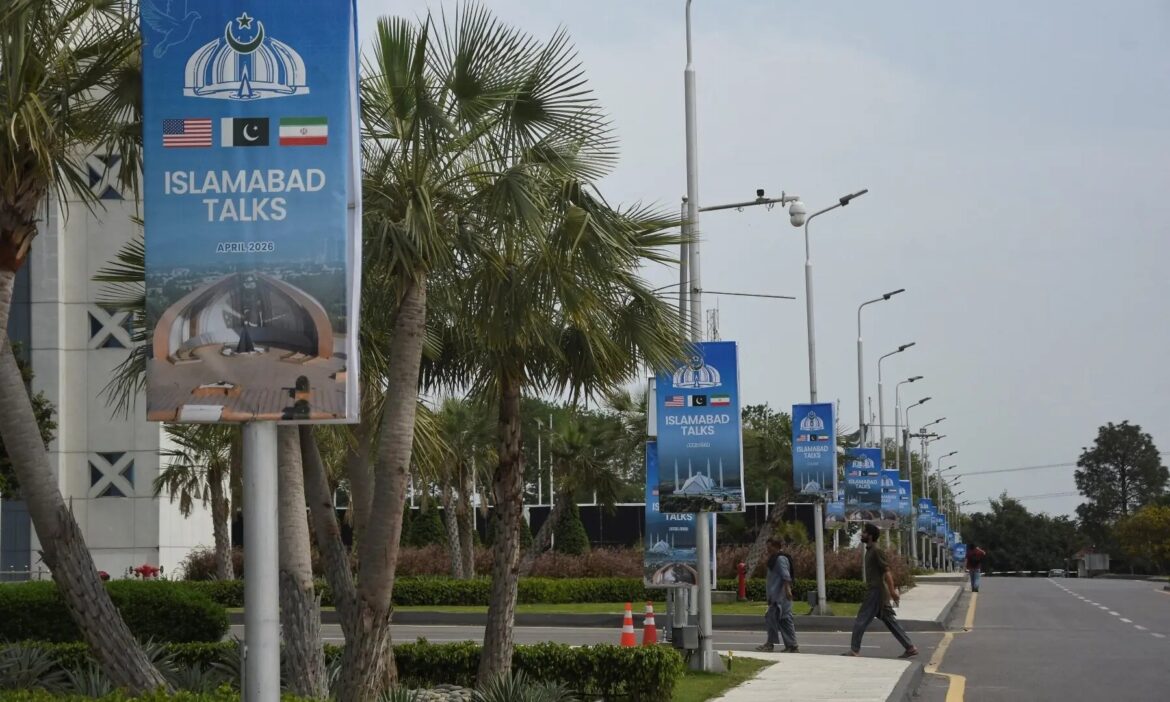
ISLAMABAD: Pakistan’s capital sealed its most sensitive districts and suspended public transportation across the twin cities of Islamabad and Rawalpindi on Sunday as authorities braced for the possible arrival of senior American and Iranian delegations for a second round of direct peace negotiations aimed at ending a seven-week Middle East conflict.
The Red Zone — the heavily guarded enclave that houses Parliament, the Supreme Court, the prime minister’s office and most foreign embassies — and its extended perimeter were closed to all traffic, Islamabad police said in a statement posted on X. Alternate routes were designated for residents, and the restrictions were expected to remain in place “until further directives.”
At the same time, Islamabad’s deputy commissioner, Irfan Nawaz Memon, ordered an immediate suspension of all public and heavy transport services. Rawalpindi’s district administration issued a parallel order, halting private, public and goods vehicles from noon Sunday until further notice. The Faizabad long-distance bus terminal, a major hub linking the two cities, was shuttered at 11 pm Saturday and is expected to stay closed at least until April 26.
Neither Washington nor Tehran has publicly confirmed that a second round of talks will take place in Islamabad. Yet the physical signs of preparation were unmistakable. Advance security teams from both countries were reported to be arriving as early as Sunday to coordinate arrangements with Pakistani authorities, according to officials familiar with the planning who spoke on the condition of anonymity because they were not authorized to discuss the matter.
The Serena Hotel, which hosted the first round of face-to-face US-Iranian negotiations on April 11 and 12, informed guests that it had been requisitioned by the government. Reservations from April 19 through April 23 were canceled, and current guests were told to vacate by Sunday night. Basement and surface parking were also closed “till Thursday” because of the “mega event,” a hotel notice said. The nearby Marriott, which faces Parliament and the Supreme Court, issued a similar order: guests were asked to check out by 3 pm Sunday so the property could be turned over for “an important event.” The luxury Mövenpick, which accommodated hundreds of journalists during the first round, reported no rooms available for the coming days.
The security posture was equally visible. More than 10,000 police officers were deployed in Rawalpindi on Saturday, with 600 special pickets established at entry and exit points. Islamabad authorities said they could draw on roughly 7,000 of their own officers, 4,000 from Punjab province and 900 from the Federal Constabulary. Four hundred elite commandos, including 100 snipers, were assigned to the multi-layered protection plan for arriving and departing delegations. Search-and-sweep operations, intelligence-based raids and round-the-clock CCTV monitoring were intensified.
The first round of talks, held three days after a Pakistan-brokered cease-fire took effect on April 8, marked the highest-level direct contact between the United States and Iran since the 1979 Islamic Revolution. US Vice President JD Vance led the American side; Iranian Parliamentary Speaker Mohammad Bagher Ghalibaf headed the Iranian delegation. The two sides spent more than 20 hours in negotiations but left without an agreement — and without a breakdown.
In a televised address on Sunday, Ghalibaf said there had been “progress” with Washington but signaled that a final peace deal remained “far.” He noted that direct talks had produced clearer mutual understanding than earlier mediated exchanges, citing past misunderstandings over asset releases. The underlying conflict began Feb. 28 when the United States and Israel launched a large-scale surprise attack on Iran even as negotiations between Washington and Tehran were underway. A fragile cease-fire has held since April 8, but it is due to expire soon.
Tensions remain acute over the Strait of Hormuz, the narrow waterway through which roughly one-fifth of global oil trade passes. Iran closed the strait again on Saturday, declaring it would not reopen until the United States lifted its blockade of Iranian ports. President Donald Trump has expressed optimism about the talks and said last week he “might” travel to Islamabad if a deal were ready to sign. He also suggested, in comments to a Washington Post reporter, that developments could be imminent.
Pakistani officials have said they continue to facilitate communication between the two sides but have not announced a date for the next round. Media reports here have pointed to a possible resumption as soon as Tuesday. Pakistan has cast itself as a neutral broker in the crisis, maintaining back-channel contacts even when direct US-Iranian communication broke down. Foreign Ministry spokesmen have repeatedly emphasised that no dates have been finalised and that consultations are continuing for a mutually acceptable schedule. As of Sunday evening, the precise composition of any returning delegations remained unclear. US officials have not said whether Vance would return or whether Trump himself might appear if a deal appeared imminent. Iranian officials have likewise kept their plans private.
Copyright © 2021 Independent Pakistan | All rights reserved