By Staff Reporter
ISLAMABAD: The ruling Pakistan Muslim League-Nawaz swept the by-elections held on Nov. 23, capturing all six vacant seats in the National Assembly and six of seven in the Punjab Assembly, amid what an independent election monitor described as “recurring violations” of campaigning rules and “gaps” in the transparency of results.
The victories consolidated the party’s dominance in Punjab, its traditional stronghold, where five of the National Assembly constituencies were located, with the sixth in Khyber Pakhtunkhwa. The seats, except for one, had been vacated following the disqualification of lawmakers from the opposition Pakistan Tehreek-e-Insaf party. In the National Assembly races, the PML-N secured close to 64 percent of the total votes polled, according to official results. In the Punjab Assembly contests, it claimed 82.41 percent of the votes in the six seats it contested, while opting not to field a candidate in the seventh, PP-269 in Muzaffargarh, against a nominee from the Pakistan Peoples Party.
But the process was far from flawless, according to a detailed observation report released by the Free and Fair Election Network, or Fafen, a nongovernmental organisation that monitors polls in Pakistan. “The November 23rd by-elections for 13 National and Punjab Assemblies constituencies, though largely well-managed, were marked by recurring violations of campaigning restrictions, gaps in results transparency and a worryingly low voter turnout,” Fafen said in a press release accompanying the report.
The monitor highlighted “weak enforcement of campaigning restrictions” as one of the persistent issues across recent elections. At 238 polling stations—representing 64 percent of those observed—at least 465 party camps were spotted in close proximity, potentially influencing voters. Transportation facilitation for voters was noted at 184 stations, or 49 percent. “Party camps were seen issuing voter slips at 216 (91pc) polling stations, and campaign material was found inside 16 (4pc) polling stations,” the report stated.
Accessibility for marginalized groups also varied widely. “While most polling stations had basic accessibility infrastructure, arrangements for women, the elderly, persons with disabilities, and transgender voters were inconsistent,” Fafen noted.
Voter participation plummeted, with overall turnout dropping by 23 percent for both men and women compared to previous elections in these areas. Only one constituency recorded a turnout above 50 percent, underscoring a broader disengagement that has troubled observers in recent Pakistani polls.
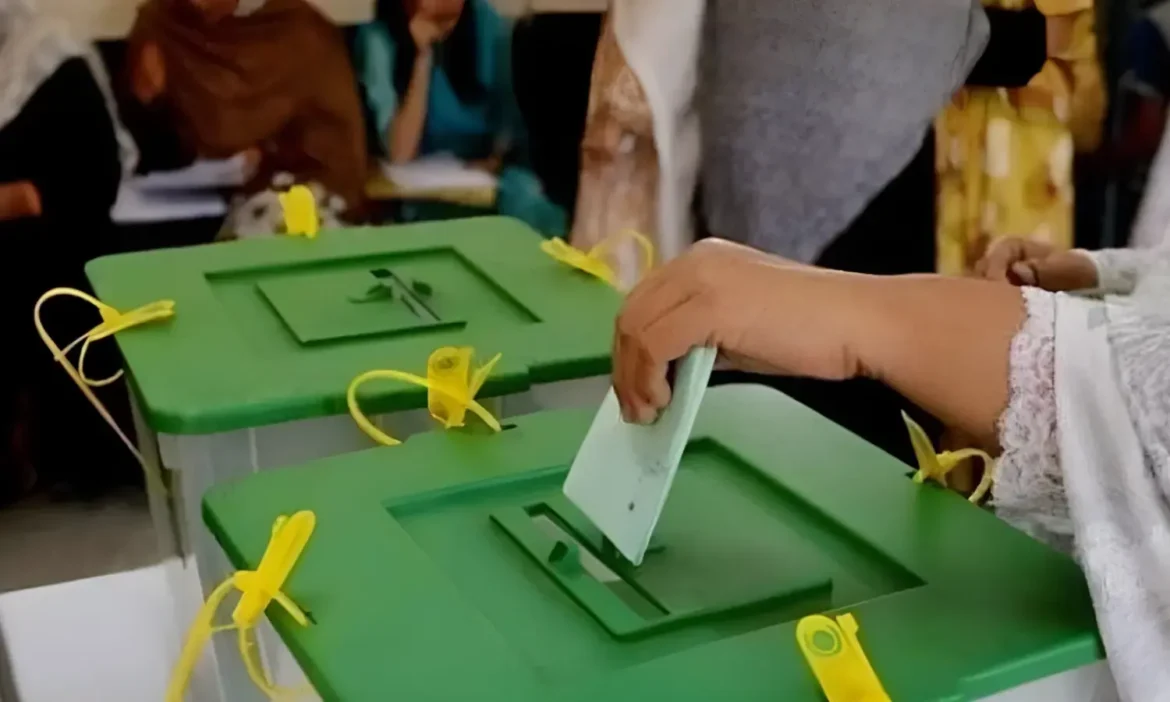
Fafen deployed 122 trained and accredited observers who monitored the opening, voting and counting processes at 373 polling stations and their 1,088 polling booths, including 626 for men and 462 for women. The observers also interviewed polling staff, security personnel and 833 polling agents to compile their findings. On the organisational front, the Election Commission of Pakistan appeared to have prepared staff adequately in many cases. Around 89 percent of presiding officers, 79 percent of assistant presiding officers and 77 percent of polling officers reported receiving training from the commission. “Ballot security and secrecy were generally upheld,” the report said, with all four required seals intact on ballot boxes at 1,072 booths, or 98 percent, and secrecy screens properly placed at 1,044 booths, or 96 percent.
The voting itself proceeded smoothly in most instances. Of the 366 polling booths closely monitored, 340—or 93 percent—were described as organised and peaceful, while only four, or 1 percent, were deemed disorganised or poorly managed. Polling officers generally verified National Identity Cards, applied thumb marks, recorded voter details and updated electoral rolls. However, at 92 booths, or 25 percent, they failed to announce voters’ names and serial numbers as mandated by law. “At 10 (3pc) booths, at least one eligible voter was turned away due to an expired NIC,” the report added.
Assistant presiding officers mostly adhered to ballot issuance procedures, but lapses raised concerns about potential vulnerabilities. At 107 booths, or 29 percent, ballots were pre-signed, and at 102 booths, or 28 percent, they were pre-stamped. “Although not illegal, these practices may increase the risk of ballot misuse,” Fafen pointed out.
The counting phase revealed more significant shortcomings in transparency. Of 79 polling stations selected for observation during counting, access was denied to Fafen observers at two. Presiding officers failed to provide the Result of the Count, known as Form 45, to polling agents at six stations, or 8 percent, and to observers at 13 stations, or 17 percent. The form was not displayed outside 15 stations, or 19 percent. Similarly, the Ballot Paper Account, or Form 46, was not given to polling agents at 15 stations, or 19 percent, nor to observers at 17 stations, or 22 percent, and it was not posted outside 16 stations, or 21 percent. “At 33 (43pc) polling stations, presiding officers did not ask polling agents to sign the result forms,” the report stated.
Despite these issues, satisfaction among participants remained high. Around 97 percent of polling agents interviewed during the voting process expressed approval of the proceedings, with only two voicing concerns. All 137 agents interviewed after counting reported satisfaction with that phase.
Copyright © 2021 Independent Pakistan | All rights reserved